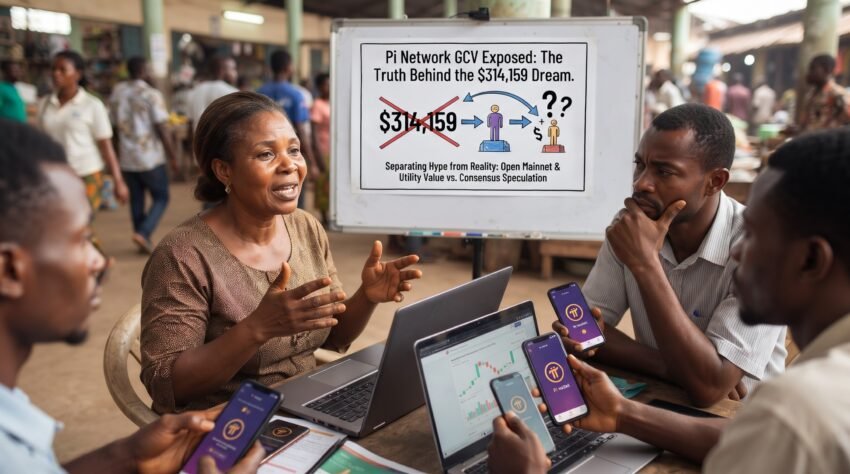
For years, many Pi Network Pioneers have hoped that the cryptocurrency they accumulated through mobile mining could one day make them wealthy. Among the most controversial ideas circulating in the community is Global Consensus Value, commonly known as GCV.
Supporters of GCV promote the idea that one Pi coin should be worth $314,159. They argue that a collective agreement among Pioneers, combined with real-world transactions and ecosystem development, could establish this extraordinary valuation.
But there is one critical question every Pi holder must ask: Who will actually pay $314,159 for one PI, and where is the verifiable mechanism that guarantees such a price?
This is not an attack on Pi Network. It is a challenge to an unsupported valuation claim that deserves serious scrutiny. Believing in a cryptocurrency’s future is not the same as believing every price prediction associated with it.
1. GCV Is Not an Official Pi Network Price
GCV, or Global Consensus Value, is a community-driven concept. It is not an officially established price for PI, and the Pi Core Team has not announced $314,159 as a guaranteed valuation for the cryptocurrency.
A community can propose a valuation, organize discussions, and encourage members to use PI in transactions. However, these activities do not automatically create an enforceable price for the entire cryptocurrency market.
Pi Network’s official documentation focuses on blockchain development, token distribution, and ecosystem growth. The official whitepaper does not establish $314,159 as the required exchange value of one PI.
You can review the official Pi Network Whitepaper to understand the project’s documented goals and tokenomics.
A price promoted by a community is not the same as a price guaranteed by the network.
Until a verifiable official mechanism establishes otherwise, claims that GCV is an officially guaranteed price should be treated with skepticism.
2. Consensus Cannot Magically Create Economic Value
One of the central arguments behind GCV is that if enough Pioneers agree on a particular value, that value can become real.
Markets do depend partly on collective beliefs, confidence, and expectations. However, agreeing on a price is different from sustaining that price through actual economic activity.
Imagine a community agreeing that a digital token is worth $100,000. Does that agreement automatically mean an external buyer will pay $100,000 for each token?
No. For a market price to be economically meaningful, there must be actual buyers, willing sellers, sufficient liquidity, and transactions that can be completed at the stated price.
If a merchant accepts one PI for a product using $314,159 as a reference valuation, that transaction does not prove that every PI holder can sell one coin for $314,159 on an open market.
Consensus can influence market behavior, but consensus alone cannot guarantee unlimited purchasing power.
3. The $314,159 Valuation Creates an Extraordinary Economic Challenge
Pi Network’s tokenomics specify a maximum supply of 100 billion PI. If every coin in that maximum supply were valued at $314,159, the implied fully diluted valuation would be:
100,000,000,000 PI × $314,159 = $31,415,900,000,000,000
That is approximately $31.4 quadrillion.
This is a theoretical fully diluted valuation based on the maximum token supply, not a statement of Pi Network’s actual market capitalization. Actual market capitalization depends on circulating supply and the relevant market price.
Nevertheless, the calculation illustrates the extraordinary economic scale implied by the GCV proposal.
It raises several important questions:
- Who would provide the purchasing power to support the proposed valuation?
- How much PI could actually be sold at that price?
- Would businesses accept PI at a price that is economically sustainable?
- Could buyers purchase meaningful quantities without exhausting available demand?
- Would the valuation remain credible when holders tried to exchange PI for other currencies or goods?
A theoretical valuation is easy to calculate. Demonstrating that the market can sustain it is an entirely different challenge.
4. Transaction Value Is Not the Same as Market Price
GCV discussions often become confusing because different types of value are treated as if they were identical. They are not.
Scenario A: A Community Transaction
A seller agrees to exchange a product for one PI using $314,159 as a reference valuation. This demonstrates that the two parties agreed to a particular exchange under specific conditions.
It does not prove that the same PI can be sold on a cryptocurrency exchange for $314,159.
Scenario B: An Advertised GCV Price
A website or social media account announces that PI has reached a GCV valuation of $314,159.
Unless that announcement is supported by verifiable transactions and a reliable pricing mechanism, it remains a claim. An advertised price is not proof that buyers are available at that price.
Scenario C: An Executable Market Price
A buyer places an order to purchase PI, a seller accepts the order, and the transaction is completed through a functioning market.
This provides evidence of an actual exchange price for the quantity traded. Even then, one transaction does not guarantee that every holder can sell an unlimited quantity at the same price.
A product transaction, a community valuation, and an executable cryptocurrency market price are three different things.
5. How GCV Expectations Can Become a Tool for Scammers
One of the most concerning issues is the possibility that unrealistic price expectations can be exploited by dishonest individuals.
When people believe a cryptocurrency could eventually be worth hundreds of thousands of dollars per coin, they may become more willing to take risks to protect or unlock their expected wealth.
Fraudsters may use claims about GCV, future exchange listings, special migration programs, or exclusive access to extraordinary valuations to convince holders to surrender money or sensitive account information.
A. Activation Fees to Unlock GCV
Someone claims that your PI balance has qualified for GCV but requires an activation fee, verification payment, tax deposit, or administrative charge before the funds can be released.
Treat this as a serious warning sign. Verify any supposed program independently through official Pi Network channels before sending money.
B. Private Buyers Offering the GCV Price
A person claims to have access to a private buyer, international institution, or exclusive trading network that will purchase PI at $314,159 per coin, then requests an upfront payment or an initial transfer of PI.
Without independently verifiable evidence of the buyer, transaction terms, and payment mechanism, this arrangement is highly risky.
Never assume that a buyer is legitimate simply because they show screenshots, testimonials, or documents bearing official-looking logos.
C. Requests for a Wallet Passphrase
Someone claims that your wallet must be registered, synchronized, or connected to a GCV system and asks for your wallet passphrase.
Never disclose your Pi Wallet passphrase to anyone. The passphrase controls access to the wallet, and a compromised wallet can result in irreversible losses.
Read the Pi Network Safety Center for security guidance.
D. Unverified Partnerships and Official Announcements
A social media account claims that the Pi Core Team has approved GCV, that banks are preparing to use the valuation, or that a global financial institution has agreed to purchase PI at the proposed price.
Such claims require evidence. Look for announcements on official channels and do not treat unverified posts as established facts.
Pi Network has also published a warning about unaffiliated and unauthorized activities.
Not everyone who believes in GCV is a scammer, and discussing GCV does not automatically constitute fraud. The danger arises when unsupported claims are used to deceive people, solicit payments, obtain wallet credentials, or induce risky transfers.
6. Why Ordinary Pi Holders Can Be Vulnerable
Many Pioneers have spent years participating in Pi Network, checking in daily, building referral teams, completing verification procedures, and waiting for the ecosystem to develop.
For some holders, PI represents more than a cryptocurrency. It represents time, effort, and the hope of improving their financial circumstances.
This emotional investment can make it difficult to evaluate extraordinary price claims objectively. After spending years accumulating a token, a holder may become reluctant to question a narrative that promises an extraordinary reward.
This can create a dangerous cycle:
- A holder hears a promise of extraordinary future wealth.
- Community discussions reinforce the promise.
- Unverified claims are interpreted as confirmation.
- The holder becomes increasingly confident in the expected valuation.
- A dishonest individual exploits that confidence to request money, PI, or confidential wallet information.
Not every GCV supporter follows this pattern. However, it illustrates how unrealistic expectations can create opportunities for financial exploitation.
The solution is not to ridicule people who believe in a project’s potential. The solution is to encourage them to demand evidence, examine incentives, and protect the assets they already possess.
7. The Real Value of PI Depends on More Than a Number
Rejecting an unsupported GCV price does not mean declaring that Pi Network has no future. These are two separate questions.
Pi Network may continue developing its technology, attracting developers, supporting applications, and expanding real-world use cases. If its ecosystem becomes more useful and demand for PI grows, those developments could influence its market value.
However, the outcome depends on factors such as adoption, token supply, demand, liquidity, competition, and practical usefulness.
A credible assessment of PI should examine measurable developments rather than rely exclusively on a predetermined price target.
- Are independent developers building useful applications?
- Are businesses accepting PI for genuine commercial transactions?
- Is there sustained demand beyond speculative expectations?
- Is there sufficient liquidity for holders to trade meaningful quantities?
- Are ecosystem developments producing measurable economic activity?
- Can the project demonstrate progress through verifiable announcements and data?
The important question is not whether a community can imagine an extraordinary price. It is whether real economic activity can support the value people expect.
8. Stop Confusing Hope With Financial Evidence
Hope is not inherently wrong. People can believe in a project, support its development, and hold a cryptocurrency because they expect its long-term prospects to improve.
The problem begins when hope is presented as certainty.
There is a difference between saying, “I believe PI could become more valuable in the future,” and saying, “PI is guaranteed to reach $314,159 because the community has agreed on GCV.”
The first is an opinion about a possible future outcome. The second makes a much stronger claim that requires substantial evidence.
Without an enforceable pricing mechanism, sufficient purchasing demand, and verifiable liquidity, a community valuation cannot guarantee that holders will be able to realize the proposed price.
Do not borrow money because someone promises that PI will soon make you wealthy. Do not pay an unknown person to unlock a supposed GCV allocation. Do not surrender your wallet passphrase because someone claims to represent an international buyer.
Always ask for independently verifiable proof.
9. What Pi Holders Should Do Instead
Rather than relying on extraordinary price promises, Pi holders can take several practical steps to protect themselves.
- Verify official announcements. Use the official Pi Network website, application, and verified communication channels.
- Protect your wallet. Never share your wallet passphrase, private credentials, or authentication codes.
- Evaluate actual market conditions. Check whether the asset can be traded through legitimate services and whether meaningful liquidity exists.
- Question extraordinary promises. Ask for independent evidence when someone guarantees an enormous return or claims secret access to a special valuation.
- Report suspicious activity. Preserve relevant messages and report suspected scams through official support channels.
You can visit the Pi Network scam reporting portal to report suspected fraudulent activity.
Protecting your assets is more important than satisfying someone else’s demand for immediate payment.
Conclusion: Pi Network Deserves Evidence, Not Blind Belief
The debate surrounding GCV raises an important question for every Pi Network holder: should the future value of a cryptocurrency be determined by a number promoted within a community, or should expectations be grounded in demonstrable economic activity?
A community can propose a valuation, but it cannot guarantee that the broader market will accept it. A merchant can agree to a particular transaction value, but that does not establish universal liquidity. An extraordinary price prediction does not become a financial fact simply because people desperately want it to be true.
The $314,159 GCV figure remains an unverified community valuation, not an officially guaranteed price established by the Pi Core Team.
Pi Network may have opportunities to develop a useful ecosystem, but its future prospects should be evaluated independently of unsupported GCV promises.
For ordinary holders, the greatest danger may be losing the PI or money they already possess because someone convinced them that a promised fortune was just one payment away.
Do not let a price prediction become a reason to abandon critical thinking. Do not let a community narrative become a substitute for verifiable evidence. And never risk your assets to unlock a valuation that nobody can independently guarantee.
Pi holders deserve honest information, transparent economic reasoning, and protection from fraudulent promises. The future of PI should be judged by what the network can demonstrate—not by how many times someone repeats the number $314,159.
Frequently Asked Questions (FAQ)
Is Pi Network GCV officially confirmed?
There is no verified official announcement establishing $314,159 as a guaranteed price for PI. Check Pi Network’s official channels for any new statements.
Does GCV mean I can sell one PI for $314,159?
No. A community valuation does not guarantee that a buyer will purchase PI at that price. Actual realizable value depends on available buyers, liquidity, and completed transactions.
Is everyone who supports GCV a scammer?
No. People can support or discuss GCV without committing fraud. Be cautious when someone uses GCV claims to demand money, PI transfers, or wallet credentials.
Should I pay a fee to activate GCV?
Do not pay an unverified person or service claiming to unlock GCV. Independently verify any claimed program through official Pi Network channels before taking action.
How can Pi holders protect themselves?
Verify announcements, protect your wallet passphrase, check market liquidity, question guaranteed-return claims, and report suspicious activity through official channels.