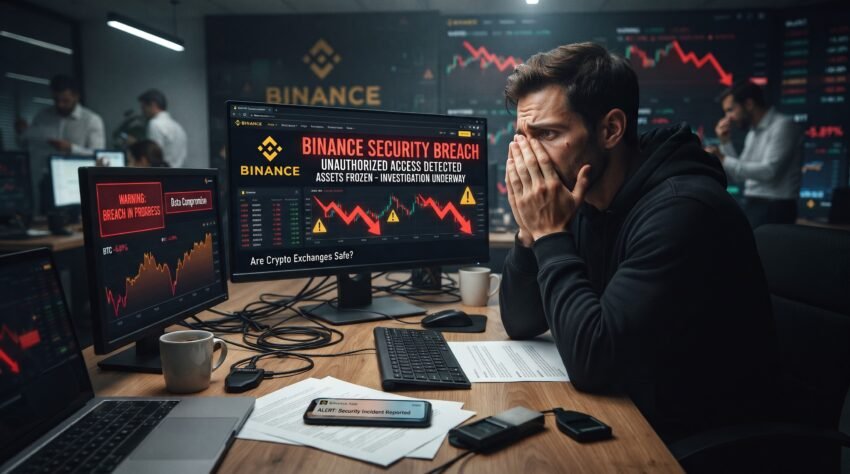
The latest Binance security incident raises important questions about centralized exchange security, cryptocurrency custody, and how investors can protect their digital assets.
Introduction: The Binance Security Breach Raises New Questions
The cryptocurrency industry faces another major security challenge following reports of a Binance security breach in October 2026. The incident has renewed concerns about the safety of centralized cryptocurrency exchanges and the risks investors face when storing digital assets on trading platforms.
Binance reportedly experienced unauthorized withdrawals from compromised hot wallets, with an estimated financial impact of approximately $6.3 billion according to reports attributed to the exchange. The incident has attracted attention from cryptocurrency investors, blockchain security researchers, and market participants worldwide.
Binance has reported measures to address the incident, including investigating the attack, coordinating with industry participants, and covering the associated losses. However, the final technical findings and recovery results should be assessed through verified official updates.
This development raises an important question for every cryptocurrency investor: Are crypto exchanges safe enough to hold your digital assets?
The answer is more complicated than a simple yes or no. Cryptocurrency exchanges provide essential services, including trading, liquidity, and asset management. However, even a major platform with extensive security infrastructure can experience a security failure.
Understanding the Binance security incident, how centralized exchanges manage digital assets, and what investors can do to reduce their exposure is essential in today’s cryptocurrency market.
What Happened in the Binance Security Breach?
The reported Binance security incident became public on October 29, 2026, after reports of suspicious activity involving the exchange’s cryptocurrency wallets.
According to reports attributed to Binance, the incident involved unauthorized withdrawals from hot wallets and an estimated financial impact of approximately $6.3 billion.
Initial technical findings reportedly pointed to a possible compromise involving a DevOps engineer’s laptop and access to a service container. Such an attack could potentially allow unauthorized transactions without requiring attackers to obtain every underlying wallet private key.
However, the precise attack sequence must be distinguished from preliminary findings. The investigation’s conclusions should be verified through official Binance announcements and independently corroborated security reports.
Key Details of the Binance Hack 2026
- Reported incident date: October 29, 2026.
- Estimated financial impact: Approximately $6.3 billion, according to reports attributed to Binance.
- Reported attack vector: Unauthorized withdrawals associated with a security compromise.
- Initial technical findings: A potentially compromised employee device and service infrastructure.
- Recovery measures: Investigation and coordination with blockchain security organizations and other industry participants.
- Customer protection: Binance reportedly committed to covering the associated financial losses.
Because the investigation may evolve, readers should consult official security announcements before treating preliminary figures or technical explanations as final.
Why the Binance Security Breach Matters to the Crypto Industry
1. A Large Exchange Is Not Automatically a Safe Exchange
Many investors assume that a large cryptocurrency exchange must be secure because it has millions of users, significant financial resources, and sophisticated technology.
However, company size and cybersecurity are not interchangeable.
A large exchange may have the resources to investigate attacks, compensate customers, and improve its systems. At the same time, its extensive infrastructure can introduce numerous potential points of failure, including employee devices, software deployment systems, internal permissions, and transaction approval mechanisms.
Original analysis: The most important question is not whether an exchange has ever experienced a security incident. It is whether the exchange can identify vulnerabilities, contain compromised systems, and independently demonstrate its ability to meet customer obligations.
Investors should evaluate an exchange’s cybersecurity practices and financial resilience separately.
2. Hot Wallets Create a Security Trade-Off
Cryptocurrency exchanges use hot wallets to facilitate deposits, withdrawals, and transactions that require online access to blockchain networks.
Hot wallets are essential for efficient exchange operations because they allow funds to move quickly. However, their connection to online systems can increase exposure to cyberattacks.
Cold wallets, by comparison, store private keys offline and can reduce exposure to certain online threats.
A well-designed exchange typically combines hot and cold storage with transaction limits, multiple approval layers, and continuous monitoring.
Nevertheless, cold storage alone cannot eliminate every risk. If attackers compromise the systems responsible for authorizing transactions, the broader security architecture may still be vulnerable.
The Binance incident highlights why protecting private keys is only one part of cryptocurrency exchange security.
3. The Financial Strength of an Exchange Matters
Following a major security incident, an exchange must do more than investigate the attack. It must also demonstrate that it can meet its financial obligations to customers.
Binance reportedly committed to covering the losses associated with the October 2026 incident. Such a commitment can help reassure customers, but investors should distinguish between public statements, reported asset holdings, and independently verified evidence of financial capacity.
Financial strength is an important part of risk management, but it should never be treated as a substitute for effective cybersecurity.
Are Crypto Exchanges Safe After the Binance Hack?
The Binance security breach demonstrates that even established cryptocurrency exchanges face significant cybersecurity risks. However, this does not mean every centralized exchange is unsafe or that investors should abandon cryptocurrency trading.
Instead, investors need to understand the different risks associated with keeping digital assets on an exchange.
Centralized Exchanges: Convenience Versus Control
Centralized cryptocurrency exchanges, commonly known as CEXs, allow users to buy, sell, and trade digital assets through a managed platform.
Their advantages include convenient trading, liquidity, customer support, and integrated portfolio management. However, users generally depend on the exchange to safeguard assets held in custodial accounts.
This introduces counterparty risk. Even if a cryptocurrency operates on a secure blockchain, the exchange controlling access to that cryptocurrency may experience a security breach, operational failure, withdrawal suspension, or financial difficulty.
Original analysis: The central issue is not simply whether cryptocurrency exchanges are safe. It is how much risk investors are willing to accept in exchange for convenience.
An exchange may be suitable for executing trades while being less appropriate for storing an investor’s entire long-term cryptocurrency portfolio.
Decentralized Exchanges Offer a Different Risk Model
Decentralized exchanges, or DEXs, allow users to trade cryptocurrencies through blockchain-based protocols and smart contracts.
Depending on the platform and transaction structure, users can retain control of their private keys rather than depositing assets with a centralized custodian.
This can reduce exposure to certain custodial risks, but it does not eliminate cryptocurrency security risks. Decentralized exchanges may be vulnerable to smart contract exploits, malicious token approvals, phishing attacks, manipulated liquidity pools, and fraudulent tokens.
Users also bear greater responsibility for securing their wallets and verifying transactions.
Neither centralized nor decentralized exchanges should automatically be considered safer in every situation. Their risks differ, and investors must evaluate each platform individually.
What Is Proof of Reserves, and Can It Protect Crypto Investors?
Following a major exchange hack, Proof of Reserves becomes an important part of the discussion about transparency.
Proof of Reserves is a method exchanges can use to demonstrate that they hold specified cryptocurrency assets. Some systems use cryptographic techniques to allow users to verify that their account balances are included in a published snapshot.
However, investors must understand the limitations of this approach.
Proof of Reserves Is Not a Complete Security Guarantee
Proof of Reserves can provide useful evidence about an exchange’s reported asset holdings, but it does not independently prove that every aspect of the business is financially healthy or secure.
For example, a reserve snapshot does not necessarily establish:
- Whether all customer liabilities have been included.
- Whether the exchange has undisclosed debts or other financial obligations.
- Whether its cybersecurity controls are effective.
- Whether its internal transaction authorization systems can resist sophisticated attacks.
- Whether its assets will remain available during a future emergency.
The methodology and scope of the report matter.
A more comprehensive assessment combines reserve verification with liability information, independent audits where available, transparent incident reporting, and evidence of effective cybersecurity controls.
Original analysis: Proof of Reserves should be treated as one piece of the security puzzle, not as a universal certificate of safety.
An exchange can report substantial reserves while still experiencing a serious operational security failure. Reserve transparency and cybersecurity must therefore be evaluated as separate but complementary safeguards.
How the Binance Hack Could Affect Bitcoin and Altcoin Prices
A major cryptocurrency exchange security breach can influence the broader market through several mechanisms. However, the direction and magnitude of the impact depend on market conditions, investor positioning, liquidity, and the incident’s financial consequences.
1. Bitcoin Price Pressure
Bitcoin can experience selling pressure when investors become concerned about the safety of cryptocurrency trading infrastructure.
Some traders may reduce their exposure to digital assets, while others may move funds away from exchanges or increase their holdings of self-custodied Bitcoin.
These responses can produce different market effects. A security incident does not automatically determine Bitcoin’s next price movement.
Macroeconomic developments, derivatives liquidations, broader risk sentiment, and other market events can also influence Bitcoin.
2. Altcoins May Experience Greater Volatility
Altcoins can be particularly sensitive to periods of uncertainty because many have thinner liquidity and less established demand than Bitcoin.
If traders reduce risk exposure, smaller cryptocurrencies may experience larger percentage declines than major assets.
Trading activity can also shift between tokens as investors reassess liquidity, exchange exposure, and the reliability of particular trading venues.
However, it would be inaccurate to assume that every altcoin must fall following an exchange security incident. Some assets may recover quickly, while others may remain under pressure depending on their fundamentals and liquidity.
3. Exchange-Related Tokens Face Additional Scrutiny
Tokens associated with centralized exchanges may attract additional attention during a security crisis.
Investors may reassess the relationship between an exchange’s operational health, its ecosystem, and the perceived utility of its associated token.
Nevertheless, a security incident does not automatically establish that an exchange token is fundamentally impaired. Investors should examine whether the incident changes the token’s actual utility or economic structure rather than making decisions based solely on headlines.
4. Stablecoins and Liquidity
Stablecoins are widely used for cryptocurrency trading, payments, and transfers between platforms.
During a major security incident, coordination between exchanges, blockchain investigators, and asset issuers may help identify or freeze certain assets.
However, freezing assets is not the same as recovering all stolen funds. The ability to freeze particular assets depends on their technical design and the issuer’s capabilities.
The broader lesson is that crypto liquidity depends not only on blockchain technology but also on the infrastructure and organizations supporting digital asset markets.
How to Protect Your Cryptocurrency From Exchange Hacks
Investors do not need to panic whenever a cryptocurrency exchange reports a security incident. However, such events provide an opportunity to review personal security practices.
1. Enable Two-Factor Authentication
Use strong two-factor authentication on your exchange account. Where supported, an authenticator application or hardware security key can provide stronger protection than relying exclusively on SMS verification.
Two-factor authentication is not a complete defense against every attack, but it can make unauthorized account access more difficult.
2. Use a Hardware Wallet for Long-Term Holdings
Investors holding cryptocurrency for the long term may consider a hardware wallet that keeps private keys offline.
This approach reduces dependence on a centralized exchange for custody, although users remain responsible for securing recovery phrases and verifying transactions.
Never share your recovery phrase with anyone. Losing it can also result in permanent loss of access to your assets.
3. Avoid Keeping Your Entire Portfolio on One Exchange
Concentrating all cryptocurrency holdings on one platform creates a single point of failure.
If that exchange suspends withdrawals or experiences an operational disruption, access to your assets may become temporarily unavailable.
Investors can reduce concentration risk by keeping only the funds needed for active trading on exchanges and using suitable self-custody solutions for longer-term holdings.
4. Review Withdrawal Whitelists and Account Permissions
Where supported, enable withdrawal address whitelisting and review account permissions regularly.
A withdrawal whitelist restricts transfers to approved addresses, potentially limiting the damage from certain forms of unauthorized account access.
Users should also review API keys and revoke permissions they no longer need. API keys with unnecessary withdrawal permissions can create additional security risks.
5. Watch for Fake Binance Recovery Scams
Major crypto hacks often create opportunities for scammers.
Fraudsters may impersonate exchange support teams, publish fake recovery websites, or claim they can retrieve stolen cryptocurrency in exchange for an upfront payment.
Be especially cautious of unsolicited messages asking for passwords, authentication codes, private keys, or recovery phrases.
Use official exchange channels to verify announcements and contact customer support.
Never trust a person who guarantees that they can recover cryptocurrency simply because they claim to have connections with investigators or exchange employees.
6. Verify Withdrawal Status Before Making Decisions
When an exchange suspends withdrawals, users should consult official service announcements for the affected networks and assets.
A withdrawal suspension does not necessarily mean customer assets have been permanently lost, but it does mean users may temporarily lack access to them.
The safest response is to verify the current situation, secure account credentials, and avoid decisions driven by panic or unverified information.
Binance Hack 2026 vs. the Binance Hack of 2019
The reported October 2026 incident should not be confused with Binance’s well-known security breach in May 2019.
In the 2019 incident, Binance reported that attackers stole approximately 7,000 BTC, then valued at around $40 million. The exchange said the loss was covered by its Secure Asset Fund for Users, commonly known as SAFU.
The reported 2026 incident differs in its estimated financial impact and the technical circumstances described in preliminary reports.
Nevertheless, both incidents illustrate a common principle: centralized exchanges must protect not only cryptocurrency holdings but also the systems, credentials, and transaction approval mechanisms used to manage those assets.
For investors, the comparison highlights why historical security incidents should be assessed in context rather than treated as proof that every exchange is either safe or unsafe.
Original Analysis: What the Binance Security Breach Reveals About Crypto Security
The most important lesson from the Binance security breach is that cryptocurrency security involves more than blockchain technology.
A blockchain may continue processing transactions correctly while the systems operated by a centralized exchange are compromised.
This distinction is essential. Blockchain security concerns the integrity of the underlying network and its transaction rules. Exchange security also depends on employee devices, internal software, access permissions, transaction monitoring, and operational procedures.
An attacker does not necessarily need to break the blockchain itself to steal assets from a poorly protected system.
The Real Test Is Whether Security Controls Can Contain an Attack
Modern exchanges need multiple independent layers of protection.
These can include hardware-backed key management, separation of duties, transaction limits, independent transaction verification, continuous monitoring, and rapid emergency controls.
The objective is not merely to prevent every possible attack. No complex system can guarantee that outcome.
The objective is also to ensure that a compromised component cannot automatically authorize large, unauthorized transfers.
This principle is known as defense in depth. If one control fails, other controls should limit the potential damage.
The Binance incident makes this a central question for the wider industry: how effectively can an exchange isolate a compromised system before it causes substantial losses?
Recovery Capacity Is Important, but Prevention Still Matters
Binance’s reported commitment to cover the losses is an important part of its response.
However, replacing stolen assets and preventing future attacks are two separate challenges.
Financial resources can help an exchange absorb losses, but they cannot guarantee that a similar incident will not happen again.
Investors should therefore examine the eventual technical post-mortem, the effectiveness of security improvements, and the quality of independent verification.
A credible recovery process should explain what happened, which controls failed, how vulnerabilities were addressed, and how improvements will be tested.
The Future of Crypto Exchanges Depends on Verifiable Trust
Trust in cryptocurrency exchanges should not depend entirely on brand recognition or public statements. It should be supported by measurable evidence.
Relevant indicators include transparent reserve reporting, clear information about customer liabilities, independent security assessments, documented incident-response procedures, and a demonstrated ability to protect customer assets.
No single indicator is sufficient. A large reserve cannot prevent every cyberattack, while a sophisticated security system cannot guarantee that an exchange will always meet its financial obligations.
Our analysis: The future of cryptocurrency exchange security will depend on whether platforms can turn public promises into verifiable safeguards. Exchanges that communicate transparently, limit the consequences of security failures, and demonstrate financial resilience may be better positioned to retain customer confidence over time.
Are Crypto Exchanges Safe? Final Verdict
So, are crypto exchanges safe after the Binance security breach?
The most accurate answer is that cryptocurrency exchanges can provide useful and reasonably secure trading services, but they are not risk-free.
The reported October 2026 Binance incident demonstrates why investors must take cybersecurity, custody arrangements, and counterparty risk seriously.
Binance’s reported efforts to address the incident and cover associated losses may help reassure customers, but these measures should not be interpreted as proof that every risk has disappeared.
The investigation, technical findings, and independent verification remain important to understanding the incident fully.
For everyday traders, centralized exchanges remain convenient tools for accessing cryptocurrency markets. For long-term investors, reducing custodial concentration and maintaining control of private keys where appropriate can provide an additional layer of protection.
Ultimately, the safest cryptocurrency strategy is not to trust an exchange blindly, but to understand its risks, verify its claims, and take responsibility for protecting your own digital assets.
Frequently Asked Questions (FAQ)
1. What happened in the Binance security breach in 2026?
Reports dated October 29, 2026, described a Binance security incident involving unauthorized withdrawals from hot wallets. The reported financial impact was approximately $6.3 billion. Readers should consult official updates to verify the final findings.
2. Were Binance customer funds affected by the hack?
The reported incident involved unauthorized withdrawals from Binance hot wallets. Binance reportedly committed to covering the associated financial losses. The precise technical circumstances and final recovery results should be assessed using verified updates from the exchange.
3. Is Binance safe to use after the security breach?
The incident raises legitimate questions about Binance’s security controls, but it does not by itself establish that every Binance service is unsafe. Users should review official security updates, withdrawal status, reserve information, and investigation findings before making decisions.
4. Are cryptocurrency exchanges safe for long-term storage?
Exchanges offer convenience, but storing cryptocurrency with a centralized platform introduces custodial and counterparty risks. Investors may consider self-custody for long-term holdings if they understand how to manage private keys and recovery phrases securely.
5. What is Proof of Reserves in cryptocurrency?
Proof of Reserves is a method used to demonstrate that a platform holds specified cryptocurrency assets. Its usefulness depends on the verification methodology and the information disclosed about customer liabilities. It is not, by itself, proof of complete financial health or cybersecurity.
6. Can a crypto exchange hack cause Bitcoin prices to fall?
Yes. A major security incident can weaken market confidence and trigger selling pressure. However, Bitcoin prices are influenced by many factors, so a price decline cannot automatically be attributed entirely to one exchange incident.
7. How can investors protect their cryptocurrency from exchange hacks?
Investors can enable strong authentication, use withdrawal whitelists where available, secure API keys, avoid phishing attempts, and consider hardware wallets for long-term holdings. Diversifying custody arrangements can also reduce dependence on a single platform.
8. What is the difference between a hot wallet and a cold wallet?
A hot wallet is connected to online systems and supports convenient transactions, while a cold wallet keeps private keys offline. Cold storage can reduce certain online attack risks, although it does not eliminate every form of cryptocurrency theft.
9. What should users do if a crypto exchange suspends withdrawals?
Users should check official announcements, confirm which assets and networks are affected, secure their accounts, and avoid unofficial recovery services. A withdrawal suspension can be temporary, but users should not assume funds will become available until the exchange confirms that services have resumed.
10. What is the biggest lesson from the Binance security breach?
The key lesson is that blockchain technology alone cannot guarantee the security of cryptocurrency held by centralized exchanges. Investors must also consider operational security, custody arrangements, financial resilience, transparency, and the ability to independently verify an exchange’s claims.
Disclaimer
This article is for informational and educational purposes only and does not constitute financial or investment advice. Cryptocurrency investments involve significant risks, including price volatility, cybersecurity incidents, and loss of access to funds. Always conduct independent research before making financial decisions.