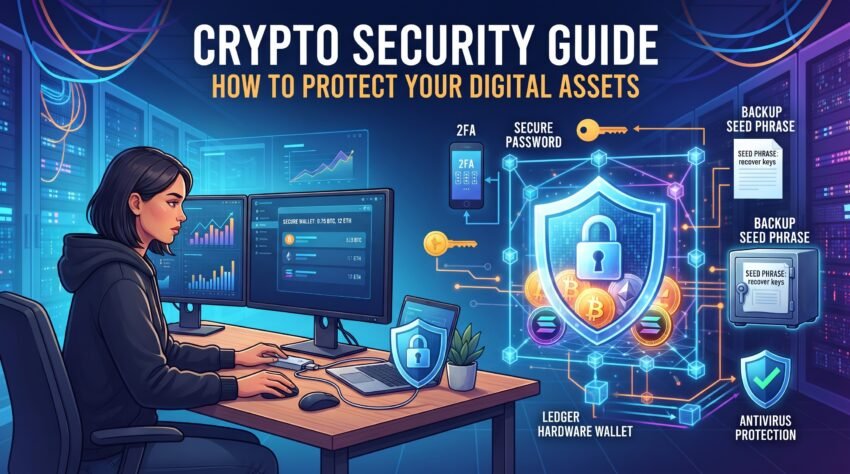
Cryptocurrency has created new opportunities for investors, traders, and blockchain enthusiasts. However, as digital assets become increasingly important in the global financial ecosystem, protecting them from hackers, scammers, and unauthorized access has become a critical priority.
Unlike traditional bank accounts, cryptocurrency wallets generally do not offer a simple way to reverse unauthorized blockchain transactions. If someone gains control of your private keys or tricks you into approving a malicious transaction, recovering your funds may be extremely difficult or impossible.
This makes crypto security one of the most important aspects of cryptocurrency investing.
Whether you hold Bitcoin, Ethereum, altcoins, stablecoins, or decentralized finance (DeFi) tokens, understanding how to protect your digital assets can significantly reduce your exposure to security threats.
In this comprehensive crypto security guide, we explain how cryptocurrency theft happens, how to secure your crypto wallet, how to recognize phishing attacks, and which security practices can help protect your digital wealth.
Most importantly, we examine a common misconception among crypto investors: blockchain technology can be highly secure, but the applications, devices, accounts, and human decisions surrounding it can still create serious vulnerabilities.
What Is Crypto Security?
Crypto security refers to the strategies, technologies, and practices used to protect cryptocurrency holdings, private keys, digital wallets, exchange accounts, and blockchain transactions from theft, fraud, and unauthorized access.
Effective cryptocurrency security involves more than choosing a trusted wallet or exchange. It requires a comprehensive approach that combines digital protection, secure storage, transaction verification, and awareness of common cryptocurrency scams.
The most important components of crypto security include:
- Wallet security: Protecting cryptocurrency wallets against unauthorized access.
- Private key protection: Keeping the cryptographic keys that control your assets confidential.
- Seed phrase security: Safeguarding wallet recovery phrases against theft or exposure.
- Exchange account protection: Securing cryptocurrency exchange accounts with strong passwords and additional authentication.
- Phishing prevention: Identifying fake websites, fraudulent messages, and malicious applications.
- Transaction verification: Checking wallet addresses, blockchain networks, and transaction details before signing.
- Smart contract security: Understanding the risks associated with DeFi applications, token approvals, and decentralized exchanges.
These measures work together to create multiple layers of defense.
A strong password cannot protect a wallet if its seed phrase has already been stolen. Similarly, a hardware wallet cannot prevent every type of loss if its owner unknowingly approves a malicious transaction.
The goal is to minimize the number of ways an attacker could gain access to your digital assets.
Why Cryptocurrency Security Matters More Than Ever
Cryptocurrency operates differently from traditional financial systems. On a conventional banking platform, customers may have access to fraud investigations, account freezes, chargebacks, or other recovery procedures, depending on the circumstances.
Blockchain transactions generally work differently. Once a transaction has been confirmed, it usually cannot be reversed simply because the sender made a mistake or discovered that the recipient was a scammer.
This creates a unique security challenge for cryptocurrency holders.
1. Cryptocurrency Transactions Are Generally Irreversible
Blockchain networks are designed to maintain transaction integrity and prevent unauthorized changes to confirmed transaction records.
Although this provides important security benefits, it also means that sending cryptocurrency to the wrong address can result in permanent loss.
Investors should always verify the recipient’s address, the selected blockchain network, and the amount before confirming a transfer.
2. Private Keys Give Users Control Over Their Assets
A private key is a cryptographic credential that allows its holder to authorize transactions for the associated blockchain account.
Anyone who obtains the necessary private key or recovery phrase may be able to take control of the assets associated with that wallet.
For this reason, private key security is fundamental to cryptocurrency ownership.
Legitimate wallet support representatives should not need you to disclose your recovery phrase to resolve an ordinary support request.
3. Crypto Scams Can Target Experienced Investors
Cryptocurrency scams do not exclusively target beginners. Experienced investors may also be vulnerable to sophisticated phishing websites, impersonation attacks, fake token launches, malicious smart contracts, and fraudulent investment opportunities.
Scammers often exploit urgency, greed, fear, or trust in well-known brands.
A message claiming that your wallet will be suspended unless you act immediately should be treated with suspicion.
4. Decentralized Finance Introduces Additional Risks
DeFi applications allow users to exchange tokens, lend assets, provide liquidity, and interact with smart contracts without relying on traditional financial intermediaries.
However, these activities introduce additional security considerations.
A malicious or vulnerable smart contract may expose users to financial losses. A legitimate application may also request permissions that allow a contract to interact with particular tokens.
Understanding what you authorize is therefore an essential part of protecting digital assets.
How to Protect Your Digital Assets: 10 Essential Crypto Security Tips
The following cryptocurrency security practices can help investors reduce common risks when buying, storing, trading, and transferring digital assets.
1. Use a Secure Cryptocurrency Wallet
Choosing the right crypto wallet is one of the first steps toward protecting your digital assets.
Cryptocurrency wallets generally fall into two broad categories: hot wallets and cold wallets.
Hot wallets are connected to the internet and are commonly used for everyday transactions, decentralized applications, and cryptocurrency trading.
Cold wallets keep private keys offline, reducing their exposure to many internet-based attacks. Hardware wallets are a common example.
Each option has advantages and limitations.
Hot wallets offer convenience but are more exposed to online threats. Cold wallets can improve the security of long-term holdings, but users must still protect their devices, recovery phrases, and transaction approvals.
A practical strategy is to separate funds according to their purpose.
Use a wallet for everyday transactions and a separate, appropriately secured wallet for long-term holdings.
This reduces the risk that a compromised application or wallet interaction will expose every asset you own.
However, wallet separation is not a guarantee of safety. Every wallet still requires careful management.
2. Never Share Your Private Keys or Seed Phrase
Your seed phrase, sometimes called a recovery phrase, is one of the most sensitive pieces of information associated with a self-custody wallet.
Depending on the wallet, it may consist of 12, 18, or 24 words that can restore access to your cryptocurrency accounts.
If someone obtains your seed phrase, they may be able to recreate your wallet and transfer its assets without needing your physical device.
Follow these essential seed phrase security rules:
- Never share your seed phrase with another person.
- Do not enter it into an unfamiliar website or application.
- Avoid storing it in screenshots, email drafts, cloud storage, or unencrypted digital documents.
- Keep a physical backup in a secure location.
- Protect the backup against theft, fire, water damage, and accidental loss.
- Be cautious of anyone claiming they need your recovery phrase to verify, synchronize, or secure your wallet.
Important: A hardware wallet manufacturer, exchange employee, or online support representative should not ask you to disclose your recovery phrase through an ordinary support conversation.
If a website asks you to enter your existing seed phrase to claim an unexpected reward or resolve an urgent security problem, stop and verify the request through official channels.
3. Enable Two-Factor Authentication on Crypto Exchanges
If you trade cryptocurrency through a centralized exchange, securing your account is just as important as protecting your wallet.
A compromised exchange account may allow an attacker to access your balances, change account settings, or attempt unauthorized withdrawals.
Two-factor authentication (2FA) adds another layer of protection beyond your password.
Where supported, consider using a hardware security key or a passkey with appropriate phishing resistance. An authenticator application is another useful option.
SMS-based verification is generally less resistant to certain attacks, including SIM swapping.
You should also:
- Create a unique password for every cryptocurrency account.
- Secure the email account associated with your exchange.
- Enable withdrawal address allowlisting if available.
- Activate login and withdrawal notifications.
- Review active sessions and remove unfamiliar devices.
- Disable API permissions that you no longer need.
These steps help reduce the likelihood that a stolen password alone will be enough to compromise your account.
4. Learn How to Recognize Crypto Phishing Scams
Phishing is one of the most important threats cryptocurrency users need to understand.
A phishing attack attempts to trick someone into revealing sensitive information, connecting a wallet to a malicious application, or approving an unauthorized transaction.
Attackers may impersonate cryptocurrency exchanges, wallet providers, blockchain projects, influencers, or customer support teams.
Common examples include:
- Fake cryptocurrency airdrop websites.
- Fraudulent wallet verification pages.
- Messages warning that an account will be suspended.
- Fake customer support accounts on social media.
- Malicious links distributed through email or messaging applications.
- Websites that imitate legitimate cryptocurrency platforms.
- Fake investment opportunities promising guaranteed profits.
To reduce your exposure to crypto phishing scams, access services through verified official websites or bookmarks rather than clicking unsolicited links.
Check domain names carefully. A fraudulent website may look almost identical to the legitimate version.
Be especially careful when connecting a wallet to a new decentralized application.
Connecting a wallet does not automatically mean you have transferred your assets, but signing messages, granting token permissions, or approving transactions can create additional risks.
Never approve a request simply because a website claims it is required to receive free tokens.
5. Verify Every Crypto Transaction Before Signing
Transaction verification is one of the most overlooked aspects of crypto wallet security.
Many users carefully protect their passwords but approve transactions without fully understanding what they are signing.
This creates an opportunity for attackers.
Before confirming a cryptocurrency transaction, review the following information:
- Recipient address: Verify the destination address. Do not rely solely on the first and last few characters if the wallet allows you to inspect more of the address.
- Blockchain network: Make sure the selected network matches the intended transaction.
- Transaction amount: Confirm the amount of cryptocurrency being sent.
- Transaction fees: Check the expected network or service fees.
- Token approvals: Understand whether you are authorizing a smart contract to spend tokens on your behalf.
- Signature requests: Be cautious when a decentralized application asks you to sign an unfamiliar message or transaction.
A particularly dangerous tactic is address poisoning.
In this type of attack, a scammer creates a wallet address resembling one that a victim has previously used. The attacker then attempts to place a similar-looking address in the victim’s transaction history, hoping the victim will copy it for a future transfer.
To reduce this risk, copy addresses from trusted sources and verify the complete destination address before sending funds.
For significant transfers, consider making a small test transaction first, taking network fees and other costs into account.
6. Use Cold Storage for Long-Term Cryptocurrency Holdings
Cold storage can be an effective way to protect long-term cryptocurrency holdings.
Hardware wallets are designed to keep private keys isolated from ordinary internet-connected environments and typically require the user to confirm transactions through the device.
However, a hardware wallet is not a complete security solution on its own.
Users still need to protect their recovery phrases, verify transaction details, purchase authentic devices through trusted channels, and follow official security instructions.
A compromised computer may attempt to trick a user into approving a malicious transaction even when the private key remains protected by a hardware wallet.
For long-term storage:
- Use a reputable wallet with security practices you understand.
- Purchase hardware wallets from the manufacturer or an authorized seller.
- Keep recovery information offline.
- Verify transaction details on the device when supported.
- Keep the wallet’s firmware and associated software updated through official channels.
- Maintain a secure recovery plan.
Remember that losing a hardware wallet does not necessarily mean losing your cryptocurrency if you have a valid recovery backup.
Conversely, someone who obtains your recovery phrase may be able to access your assets even if your physical device remains secure.
7. Be Careful When Using DeFi Platforms and Smart Contracts
Decentralized finance allows cryptocurrency holders to interact directly with smart contracts.
However, smart contract interactions can expose users to risks that are different from simply holding cryptocurrency in a wallet.
For example, a decentralized application may request permission to spend a particular token. Depending on the permission granted and the contract’s behavior, an attacker may be able to exploit that authorization.
Before using a DeFi platform, consider the following precautions:
- Verify the application’s official website.
- Research the development team and project’s history.
- Look for credible, relevant smart contract audits.
- Understand the risks of token approvals.
- Avoid signing transactions you do not understand.
- Review and revoke unnecessary token permissions where appropriate.
- Use a separate wallet for unfamiliar or higher-risk applications.
An audit can help identify certain vulnerabilities, but it does not guarantee that a project is safe.
Similarly, a popular project is not automatically secure simply because it has a large community or substantial trading volume.
Investors should distinguish between a project’s reputation, its technical security, and the actual permissions they grant when interacting with it.
8. Protect Your Devices and Internet Connection
Cryptocurrency security depends partly on the security of the devices used to access wallets and exchanges.
Malware, malicious browser extensions, keyloggers, and compromised applications may expose passwords or interfere with transactions.
To improve device security:
- Install operating system and browser updates promptly.
- Download wallet applications from verified official sources.
- Avoid installing unknown software or browser extensions.
- Use a screen lock and strong device authentication.
- Keep reputable security software updated.
- Avoid performing sensitive transactions on unfamiliar or shared devices.
- Be cautious when using public Wi-Fi.
- Never run commands copied from unknown websites or social media posts.
Public Wi-Fi does not automatically make every cryptocurrency transaction unsafe, but unfamiliar networks can introduce additional risks, especially when combined with fake websites, malicious software, or poor device security.
A VPN may improve privacy in some circumstances, but it cannot protect you from voluntarily revealing a seed phrase or approving a fraudulent transaction.
9. Avoid Cryptocurrency Investment Scams
Not every cryptocurrency security threat involves hacking.
Many losses occur because investors voluntarily send assets to fraudulent projects or individuals.
Scammers may promote fake token launches, fraudulent trading platforms, counterfeit giveaways, Ponzi schemes, or investment programs promising unrealistic returns.
Common warning signs include:
- Guaranteed daily or monthly profits.
- Pressure to invest immediately.
- Requests to pay additional fees to unlock supposed profits.
- Unverifiable claims about partnerships or exchange listings.
- Anonymous operators who cannot provide credible project information.
- Fake testimonials and manipulated screenshots.
- Withdrawal restrictions followed by demands for additional deposits.
Before investing in a cryptocurrency project, research its team, tokenomics, smart contracts, liquidity, and independent reputation.
Do not assume that a project is legitimate because its website looks professional or its social media accounts have many followers.
A cryptocurrency investment can be risky even when its wallet and smart contracts have no known technical vulnerabilities.
Technical security and investment legitimacy are two different questions, and both require careful evaluation.
10. Monitor Your Wallet and Exchange Accounts Regularly
Strong security practices should continue after you purchase cryptocurrency.
Regular monitoring can help you identify suspicious activity before additional damage occurs.
Consider reviewing your accounts weekly or whenever you interact with a new platform.
Check for:
- Unexpected wallet transactions.
- Unfamiliar token approvals.
- Unknown exchange login sessions.
- Changes to withdrawal settings.
- Suspicious API keys.
- Unexpected account verification messages.
- New applications connected to your wallet.
Where supported, enable transaction notifications and account security alerts.
If you identify an unfamiliar transaction or suspicious wallet interaction, stop using the affected wallet or account until you understand what happened.
If a seed phrase or private key has been compromised, creating a new password is not enough. The attacker may retain access to the wallet itself.
In that situation, prioritize moving remaining assets to a new, uncompromised wallet using a secure device and trusted software. If a malicious smart contract approval is involved, review the relevant permissions and revoke them when appropriate.
If an exchange account is affected, contact the platform through its official support channels and use available account security controls.
Hot Wallet vs. Cold Wallet: Which Is Safer?
Choosing between a hot wallet and a cold wallet depends on how you use cryptocurrency.
| Feature | Hot Wallet | Cold Wallet |
|---|---|---|
| Internet connectivity | Generally connected | Private keys kept offline |
| Transaction convenience | Usually high | May require additional steps |
| Exposure to online attacks | Generally higher | Generally lower for remote key theft |
| Long-term storage | Useful for smaller balances | Often suitable for long-term holdings |
| DeFi interaction | Usually convenient | Possible, depending on wallet and setup |
| Recovery responsibility | Depends on custody model | Depends on custody model |
| Main security concern | Online threats and malicious interactions | Physical security, recovery phrase protection, and transaction approval |
Neither wallet type eliminates all security risks.
A hot wallet may be appropriate for everyday transactions, while a hardware wallet may be preferable for substantial long-term holdings.
The best choice depends on your technical understanding, financial circumstances, transaction frequency, and ability to maintain secure backups.
Investors should also understand the distinction between self-custody and third-party custody.
With self-custody, you control the private keys and take responsibility for protecting them. With third-party custody, a service provider manages the keys, introducing risks associated with the provider’s security, operational practices, and financial condition.
Neither arrangement is risk-free.
What Should You Do If Your Crypto Wallet Is Hacked?
Discovering unauthorized cryptocurrency activity can be stressful, but taking the right steps quickly may help limit further losses.
The appropriate response depends on whether your seed phrase was exposed, a smart contract approval was exploited, your device was compromised, or an exchange account was accessed.
Step 1: Stop Interacting With the Suspicious Application
Do not sign additional transactions or follow instructions from suspicious websites, messages, or support accounts.
Avoid downloading unfamiliar security tools recommended by strangers.
Step 2: Determine What Was Compromised
Try to identify whether the problem involves your wallet’s recovery phrase, an individual transaction, a token approval, your device, or a centralized exchange account.
This distinction matters because different security incidents require different responses.
Step 3: Protect Your Remaining Assets
If your private key or seed phrase is compromised, create a new wallet using trusted software on a secure device and transfer any remaining assets as soon as it is safe to do so.
Do not restore a compromised seed phrase into another wallet and assume the assets are protected.
If you suspect malware on your device, avoid using that device to generate or manage replacement wallet credentials until it has been secured.
If only an exchange account is affected, secure the associated email account, change compromised passwords, revoke unfamiliar sessions, and contact the exchange through its verified official channels.
Step 4: Review Smart Contract Permissions
If a malicious token approval is involved, use a trusted wallet interface or blockchain explorer to review and revoke the relevant permission where possible.
Revoking an approval does not reverse transactions that have already occurred.
Step 5: Preserve Evidence and Report the Incident
Save transaction hashes, wallet addresses, suspicious URLs, messages, and other relevant evidence.
Report the incident to the relevant exchange, wallet provider, law enforcement agency, or appropriate cybercrime reporting authority.
Be cautious of recovery services that demand an upfront payment or promise guaranteed recovery of stolen cryptocurrency. Victims are frequently targeted by secondary scams.
Original Analysis: Why Crypto Security Is More Than Preventing Hacks
One of the most important lessons in cryptocurrency security is that protecting digital assets requires more than defending against direct attacks on blockchain networks.
The weakest point in a crypto security system may be the person authorizing a transaction, the application requesting access, or the process used to recover a wallet.
This distinction helps explain why investors can lose cryptocurrency even when the underlying blockchain continues to operate normally.
Consider three hypothetical scenarios.
In the first scenario, an investor stores cryptocurrency in a hardware wallet but enters the recovery phrase into a fake website. The hardware wallet cannot protect the assets once the recovery phrase has been exposed.
In the second scenario, an investor uses a legitimate wallet application but approves a malicious smart contract transaction without understanding its consequences. The wallet may operate exactly as designed, yet the investor can still suffer a loss.
In the third scenario, an investor protects a self-custody wallet carefully but keeps most of their assets on a cryptocurrency exchange. Their exposure then depends partly on the exchange’s security, operational controls, and ability to protect customer assets.
These examples demonstrate that crypto security is a system of interconnected risks rather than a single product or feature.
Analysis 1: Wallet Security Should Be Based on Risk, Not Convenience Alone
Many cryptocurrency users choose a wallet based primarily on convenience.
However, a wallet used to trade small amounts every day has a different purpose from one holding an investor’s long-term savings.
Combining both purposes in a single wallet can increase the potential consequences of a compromised application or mistaken transaction.
A more resilient approach is to separate cryptocurrency holdings by function:
- Storage wallet: Holds long-term assets and interacts with as few applications as practical.
- Transaction wallet: Holds funds needed for regular transfers and trading.
- Experimental wallet: Used to interact with unfamiliar decentralized applications or higher-risk projects, with only limited funds exposed.
This approach does not eliminate risk, but it can reduce the amount of cryptocurrency exposed to a single security incident.
The key principle is simple: do not expose all your assets to the same online activities unless there is a compelling reason to do so.
Analysis 2: The Real Security Boundary Is Often the Transaction Approval
Investors frequently focus on whether a wallet can be hacked.
A more useful question is whether they can reliably distinguish a legitimate transaction from a dangerous one.
Cryptocurrency wallets are designed to let users authorize transactions. That flexibility is fundamental to blockchain participation, but it also means that users must understand what they are approving.
A malicious application does not always need to steal a private key directly. It may instead manipulate the user into signing a transaction or granting a permission that benefits the attacker.
For this reason, transaction literacy should be treated as a core security skill.
Investors should learn to recognize token approvals, understand the purpose of signatures, verify recipient addresses, and question unexpected requests for authorization.
The security of a transaction depends not only on how the key is stored, but also on how the key is used.
Analysis 3: Recovery Planning Is as Important as Theft Prevention
Another overlooked part of cryptocurrency security is recovery.
Users often spend considerable time selecting wallets and setting strong passwords but fail to prepare for device loss, accidental deletion, damaged hardware, or forgotten recovery information.
A wallet can be perfectly secure against remote attackers and still become inaccessible to its legitimate owner.
A sound recovery plan should answer three questions:
- Can the wallet be restored if the primary device is lost?
- Is the recovery information protected against both theft and physical damage?
- Can the owner or an authorized successor access the assets under appropriate circumstances?
Recovery arrangements must be designed carefully. Keeping multiple backups can improve resilience, but creating unnecessary copies may also increase the number of places an attacker could find sensitive information.
The goal is to balance availability with confidentiality.
Analysis 4: Security Habits Matter More Than Brand Reputation Alone
A well-known exchange, hardware wallet, or blockchain project may have strong security practices, but its reputation cannot eliminate every risk.
Users still need to verify websites, protect their credentials, understand custody arrangements, and review transaction permissions.
Similarly, a project audit is evidence of a particular security assessment, not proof that every component of a project is safe.
Investors should evaluate the actual security controls available to them rather than relying entirely on brand recognition, follower counts, promotional claims, or online popularity.
Ultimately, good security decisions require independent verification and consistent habits.
The Bottom Line From Our Analysis
The strongest practical crypto security strategy combines three layers:
- Prevention: Reduce exposure through secure wallets, protected credentials, trusted applications, and careful transaction verification.
- Containment: Separate funds and account permissions so that one compromised wallet or application does not automatically expose every asset.
- Recovery: Maintain secure backups and know how to respond if a wallet, device, exchange account, or smart contract interaction is compromised.
These layers provide a more realistic approach than assuming any single wallet, platform, or security tool can eliminate cryptocurrency risk.
Crypto Security Checklist for 2026
Use this checklist to review your current cryptocurrency security practices.
| Security Measure | Recommended Action |
|---|---|
| Wallet selection | Choose a wallet appropriate for your needs and risk tolerance. |
| Seed phrase | Store recovery information securely offline. |
| Passwords | Use strong, unique passwords. |
| Two-factor authentication | Enable phishing-resistant options where available. |
| Long-term storage | Consider an appropriately configured hardware wallet. |
| Exchange security | Review sessions, withdrawal controls, and account alerts. |
| Phishing protection | Verify websites and ignore suspicious requests. |
| Transaction verification | Check the destination address, network, amount, and permissions. |
| DeFi security | Research applications and review token approvals. |
| Device protection | Install updates and avoid untrusted software. |
| Wallet monitoring | Review transactions and suspicious permissions regularly. |
| Recovery planning | Maintain a secure, tested recovery procedure. |
Review this checklist periodically and whenever you begin using a new cryptocurrency exchange, wallet, or decentralized application.
Security practices should evolve as your holdings, transaction patterns, and exposure to new applications change.
Frequently Asked Questions About Crypto Security
What Is the Safest Way to Store Cryptocurrency?
For many users holding substantial amounts of cryptocurrency over the long term, a properly configured hardware wallet can reduce exposure to internet-based attacks.
However, security also depends on protecting the recovery phrase, verifying transactions, maintaining backups, and following sound operational practices.
There is no universally risk-free storage method.
How Can I Protect My Crypto Wallet From Hackers?
Use a reputable wallet, protect your private keys and recovery phrase, enable strong authentication where applicable, keep your devices updated, avoid suspicious links, and verify every transaction before signing.
For additional protection, separate long-term holdings from wallets used for routine transactions or unfamiliar DeFi applications.
Can Cryptocurrency Be Stolen From a Hardware Wallet?
Yes, cryptocurrency associated with a hardware wallet can still be stolen under certain circumstances.
For example, an attacker may obtain the recovery phrase, exploit a compromised recovery process, or trick the owner into approving a malicious transaction.
A hardware wallet reduces certain risks but does not eliminate every threat.
Should I Keep My Cryptocurrency on an Exchange or in a Wallet?
The answer depends on your needs and risk tolerance.
Keeping assets on an exchange may be convenient for frequent trading, but it exposes you to third-party custody and platform risks.
Self-custody provides more direct control over private keys but also makes you responsible for protecting them and maintaining recovery arrangements.
Some investors use a combination of both approaches.
What Is a Seed Phrase, and Why Is It Important?
A seed phrase is a sequence of words used by compatible wallets to recover cryptographic keys.
Anyone who obtains the necessary recovery phrase may be able to access the associated assets.
Keep it private, store it securely offline, and never disclose it to someone claiming to provide routine technical support.
How Do I Know if a Crypto Website Is a Scam?
Look for suspicious domain names, unsolicited links, unrealistic profit promises, unexpected requests for seed phrases, and pressure to approve transactions immediately.
Verify the website through official project channels and independent sources.
A professional-looking website or large social media following does not prove that a project is legitimate.
Can I Recover Stolen Cryptocurrency?
Recovery is difficult and is not guaranteed.
Blockchain transactions generally cannot be reversed by the sender. In some cases, exchanges or law enforcement agencies may be able to investigate, identify funds, or help prevent further transfers.
Preserve transaction evidence and report the incident promptly. Avoid anyone promising guaranteed recovery in exchange for an upfront payment.
Final Thoughts: Protect Your Digital Assets Before It’s Too Late
Cryptocurrency ownership provides greater control over digital assets, but that control comes with security responsibilities.
Protecting Bitcoin, Ethereum, altcoins, and other digital assets requires a combination of secure storage, strong account protection, careful transaction approval, and awareness of cryptocurrency scams.
Investors should understand that even a secure blockchain cannot protect them from every compromised device, fraudulent website, malicious smart contract, or unsafe decision.
The most effective crypto security strategy is not simply to choose the most expensive wallet or the most popular exchange. It is to build a security system that limits exposure, protects recovery information, and provides a clear response plan when something goes wrong.
Start with the fundamentals: secure your seed phrase, enable strong authentication, separate long-term holdings from everyday transactions, verify every transaction, and never approve an unfamiliar request without understanding it.
In cryptocurrency, protecting your digital assets is not a one-time task. It is an ongoing responsibility that should evolve alongside the risks you face.
Disclaimer
This article is intended for educational and informational purposes only. It does not constitute financial, investment, or cybersecurity advice tailored to your individual circumstances. Cryptocurrency security practices can reduce risk but cannot guarantee the prevention or recovery of losses. Always conduct independent research and consult qualified professionals when necessary.