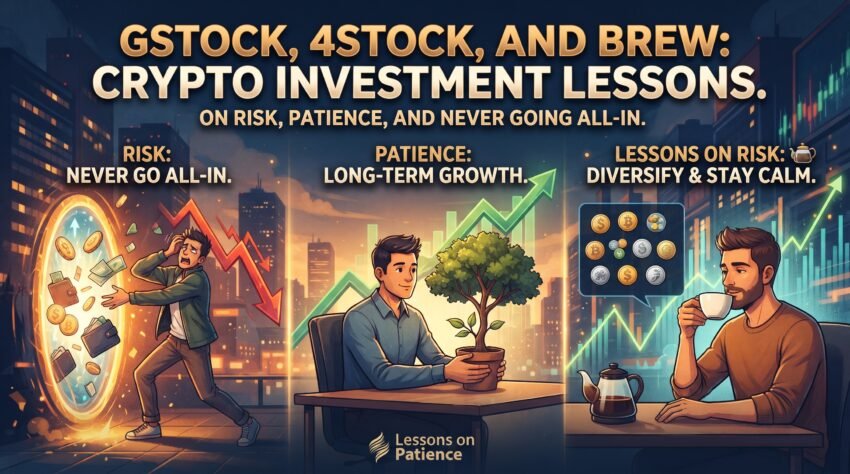
Cryptocurrency investing can offer significant opportunities, but it can also expose investors to painful losses. The market experiences sharp rallies, sudden corrections, emotional sell-offs, and periods when even promising projects struggle to maintain their token prices. The experiences surrounding Gstock (GSTOCK), 4Stock (4STOCK), and Brew (BREW) provide an opportunity to examine an important lesson: believing in a project’s long-term potential is not the same as knowing what its token price will do next.
For investors who believe these projects have a future, falling prices may test their patience and conviction. Others who entered near market peaks may face significant unrealized losses or sell at a loss because they can no longer tolerate the uncertainty.
The objective should not be to label every struggling crypto project a failure. Instead, investors should learn how to evaluate risk, protect their capital, manage expectations, and distinguish a project’s potential from the speculative behavior of its token market.
Disclaimer: This article is for educational and informational purposes only. It does not constitute financial advice or a recommendation to buy, sell, or hold GSTOCK, 4STOCK, BREW, or any other cryptocurrency.
Why Gstock, 4Stock, and Brew Have Attracted Attention
Gstock, 4Stock, and Brew represent different narratives within the cryptocurrency market. Their communities, token utilities, trading activity, and perceived growth opportunities may attract investors for different reasons.
Gstock (GSTOCK)
Gstock is a BNB Chain token associated with a stock-meme narrative and the Genius.fun ecosystem. Its appeal includes the possibility of attracting attention from crypto traders interested in experimental models that combine meme-token communities with stock-related narratives.
However, investors must distinguish between a token inspired by a stock-related concept and an actual ownership interest in a company. Holding GSTOCK should not automatically be interpreted as owning shares, receiving dividends, or having shareholder voting rights.
For Gstock, the important questions include whether its ecosystem can sustain meaningful user activity, whether its token has a clear value proposition, and whether market demand can persist beyond speculative attention.
4Stock (4STOCK)
4Stock has attracted interest through its association with the stock-meme narrative on BNB Chain. That narrative can generate considerable attention when traders become interested in tokenized equities and related speculative assets.
Nevertheless, investors should verify the exact token and contract address before making decisions. Similar names can refer to different products, and confusion between a meme token and a stock-related product can create unnecessary financial risk.
Investors should also examine liquidity, holder concentration, trading volume, distribution mechanisms, and official project communications. These factors can help explain why a token’s market price may behave differently from the expectations of its community.
Brew (BREW)
Brew is associated with a token-launching ecosystem on BNB Chain. A launchpad model can attract users by making it easier to create tokens and establish trading pools.
However, the potential usefulness of a launchpad and the investment performance of its associated token are two different questions. A platform could attract developers and users without guaranteeing that its token will appreciate in value.
Investors should investigate how BREW captures value from platform activity, whether its tokenomics are sustainable, how liquidity is managed, and whether actual adoption supports the project’s growth narrative.
What Historical Price Data Tells Us
Historical market data provides a useful starting point for understanding the risks associated with volatile tokens. It does not establish why every investor lost money, but it demonstrates how quickly market conditions can change.
A market report published by Kriptosignal on September 16, 2026, reported that BREW had fallen approximately 42.1% in 24 hours, while 4STOCK had declined approximately 33.8% during the same period. These figures describe the market snapshot reported at that time, not current prices or guaranteed trading outcomes.
Historical data published by CoinGecko also shows substantial price fluctuations for both 4STOCK and GSTOCK during October 2026.
- 4STOCK: Its reported closing price declined from approximately $0.00459 on October 12 to $0.00301 on October 30.
- GSTOCK: Its reported closing price declined from approximately $0.00597 on October 12 to $0.00394 on October 30.
These historical comparisons indicate substantial weakness over the selected period. They should not be interpreted as proof that every holder suffered a loss because individual outcomes depend on entry prices, sales, fees, and portfolio decisions.
Sources: Kriptosignal’s September 2026 market report, CoinGecko 4Stock historical data, and CoinGecko Gstock historical data.
These examples highlight a crucial point: a token can experience a severe correction even when some investors remain optimistic about the project’s long-term prospects.
Investor Complaints: Price Losses Are Not the Only Concern
Public discussions about crypto tokens can reveal concerns that go beyond price movements. Investors may question project communication, token distribution, liquidity, exchange support, or whether the benefits they expected have materialized.
Publicly indexed discussions concerning 4Stock have included complaints about falling prices, expectations surrounding token distribution, and the level of communication investors wanted from the project. Some posts also describe personal financial disappointment.
Separately, market commentary concerning BREW has discussed substantial price weakness and possible selling by large holders. Such observations can raise questions about market structure, but wallet movements alone do not establish the identity or intentions of wallet owners.
For GSTOCK, price volatility has also attracted attention. However, price declines and negative comments are not sufficient evidence to conclude that a project is fraudulent, abandoned, or fundamentally worthless.
Investors should distinguish between verified on-chain activity, published market data, personal testimonials, and unproven allegations. Responsible analysis requires evidence before assigning blame.
The Biggest Mistake: Going All-In on a Single Crypto Token
One of the most important lessons from volatile crypto markets is to avoid committing all available investment capital to one token.
Even when investors strongly believe in a project’s vision, they cannot control market liquidity, broader economic conditions, changes in investor sentiment, or unexpected developments affecting the ecosystem.
Consider an investor who commits $10,000 to a single token. If its market price falls by 70%, the position is worth approximately $3,000 before fees and other trading costs. The investor has an unrealized loss of $7,000 if the entire position remains unsold.
Recovering from that decline requires a gain of approximately 233.3% from the remaining $3,000 to return to the original $10,000 value.
This mathematical reality explains why large losses are so difficult to recover from. A 70% decline does not require a 70% recovery; it requires a much larger percentage increase from the reduced balance.
Investors who concentrate too much capital in one token also expose themselves to project-specific risks. If that token never recovers, the damage to their financial position can be substantial.
Original Analysis: A Good Project and a Good Token Investment Are Not the Same Thing
One of the most overlooked issues in cryptocurrency investing is the difference between a project’s potential and the economic value of its token.
A project may have an interesting concept, an active community, or useful technology. However, those qualities do not automatically create sustained demand for its token.
To understand this distinction, investors should examine three separate layers.
1. Product Value
Does the project solve a real problem? Are people using its platform? Is there evidence of developer activity, genuine adoption, or repeat usage?
For a launchpad such as Brew, meaningful indicators might include the number and quality of launches, sustained user activity, and the reliability of its infrastructure. For tokens associated with stock-related narratives, investors should examine whether the underlying model offers clear and verifiable benefits rather than relying on the narrative alone.
2. Token Value Capture
Even if a platform becomes successful, investors must understand how that success benefits the token they hold.
Does platform activity create a measurable source of demand for the token? Does the token have a necessary function? Are there substantial emissions, unlocks, or other supply changes that could offset demand?
If a project’s user base grows but its token has no clear mechanism for capturing economic value, the token’s price may not reflect the platform’s progress.
3. Market Price and Liquidity
A token’s price is determined by market participants, available liquidity, and the balance between buying and selling activity. It can therefore diverge significantly from an investor’s assessment of fundamental value.
A project might continue developing while its token declines. Conversely, a token can rise sharply because of speculation even when measurable adoption has not improved.
Original insight: Investors should evaluate the project, the token’s value-capture mechanism, and the market price independently. Treating these three elements as interchangeable can lead to poor decisions.
Why Buying in Large Amounts Can Create Psychological Pressure
Position size affects more than financial exposure. It also changes how investors respond emotionally to market volatility.
An investor with a small, manageable position may be able to evaluate new information calmly. Someone who commits most of their savings to one token may experience anxiety every time the price falls.
That pressure can lead to several behavioral mistakes:
- Panic selling: Selling during a sharp decline without evaluating whether the original investment thesis has changed.
- Confirmation bias: Searching only for positive news while ignoring evidence that challenges an investment decision.
- Sunk-cost thinking: Holding an investment simply because a large amount of money has already been lost.
- Revenge trading: Taking increasingly risky positions to recover previous losses quickly.
- Social-media dependence: Making decisions based on influencers, rumors, or community excitement rather than independently verified information.
These behaviors can turn a difficult market experience into a much larger financial problem.
The solution is not to eliminate emotions completely. It is to establish investment rules before emotions become intense.
Patience Can Matter, but Waiting Is Not a Guarantee of Recovery
Investors who believe in the long-term potential of Gstock, 4Stock, or Brew may decide to hold their positions through a market downturn. That decision can be reasonable only when it is supported by an investment thesis, a realistic time horizon, and an understanding of the risks.
Crypto markets can remain weak for extended periods. Some tokens eventually recover, while others never return to their previous highs.
Therefore, investors who buy large amounts should be financially prepared for the possibility of waiting months or years without a recovery. They should also accept that the final outcome may be a permanent loss.
Patience should mean giving a fundamentally sound thesis time to develop, not refusing to acknowledge negative evidence.
A disciplined long-term investor periodically reviews important questions:
- Is the project still developing and communicating transparently?
- Are users adopting the product or platform?
- Does the token still have a credible value proposition?
- Have token supply, liquidity, or holder concentration changed materially?
- Has new evidence invalidated the original investment thesis?
If the answers change, an investor should be willing to reassess the position. Holding indefinitely simply to avoid admitting a mistake can make losses worse.
Why a Lower Token Price Does Not Automatically Mean a Bargain
A common mistake is assuming that a token becomes attractive merely because it has fallen 70%, 80%, or even 90% from its peak.
Suppose a token falls from $0.10 to $0.01. Its price is now 90% below its previous high. An investor might consider it cheap because it costs only one-tenth of its former price.
However, the previous peak does not establish its fair value. The token may have been overvalued during its rally, and demand may have changed permanently.
To return from $0.01 to $0.10, the token would need to increase by 900%. That recovery is mathematically possible, but it should never be treated as inevitable.
A better approach is to evaluate current market capitalization, circulating supply, liquidity, demand, project progress, and token economics. Historical highs can provide context, but they should not be the primary reason for buying.
Liquidity Risk: The Hidden Problem Behind Large Positions
Another important issue is the difference between a displayed market price and the price at which a large position can actually be sold.
A token may show a particular price on a tracking website, but the available liquidity at that price may be insufficient to absorb a large sell order.
When an investor sells a substantial position into a shallow market, the order may consume several levels of available liquidity. The final average sale price can therefore be much lower than the price displayed before the trade.
This is known as slippage. It can be particularly important for smaller tokens with concentrated ownership or limited trading depth.
Investors should therefore examine liquidity and realistic exit capacity, not just market capitalization or daily trading volume.
Daily volume measures reported trading activity, but it does not guarantee that a particular investor can exit a large position without materially affecting the price.
A Practical Risk Management Framework for Crypto Investors
There is no universally correct allocation for every investor. However, several principles can help reduce the risk of financial distress.
1. Never Invest Money Needed for Essential Expenses
Rent, food, medical expenses, debt payments, education costs, and emergency savings should not depend on a speculative token recovering its price.
2. Set a Maximum Position Size
Decide how much capital you can afford to expose to a highly volatile asset before buying. Avoid allowing excitement or fear of missing out to determine the position size.
3. Diversify Thoughtfully
Holding multiple tokens does not necessarily create effective diversification if all of them depend on the same market narrative or liquidity conditions.
Investors should understand the relationships between their holdings and avoid concentrating their entire portfolio in closely related speculative assets.
4. Plan Your Exit Before Entering
Define the conditions under which you would reduce or close a position. These conditions might involve a change in fundamentals, deteriorating liquidity, unexpected token unlocks, or a maximum acceptable portfolio loss.
An exit plan should account for both market conditions and the investor’s financial circumstances.
5. Avoid Borrowing to Speculate
Using borrowed money to purchase highly volatile tokens can amplify losses and create obligations that remain even if the investment fails.
Investors should be particularly cautious about leverage, margin trading, and loans taken to recover previous losses.
6. Keep an Investment Journal
Record why you bought a token, what evidence supports your thesis, what could invalidate it, and how much you are prepared to lose.
This simple practice can help distinguish a deliberate long-term investment from an emotional decision driven by market excitement.
What Should Investors Watch Next for Gstock, 4Stock, and Brew?
Rather than relying entirely on price predictions, investors can monitor a set of measurable indicators to determine whether the projects are progressing.
| Indicator | What to Examine | Why It Matters |
|---|---|---|
| Project development | Product releases, technical progress, and credible updates | Helps evaluate whether the project continues to execute its plans. |
| Real usage | Active users, repeat activity, and meaningful platform engagement | Helps distinguish genuine adoption from short-term speculation. |
| Tokenomics | Supply changes, unlock schedules, emissions, and token utility | Can reveal potential sources of selling pressure or demand. |
| Liquidity | Trading depth, available exit liquidity, and slippage | Helps estimate the practical cost of entering or exiting a position. |
| Holder concentration | Large-wallet balances and transfers, interpreted carefully | Can help identify concentration risks without assuming wallet ownership. |
| Community transparency | Consistent updates, verifiable claims, and responses to concerns | Helps investors assess communication quality and accountability. |
No single indicator can determine whether a token will rise or fall. A stronger assessment combines market data, project information, tokenomics, liquidity, and an understanding of the broader crypto environment.
Final Thoughts: Believe in the Project, but Protect Your Capital
The discussions surrounding Gstock, 4Stock, and Brew illustrate a difficult reality of cryptocurrency investing: even when investors believe a project has potential, its token price can decline sharply and remain weak for an extended period.
It is not necessary to assume that every price decline means a project is bad. At the same time, optimism should never prevent investors from evaluating risks objectively.
The most important lesson is to avoid going all-in on an asset you do not fully understand. Large positions require careful risk assessment, realistic expectations, and enough financial flexibility to withstand adverse market conditions.
If you believe a project has strong long-term potential, be prepared for volatility and the possibility of a long waiting period. But remember that patience is not a guarantee of recovery, and conviction is not a substitute for evidence.
Successful investing is not simply about finding a token that could rise dramatically. It is also about managing risk well enough to survive when the market moves in the opposite direction.
Never let one crypto investment determine your entire financial future. Protect your capital, do your own research, and make decisions based on evidence rather than hype or fear.
Frequently Asked Questions (FAQ)
Are Gstock, 4Stock, and Brew bad crypto projects?
A falling token price alone does not prove that a project is bad or fraudulent. Investors should evaluate each project’s development, adoption, token utility, tokenomics, liquidity, and transparency independently.
Should investors buy more when GSTOCK, 4STOCK, or BREW prices fall?
Not automatically. A lower price does not guarantee better value. Investors should review their original thesis, current fundamentals, liquidity, and risk exposure before considering any additional purchase.
Is holding a crypto token for the long term always a good strategy?
No. Long-term holding can expose investors to prolonged declines or permanent losses. It should be based on a credible thesis and periodic reassessment, not the assumption that every token eventually returns to its previous high.
Why is going all-in on a crypto token dangerous?
Concentrating all available capital in one token exposes an investor to severe project-specific and market risks. A large decline can be difficult to recover from, especially if the money is needed for essential expenses.
What is more important: the project’s potential or its token price?
Both matter, but they answer different questions. Project potential concerns future adoption and execution, while token price reflects market trading. Investors should also determine whether the token has a credible mechanism for capturing value from the project’s success.
Risk disclosure: Cryptocurrency assets are highly volatile and speculative. Investors may lose some or all of their capital. Historical performance does not guarantee future results. Always verify information independently and assess your personal financial circumstances before making investment decisions.