
Is Amazon Flex worth it? For many people it can be a decent side gig, especially during the busy holiday season, but only if your local station sends you on routes that do not burn through your car and your fuel budget. Amazon says most drivers earn $18 to $25 an hour before expenses, and you pay your own gas, wear and tear and self-employment tax out of that.
With Black Friday deliveries piling up and Cyber Monday on November 30, 2026, a lot of people are looking at Flex for some extra holiday cash. This guide covers how pay works, what costs come out of it, and how to tell whether it makes sense for you.
Is Amazon Flex Worth It? The Short Answer
Amazon Flex tends to work best as supplemental income. Amazon itself describes it as “a flexible opportunity for delivery partners looking to turn free time into supplemental or part-time income” and warns that available blocks “may fluctuate week to week and are not guaranteed” (Amazon Flex FAQ). It is usually a better fit if you:
- Live near a delivery station with compact, dense routes
- Drive a fuel-efficient car that already qualifies (a 4-door midsize sedan or larger)
- Want flexible hours more than a steady paycheck
- Are willing to track your mileage and set money aside for taxes
It is usually a weaker fit if your routes run long and rural, your car gets poor gas mileage, or you need a guaranteed number of hours every week.
How Amazon Flex Pay Works
You reserve “blocks,” which are scheduled delivery windows. Amazon’s earnings page says you see the location, duration and earnings before you accept, and you can reserve blocks up to a week ahead or grab instant offers when they appear.
Guaranteed block pay
According to the Flex FAQ, for blocks without tips the amount shown in the offer is what you earn, “regardless of whether a block ends early or late.” Amazon gives the example of a $72 offer for a 4-hour block paying $72. It also says Amazon “will always contribute at least $15-$19 per scheduled hour, depending on your location and demand,” and that its contribution may go up during periods of high customer demand.
Tips
For tip-eligible deliveries, which mostly means grocery blocks such as Amazon Fresh, the offer shows a range or “$XX + tips,” and Amazon says you keep 100% of tips. The lower number is your guaranteed minimum if no one tips.
When you get paid
Amazon says earnings from blocks completed Sunday to Thursday arrive on your next payment day, while Friday and Saturday blocks pay on Monday. Tips arrive 2 to 3 days later, and payments that land on a bank holiday may move to the next business day. Drivers with the optional Amazon Flex Debit Card can use Instant Pay at no charge.
The Costs That Decide Whether It Pays Off
This is the part many first-timers miss. Amazon’s FAQ is clear: “As an independent contractor, you are responsible for your own expenses,” and that includes mileage, parking and tolls. Your real hourly rate depends on how many miles each block puts on your car.
One useful benchmark is the IRS standard mileage rate, which tries to capture the full cost of running a car, including fuel, maintenance and depreciation. For July 1 to December 31, 2026, the business rate is 76 cents per mile (it was 72.5 cents for the first half of the year). Your own costs may be higher or lower, but the rate gives you a reasonable yardstick.
Example: same block, different routes
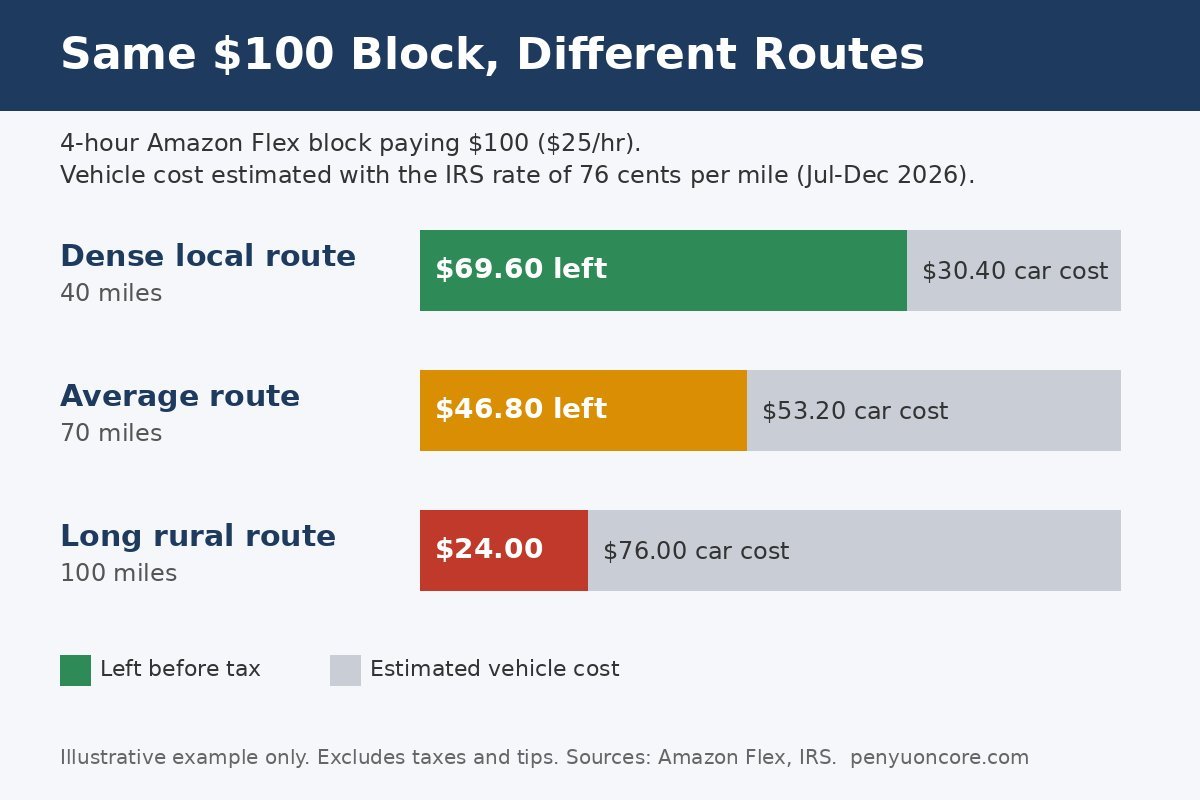
The table below is a purely illustrative example. It assumes a 4-hour block paying $100 ($25 an hour, the top of Amazon’s typical range) and uses the IRS rate as a stand-in for vehicle costs. It does not include taxes.
| Scenario | Block pay | Total miles (incl. to and from station) | Vehicle cost at 76 cents/mile | Left before tax |
|---|---|---|---|---|
| Dense local route | $100 | 40 | $30.40 | $69.60 (about $17.40/hr) |
| Average route | $100 | 70 | $53.20 | $46.80 (about $11.70/hr) |
| Long rural route | $100 | 100 | $76.00 | $24.00 (about $6.00/hr) |
The same offer can be worth very different amounts depending on the route. Before you commit to a station, track your miles on your first few blocks and work out your own numbers.
Taxes: Budget for Them From Day One
Flex drivers are independent contractors, so Amazon does not withhold tax from your pay. According to the IRS gig work guidance, you must file a tax return if you have net earnings from self-employment of $400 or more, and you may need to make quarterly estimated tax payments. Gig income is taxable even if you never get a 1099 form. We explain when platforms have to send forms in our guide to the 1099-NEC threshold for 2026.
On top of regular income tax, the self-employment tax rate is 15.3% (12.4% for Social Security and 2.9% for Medicare), calculated on Schedule SE. The good news is that business expenses such as qualifying mileage can lower your taxable profit, so keeping a mileage log really does pay off. If you also deliver for tip-heavy apps, our explainer on whether DoorDash tips are tax free covers the 2026 tip rules for delivery drivers.
Amazon Flex During the Holiday Season
Amazon’s FAQ says the winter holiday season “is typically our busiest time of year, which means expanded delivery opportunities,” and that it sometimes recruits drivers for a limited time over busy holiday seasons. More volume usually means more blocks are available, but it does not guarantee higher pay. In recent Reddit threads, drivers describe very different experiences from one market to the next, with fuller routes in some areas and few surge offers in others.
If you are weighing Flex against a seasonal job, remember the difference: Flex drivers are contractors with no holiday pay or employer-paid taxes, while seasonal employees may have other protections. Our guide to seasonal workers’ holiday pay explains the employee side.
Requirements to Get Started
Per Amazon’s requirements page and FAQ, you need to:
- Be 21 or older, with a valid U.S. driver’s license and a Social Security number
- Have a 4-door midsize sedan or larger vehicle (SUV, van, or truck with a covered bed). Smaller cars, open-bed trucks, motorcycles and scooters do not qualify.
- Carry personal auto insurance that meets your local requirements
- Have a compatible iPhone or Android phone and a checking or savings account
- Pass a background check that includes your motor vehicle record
Amazon says it provides commercial auto insurance at no cost in all states except New York, but only while you are actively delivering during a block. Openings depend on your area, and if there are none you will be added to an interest list.
Pros and Cons at a Glance
| Pros | Cons |
|---|---|
| Pay is shown before you accept a block | Blocks are not guaranteed and can be hard to get |
| Block pay is fixed even if you finish early | No reimbursement for gas, mileage, parking or tolls |
| No minimum number of deliveries required | Long routes can add a lot of wear to your car |
| Flexible scheduling and fast payment options | No tax withholding; 15.3% self-employment tax applies |
How to Decide if It Is Worth It for You
- Do a test week. Take a few blocks at different times and, where possible, different station types.
- Log every mile, including the drive to and from the station.
- Calculate your net hourly rate: (block pay + tips – vehicle costs) divided by the total hours, including travel and waiting time.
- Set aside money for taxes from every payout.
- Compare the result with other options, such as a seasonal job or a skills-based side hustle like short-form video editing.
FAQ
How much do Amazon Flex drivers make per hour?
Amazon says most drivers earn $18 to $25 an hour before expenses, and it contributes at least $15 to $19 per scheduled hour depending on location and demand. Your actual earnings depend on your area, tips and how long deliveries take.
Does Amazon Flex pay for gas?
No. Amazon says independent contractors are responsible for their own expenses, including mileage, parking and tolls. Drivers in the rewards program can get fuel discounts and cash back on fuel with the Amazon Flex Debit Card.
Is Amazon Flex worth it as a side hustle?
It can be, if you have dense local routes and a fuel-efficient car. Amazon itself positions Flex as supplemental or part-time income, not a guaranteed full-time job.
Do I have to pay taxes on Amazon Flex income?
Yes. Gig income is taxable, and if your net self-employment earnings are $400 or more you must file a return and pay self-employment tax.
Disclaimer: This article is for general information only and is not financial or tax advice. Amazon Flex terms, pay and availability vary by location and can change. Check the official Amazon Flex app and IRS guidance, or speak to a qualified tax professional about your situation.