
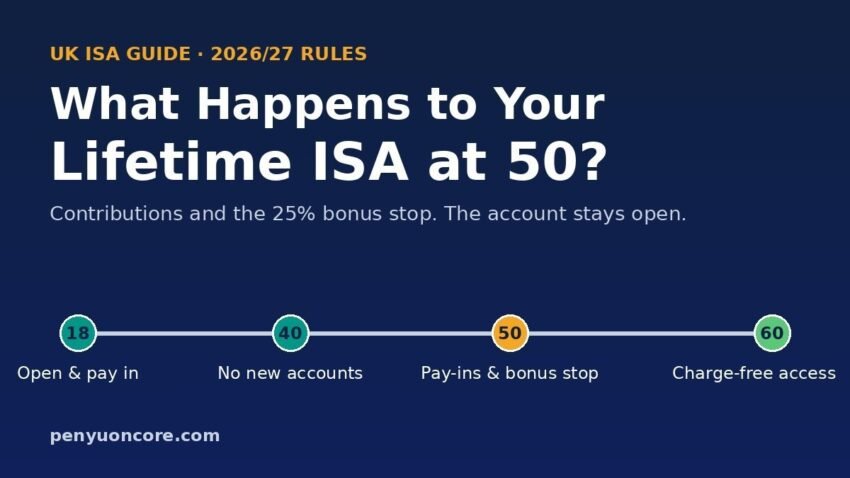
Turning 50 changes how your Lifetime ISA at 50 works, but it does not close the account. From your 50th birthday you can no longer pay in or earn the 25% government bonus, yet GOV.UK confirms your account stays open and your savings keep earning interest or investment returns. The money then becomes free of the withdrawal charge once you reach 60.
This guide covers what changes at 50, what you can still do with the account, and the decisions people usually face in the ten years between 50 and 60. It uses the current 2026/27 rules from GOV.UK and HMRC.
The short answer
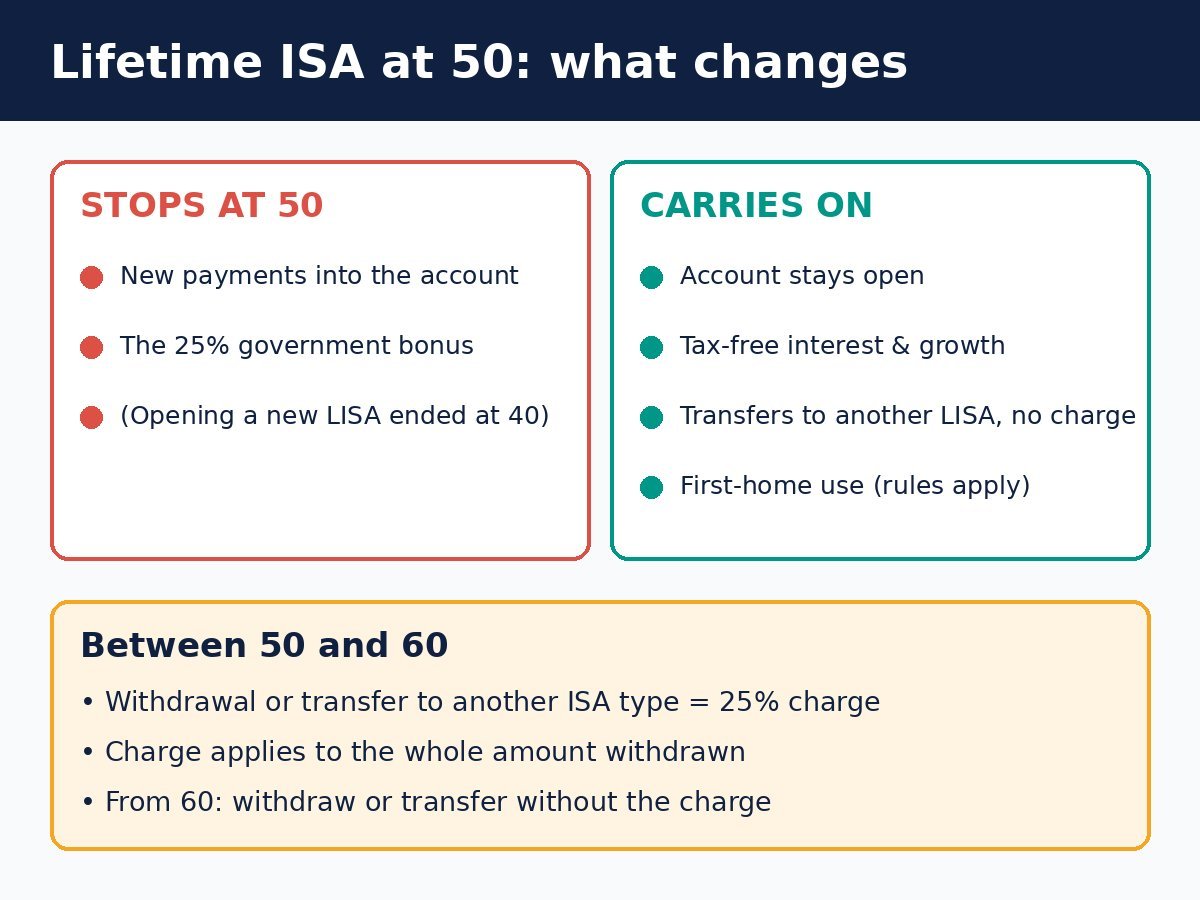
At 50, contributions stop and so does the bonus. The pot stays invested or in cash, keeps growing tax-free, and you can still move it to another Lifetime ISA provider without a charge. If you take money out (or move it into a different type of ISA) before 60 for a reason that doesn’t qualify, you pay the 25% withdrawal charge. From 60, you can withdraw without the charge.
What changes on your 50th birthday
You can no longer pay in
HMRC’s guidance to providers says investors can pay into their Lifetime ISA any time before their 50th birthday, and providers “must not accept payments from an investor once they reach 50”. Before that, the limit is £4,000 per tax year, and it counts towards your overall £20,000 ISA allowance for 2026/27.
The same guidance lists two exceptions that are still allowed after 50, because they aren’t new savings:
- a defaulted Lifetime ISA payment
- money returned to the account after a first-home purchase that fell through
The 25% bonus stops
The bonus is paid on what you put in: 25%, up to £1,000 a year if you save the full £4,000. Since you can’t put money in after 50, no new bonus is earned. Bonuses already paid into your account stay there. MoneyHelper notes the bonus is paid monthly, so the bonus on a payment made just before your 50th birthday may land in your account after it.
What does not change
- The account stays open. You don’t have to do anything at 50, and the provider won’t close the account.
- Growth stays tax-free. Interest, dividends and gains inside the account remain sheltered, as with any ISA.
- You can still switch providers. HMRC says Lifetime ISAs can be transferred between Lifetime ISA managers without a withdrawal charge, with no limit on the amount. So you can move from cash to a stocks and shares Lifetime ISA (or the other way round), or to a provider with lower fees, at any age.
Lifetime ISA rules by age
| Age | Open a new Lifetime ISA? | Pay in and get the bonus? | Withdraw for retirement without the 25% charge? |
|---|---|---|---|
| 18 to 39 | Yes | Yes, up to £4,000 a year | No |
| 40 to 49 | No (except to receive a transfer from a Lifetime ISA opened before 40) | Yes, if your first payment was made before 40 | No |
| 50 to 59 | No | No | No |
| 60 and over | No | No | Yes |
Two other routes avoid the charge at any age: being terminally ill with less than 12 months to live, and buying your first home under the qualifying conditions (more on that below).
Taking money out between 50 and 60
This is where most of the cost comes in. GOV.UK says that if you withdraw money or transfer the Lifetime ISA to another type of ISA before 60, you pay a 25% charge. The charge applies to the whole amount you withdraw, including the bonus and any growth, not just the bonus.
GOV.UK gives this example: with no growth, £800 of savings plus a £200 bonus makes a £1,000 pot. Withdrawing all of it means a £250 charge, leaving £750, which is less than the £800 you paid in. If you only need part of the money, you have to withdraw more to cover the charge. GOV.UK’s example is that to get £120 in cash, you withdraw £160 and lose £40 to the charge.
Moving it to a stocks and shares ISA counts as a withdrawal
A common idea at 50 is to “tidy up” by moving the Lifetime ISA into an ordinary stocks and shares ISA. HMRC’s transfer guidance says transfers to other types of ISA are treated as a withdrawal and are subject to the 25% charge unless the transfer happens after your 60th birthday or you have declared a terminal illness. If you want different investments before 60, move to another Lifetime ISA instead. (For how ISA subscriptions work more generally, see our guide to holding two stocks and shares ISAs in the same tax year.)
Can you still use it for a first home after 50?
GOV.UK’s conditions for using Lifetime ISA savings on a first home don’t include an upper age limit. You must be a first-time buyer, buy at least 12 months after your first payment, use a conveyancer or solicitor (the provider pays them directly) and buy with a mortgage. You also can’t use it if the mortgage is a private one from a relative, spouse or civil partner, as GOV.UK lists.
The price cap is £450,000. HMRC’s updated withdrawal-charge guidance says there’s no charge for qualifying purchases at or below that price. For withdrawals made on or after 29 October 2026 for a property costing more than £450,000, the charge is 20% rather than 25%.
What happens at 60
HMRC lists reaching 60 as a charge-free withdrawal event, and adds that any later growth or interest in the Lifetime ISA “will continue to be tax free”. You can withdraw some or all of it. From 60 you can also transfer it to another type of ISA without the charge. HMRC also says providers should normally process withdrawals within 30 days of your instruction.
If you die before 60
GOV.UK says that if you die, your Lifetime ISA ends on the date of your death and there’s no charge to withdraw the funds or assets. Terminal illness (less than 12 months to live) also allows charge-free withdrawals. For related edge cases, see our guides on the extra ISA allowance after a spouse’s death and what happens to Premium Bonds after death.
Does the new First Time Buyer ISA affect you?
The government has confirmed that a First Time Buyer ISA will be introduced from April 2029 in place of the Lifetime ISA. Lifetime ISAs opened before then can continue under their existing terms. You won’t be able to transfer a Lifetime ISA into the new product, but both can be used towards the same purchase. If you’re already 50, you can’t pay in anyway, so the main point is that your existing account and its rules carry on.
Practical checklist at 50
- Make any final contribution before your 50th birthday if you want the last bonus. Payments from your birthday onwards can’t be accepted.
- Check that your investments or cash rate still suit a horizon of about ten years to your 60th birthday.
- Compare provider fees. A Lifetime ISA-to-Lifetime ISA transfer avoids the charge.
- Don’t move the money to a cash or stocks and shares ISA before 60 unless you accept the 25% charge.
- Note your 60th birthday as the date the charge-free access starts.
If you’re helping a younger family member think about Lifetime ISAs, our guide to moving a Junior ISA into a Lifetime ISA covers the other end of the age range.
FAQ
Does my Lifetime ISA close when I turn 50?
No. GOV.UK says the account stays open and keeps earning interest or investment returns. You just can’t pay in or receive new bonuses.
Can I pay in on my 50th birthday?
No. HMRC says payments can be made any time before your 50th birthday and must not be accepted once you reach 50.
Can I transfer my Lifetime ISA to another provider after 50?
Yes. Transfers between Lifetime ISA managers carry no withdrawal charge. Transfers to a different type of ISA before 60 are charged at 25%.
Can I open a Lifetime ISA at 50?
No. You must be 18 to 39 to open one and make your first payment, according to GOV.UK and HMRC guidance.
Is the 25% charge only on the bonus?
No. It applies to the full amount withdrawn, including your own contributions, the bonus and any growth. That’s why an early withdrawal can leave you with less than you paid in.
Disclaimer: This article is general information based on GOV.UK and HMRC guidance as of November 2026. It is not financial or tax advice. Rules can change, and your provider’s terms also apply. Consider speaking to a regulated financial adviser about your situation.