
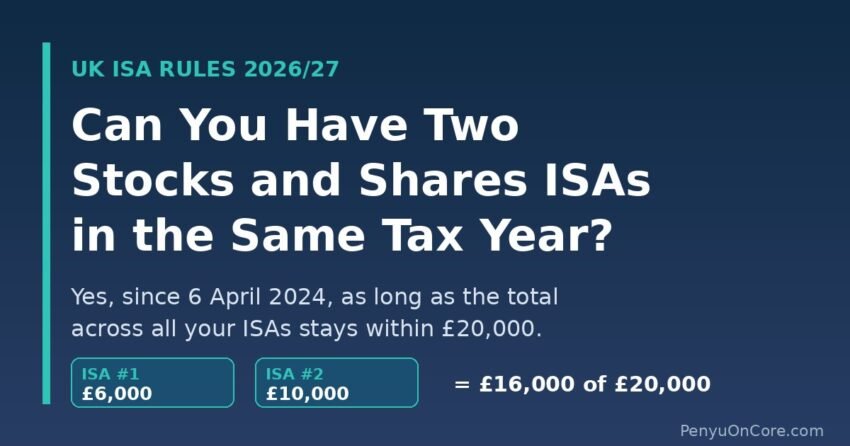
Short answer: Yes. Since 6 April 2024, UK rules let you open and pay into two (or more) Stocks and Shares ISAs in the same tax year, with the same provider or with different ones. The catch is that everything you pay into all your ISAs combined must stay within the £20,000 annual allowance, and keeping track of that across providers is your job, not theirs.
This guide covers what changed, the limits that still apply, what happens if you go over, and the April 2027 cash ISA changes. It’s written for UK residents.
What changed on 6 April 2024
Before April 2024, you could pay into only one ISA of each type per tax year. If you’d already put money into a Stocks and Shares ISA with one platform, you had to wait until the next tax year (starting 6 April) to pay into a second one. The Individual Savings Account (Amendment) Regulations 2024 scrapped that rule. According to the explanatory memorandum, the changes:
- allow you to subscribe to more than one ISA of the same type in a tax year
- remove the restriction on partial transfers of money paid in during the current tax year
- remove the need to fill in a fresh application when an existing ISA hasn’t had any money paid in for over a year
- set 18 as the minimum age for opening adult ISAs, with protection for people who already had a cash ISA as 16- or 17-year-olds
HMRC’s guidance for ISA providers confirms it: “From 6 April 2024 investors can subscribe in each tax year to multiple ISAs of the same type within the annual subscription limits.”
The limits that still apply
The flexibility has limits. GOV.UK’s page on how ISAs work and HMRC’s manager guidance set out these rules:
| Rule | 2026/27 position |
|---|---|
| Overall ISA allowance | £20,000 per tax year across all your ISAs combined |
| Stocks and Shares ISAs | You can pay into as many as you like, as long as your total stays within £20,000 |
| Cash and Innovative Finance ISAs | Multiple accounts allowed, same overall limit |
| Lifetime ISA | Only one per tax year, max £4,000 (counts toward the £20,000) |
| Junior ISA | Only one per child per tax year |
| Age 17 and under | Can’t pay into more than one cash ISA in a tax year |
| Unused allowance | Can’t be carried forward to next year |
To open an adult ISA you also need to be 18 or over and either UK resident or a Crown servant (or their spouse or civil partner) working abroad. That’s set out in the GOV.UK ISA overview. You can’t hold an ISA jointly with someone else.
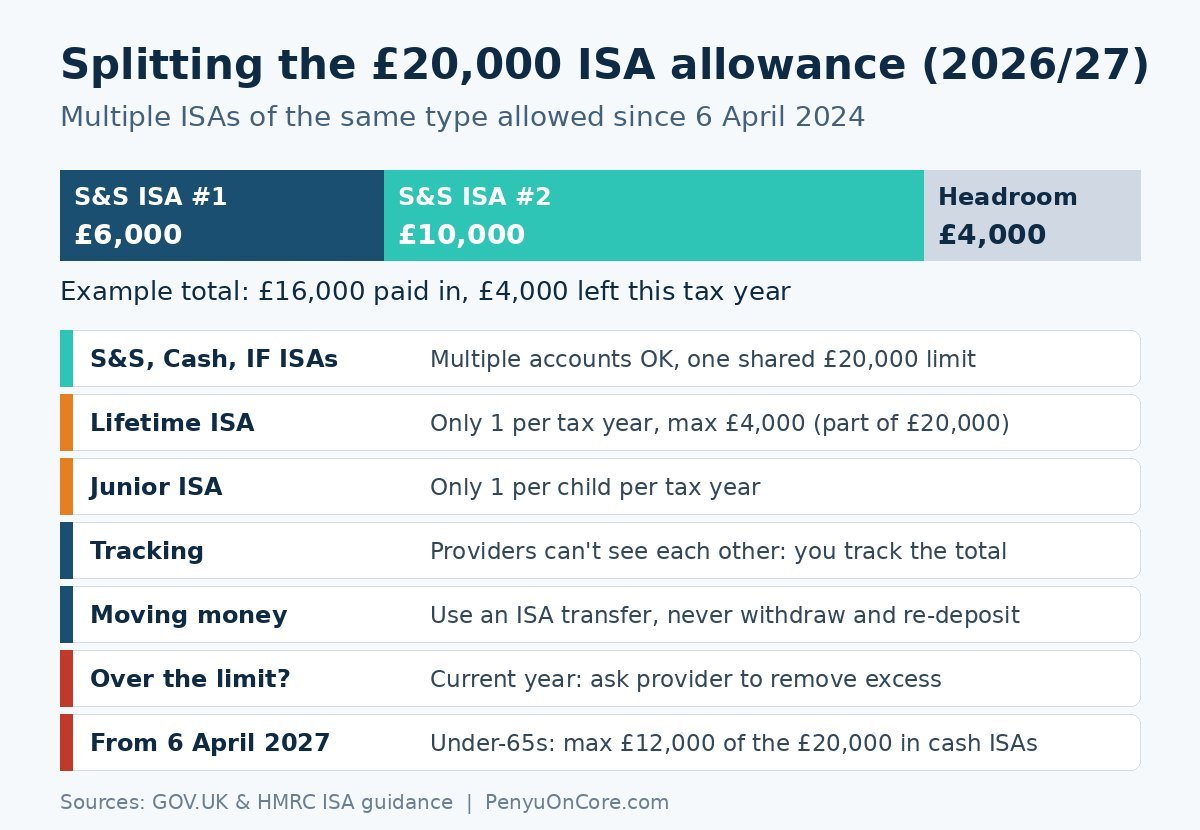
A worked example
Say you already have a Stocks and Shares ISA on Platform A with a monthly direct debit of £500. In September you want to try a cheaper index-fund platform, Platform B, without moving your old account.
- April to March on Platform A: 12 × £500 = £6,000
- Lump sum into Platform B in September: £10,000
- Total paid in: £16,000, leaving £4,000 of headroom for this tax year
That’s within the rules. GOV.UK gives a similar example for cash ISAs: £10,000 in one cash ISA, £3,000 in another and £7,000 in a Stocks and Shares ISA in a single year. Whether you should pay in monthly or as a lump sum is a different question. We look at it in dollar-cost averaging vs lump sum.
Neither provider is tracking your total
This is where people get caught out. HMRC says providers “do not need to establish the amount subscribed to ISAs held with other managers”, and that investors who use different providers “are responsible for ensuring that they do not exceed the overall subscription limit.” Platform B has no idea what you paid into Platform A. A simple spreadsheet or note listing every ISA payment by date for the tax year (6 April to 5 April) prevents most mistakes.
Withdrawals don’t give you allowance back unless the ISA is flexible
Under the HMRC guidance, for non-flexible ISAs the amount you’ve subscribed isn’t reduced when you take money out. With a flexible ISA, you can take cash out and put it back in the same tax year without using up more allowance. But replacement money has to go back into the same account it came from. You can’t take it out of Platform A and pay it into Platform B as “replacement” money.
Moving money between your Stocks and Shares ISAs
If you want to move money from one ISA to another, use a transfer. Don’t withdraw it and pay it back in. GOV.UK warns that if you withdraw the money instead of using an ISA transfer form, “you will not be able to reinvest that part of your tax-free allowance again.” Some other transfer points:
- You can transfer all or part of an ISA, including money paid in this tax year. Partial transfers of current-year money became possible in April 2024, but providers don’t have to offer them, so check both providers’ terms.
- Transfers other than cash-to-cash should take no more than 30 calendar days. Cash ISA to cash ISA transfers should take no more than 15 working days.
- A transfer doesn’t use up any new allowance. HMRC treats current-year subscriptions that you transfer as if they’d been made to the receiving ISA.
- If a transfer is late and your provider’s response doesn’t fix it, you can complain to the Financial Ombudsman Service.
Wondering what protects your investments if a platform fails? See what happens if your broker goes bankrupt.
What if you accidentally go over £20,000?
What happens depends on when you find out. HMRC’s guidance on closing, voiding or repairing an ISA says:
- Current tax year: contact your provider. They can remove the excess and any related gains, and you tell them which payments to remove.
- Previous tax year: don’t try to fix it yourself. HMRC may write to you. If a repair is needed, it sends the provider a notice, and the provider removes the excess investments and the income from them within 30 days of that notice.
- Tax: tax relief on the excess is lost up to the date of repair. Income removed from the ISA counts toward your Personal Savings Allowance and may be taxable. The rest of your ISA stays tax-free.
If you also paid into a Lifetime ISA, HMRC says the excess is taken from your other (non-Lifetime) ISAs in date order.
What changes from 6 April 2027
Splitting your money across ISAs gets more complicated from April 2027. The government has confirmed a cash ISA limit reduction: the overall allowance stays at £20,000, but if you’re under 65, only £12,000 of it can go into cash ISAs. HMRC’s June 2026 and September 2026 newsletters list rules to stop people getting around the lower limit:
- a flat-rate charge (22%, the savings basic rate) on interest paid on cash held inside Stocks and Shares and Innovative Finance ISAs
- for under-65s, no transfers from a Stocks and Shares or Innovative Finance ISA into a cash ISA (cash-to-stocks transfers stay allowed)
- a Stocks and Shares ISA that holds nothing but money market funds won’t qualify (this doesn’t apply to Junior ISAs)
The regulations were laid before Parliament on 14 September 2026 and are due to come into force on 6 April 2027. In practice, holding two Stocks and Shares ISAs stays fine. But leaving large amounts of uninvested cash in either one could start to cost you from 2027/28. HMRC says it will publish updated guidance before then, so check again in early 2027.
Is it worth having two Stocks and Shares ISAs?
The rules allow it, but whether it suits you depends on your situation. People do it to try a new platform without transferring an old account, or to keep separate goals apart. The downsides are practical: two sets of platform fees (fixed fees especially), two logins, and more chance of losing track of your total. If cost is the main reason, compare total annual charges at your portfolio size before opening a second account.
FAQ
Can I open two Stocks and Shares ISAs with the same provider?
The law allows it, but each provider decides what it offers. Some give you one ISA account with several portfolios inside it instead. Either way, all your payments count toward the same £20,000.
Do I need to tell HMRC I have more than one ISA?
No. GOV.UK says you don’t need to declare ISA interest, income or gains on a tax return. You just need to make sure your total doesn’t go over the limit.
Can I pay into two Lifetime ISAs this year?
No. You can pay into only one Lifetime ISA per tax year, up to £4,000.
Can I inherit extra allowance on top of the £20,000?
Yes, a surviving spouse or civil partner can get an additional permitted subscription. See inheriting a spouse’s ISA allowance.
Disclaimer: This article is general information about UK ISA rules as published by GOV.UK and HMRC as of November 2026, not financial or tax advice. Rules can change, and investments can fall as well as rise. Check your provider’s terms and consider speaking to a regulated adviser about your own situation.