
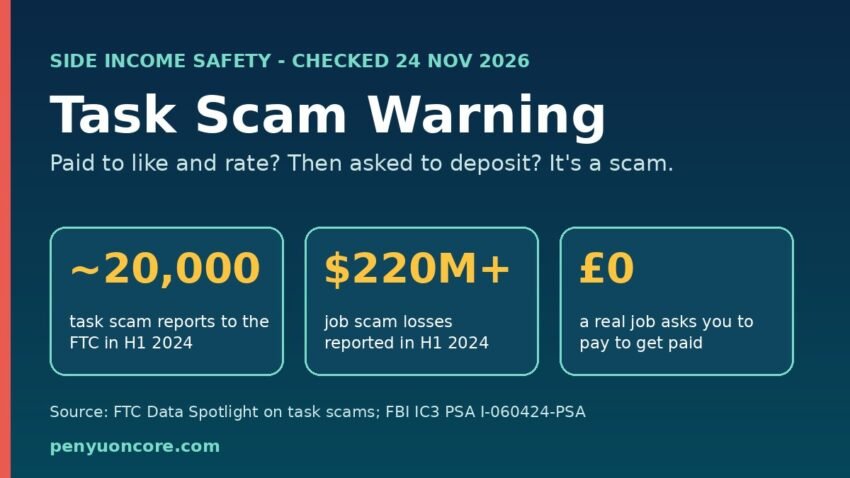
A task scam is a fake online job that pays you to “like” videos, rate products or “boost” apps, then asks you to deposit your own money to unlock more tasks or withdraw what you’ve earned. The earnings on screen aren’t real, and the deposits go straight to the scammers. With Black Friday on 27 November and Cyber Monday on 30 November, lots of people in the US and UK are looking for quick holiday side income, which is exactly who these offers target.
Short answer: If a “job” pays you for clicks, likes or ratings and then asks you to pay, deposit or “recharge” (often in crypto) before you can be paid, it’s a task scam. Stop paying, don’t send any “fee” to release your balance, and report it straight away to your bank and to the FTC (US) or Report Fraud (UK).
The FTC, FBI, Report Fraud, Payment Systems Regulator and Which? pages linked below were checked on 24 November 2026.
What is a task scam?
The US Federal Trade Commission calls them “gamified job scams” in its Data Spotlight on task scams. You’re asked to do simple, repetitive tasks such as liking videos or rating product images inside an app or website that “creates the illusion you’re racking up commissions with every click.” Tasks often come in sets of 40, with the promise of “leveling up” when you finish a set.
The scale is large. The FTC says about 20,000 people reported task scams in the first half of 2024, up from about 5,000 in all of 2023, and that reported losses to job scams overall topped $220 million in those six months. The FBI issued its own warning, PSA I-060424-PSA, about fake work-from-home jobs that involve “rating restaurants or ‘optimizing’ a service by repeatedly clicking a button.” In the UK, Which? describes task scams as one of the most common forms of job scam reported to it.
The warnings haven’t stopped. On 19 November 2026, FOX23 ran a job scam warning pointing to the FTC’s alerts about “product boosting” apps that show fake earnings before asking workers to deposit their own money.
How a task scam works, step by step
The details vary, but the FTC, FBI and Which? all describe the same basic pattern:
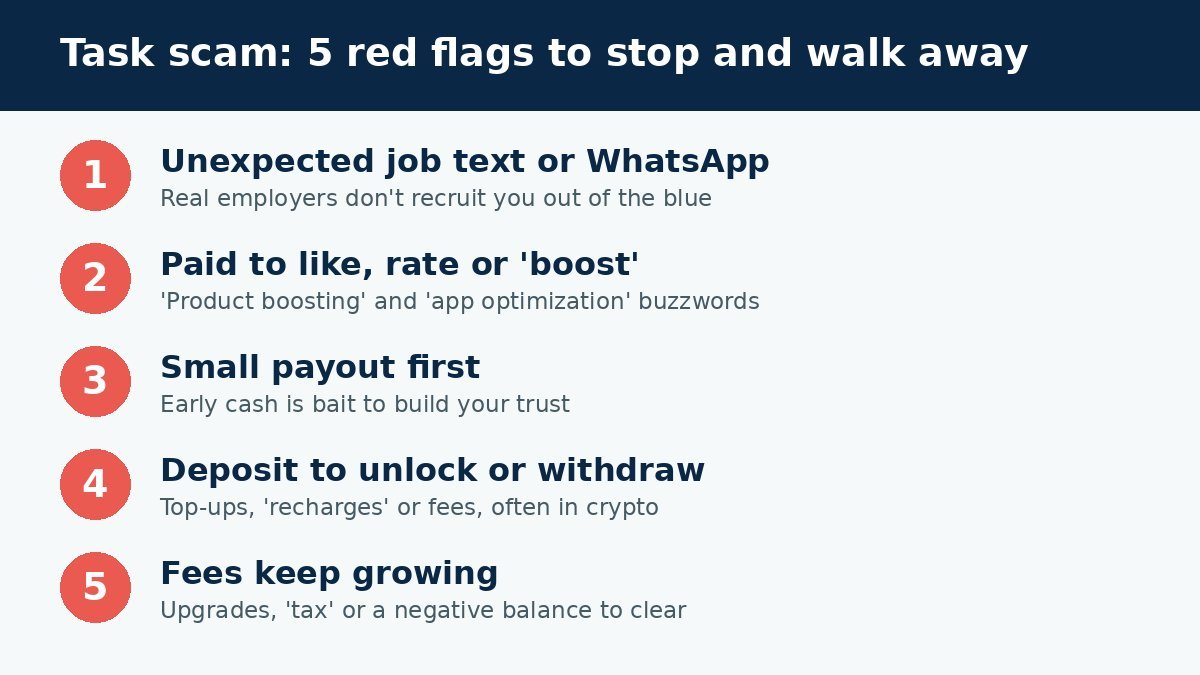
- An out-of-the-blue message. It usually starts with an unexpected text, WhatsApp or Telegram message offering flexible online work “but no specifics”, according to the FTC. Which? says scammers also impersonate recruitment agencies and job sites.
- Buzzwords and a slick dashboard. You’re told you’ll be doing “product boosting”, “app optimization” or reviews. A platform shows your commission balance growing as you click.
- A small real payout. The FTC says many people get small payouts at first, which builds trust. Which? describes this early payout as the bait.
- The deposit. You’re told you must “charge up” or top up your account to finish a set, clear a negative balance, unlock a “double task” or withdraw. The FBI says the pay structure is deliberately confusing and requires cryptocurrency payments that “go directly to the scammer.”
- More fees. Which? reports victims being asked to pay again to “upgrade” accounts, release commission or cover “tax liabilities”. If you hesitate, the FTC says you may be added to a group chat where (fake) experienced workers share success stories.
The FTC’s conclusion is blunt: “no matter what the system says you’ve earned, you didn’t. That money isn’t real. And if you deposit money, you won’t get it back.”
Task scam red flags vs a real side gig
Real gig and freelance platforms can delay your money too. Fiverr has a clearance period, and PayPal can hold a new seller’s funds. But a genuine platform takes its fees out of what you earn. It never asks you to send in fresh money before you can be paid.
| Sign | Task scam | Legitimate side gig |
|---|---|---|
| How you’re contacted | Unsolicited text, WhatsApp, Telegram or social media message | You apply or sign up yourself on a known platform or company site |
| The work | Liking, rating, “boosting” or “optimizing” in sets of tasks | A defined service, product or shift with a clear description |
| Paying to work | Deposits, top-ups or “fees” to unlock tasks or withdraw | Fees, if any, are deducted from your earnings |
| How money moves | Cryptocurrency or transfers to personal accounts | Payouts to your own bank, PayPal or platform wallet |
| Interview and checks | None, or chat only; the FBI notes no references are needed | Proper sign-up, identity checks through the official app or site |
| Pay promised | High pay for very little effort | Pay that matches the time and skill involved |
Report Fraud’s work-from-home scam guidance adds two more UK warning signs: being asked to call a mobile number or reply to a free webmail address, and being given a reason to pay up front. It also says the majority of legitimate employers “shouldn’t require you to pay anything to start working for them.”
Why the holiday season makes task scams harder to spot
November and December are when many people look for seasonal work or a way to cover holiday costs, so a message promising flexible online income can feel well timed rather than suspicious. Scammers lean on the same things that make genuine side gigs appealing: work from your phone, choose your own hours, get paid fast. The FTC also warns that being paid to rate or “like” things online is itself a red flag: “That’s illegal and no honest company will do it.”
A simple rule covers almost every version: never pay anyone to get paid. The FTC calls a request to pay money to release your earnings “a sure sign of a scam.”
Already paid a task scam? What to do now
- Stop sending money. Each new “fee” leads to another. A deposit won’t unlock the balance on screen.
- Contact the firm you paid through. Call your bank, card issuer, payment app or crypto exchange using the number on its official website or your card, report the fraud and ask whether the payment can be stopped or reversed.
- Keep evidence. Save chats, usernames, website addresses, screenshots of the “dashboard” and every transaction record. Report Fraud advises keeping relevant messages and documents as evidence.
- Stop moving money for anyone. Which? warns that scammers can manipulate job seekers into forwarding money for them, which makes you a money mule, a criminal offence in the UK.
- Report it, as set out below.
If you’re in the US
Report to the FTC at ReportFraud.ftc.gov and to the FBI at ic3.gov. The FBI asks victims to include any transaction information linked to the scam. Report the account to the messaging app or job site where it started too.
If you’re in the UK
Tell your bank first, then report to Report Fraud, which replaced Action Fraud on 4 December 2025 for England, Wales and Northern Ireland (online or on 0300 123 2040). In Scotland, call Police Scotland on 101. You can forward scam texts free to 7726, the reporting number listed by the NCSC.
If you sent the money by UK bank transfer, the Payment Systems Regulator’s APP fraud rules may help. They cover payments made on or after 7 October 2024 by Faster Payments or CHAPS, with claims up to £85,000. Firms may apply an excess of up to £100, and you should claim within 13 months. Card payments have their own protections. Crypto sent from a wallet isn’t a UK bank transfer, so these rules may not cover that part of your loss.
Watch out for recovery scams
After a loss, you may be contacted by “recovery agents” offering to get your crypto back for a fee. The FBI’s PSA says plainly: “Do not pay for services that claim to be able to recover any lost cryptocurrency funds.” This kind of follow-up targeting is common in crypto fraud. See also our guide to the 0 USDT transfer scam.
Safer ways to earn extra money online
Real online income takes real work and usually comes through a platform you’ve chosen and can check. Selling a skill, like short-form video editing, or freelancing on an established marketplace takes longer to pay off than a “boosting” app promises. But the money you see is money you can actually withdraw. Before you sign up for anything, look up the company yourself rather than using the link you were sent, and search its name together with “scam”.
FAQ
Are task scams illegal?
Yes. They’re fraud. The FTC also says paying people to rate or “like” things online is illegal, so the “job” itself isn’t legitimate either.
I got paid a small amount at first. Does that mean it’s real?
No. The FTC and Which? both say small early payouts are used to build trust before the deposit requests begin.
Can I get my money back from a task scam?
Sometimes, but it isn’t guaranteed. Act quickly through your bank, card issuer or payment provider. UK bank transfers may qualify for APP fraud reimbursement. Crypto payments are much harder to recover.
What if they ask me to pay tax before withdrawing?
That’s another fee designed to take more money. Which? lists made-up “tax liabilities” as one of the excuses task scammers use.
Note: This article is general information, not financial or legal advice. Rules on fraud reimbursement differ by country and payment method and can change, so check with your bank and the official sources linked above.