
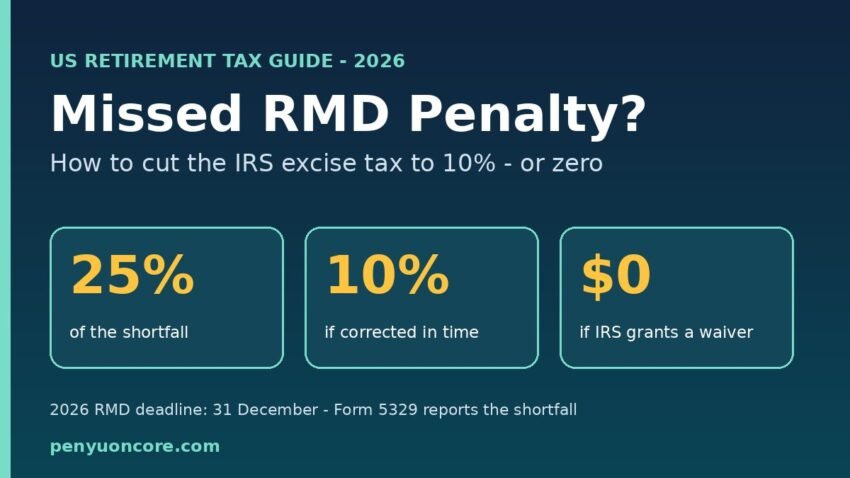
The missed RMD penalty is a 25% IRS excise tax on whatever part of a required minimum distribution you didn’t withdraw by the deadline. It drops to 10% if you fix the shortfall within the IRS “correction window”, and the IRS can waive it entirely for a reasonable error. With the 31 December 2026 deadline five weeks away and the holidays in between, now is the time to check every account that owes a withdrawal this year.
Short answer: If you miss an RMD, take the missing amount out as soon as you can, then report it on IRS Form 5329. Either pay the reduced 10% tax, or attach a letter asking the IRS to waive it for reasonable error. If you missed a 2024 RMD and haven’t fixed it yet, the correction window generally closes on 31 December 2026.
This guide is for US retirement savers and heirs with traditional IRAs, 401(k)s and similar plans. It’s based on IRS pages and the 2025 Form 5329 instructions, checked on 24 November 2026.
What is the missed RMD penalty in 2026?
The IRS’s RMD FAQs say the amount you don’t withdraw “may be subject to an excise tax of 25%, 10% if the RMD is timely corrected within two years.” According to Moneywise, the penalty was 50% before the SECURE 2.0 Act of 2022 cut it.
The tax applies only to the shortfall, which the Form 5329 instructions call the “excess accumulation”. That’s the difference between what you had to withdraw and what you actually took. It is on top of the regular income tax you’ll owe when the money finally comes out.
Here’s an example using a figure from a CNBC report published on 21 November 2026. Vanguard told CNBC the average missed RMD among its RMD-age investors was $10,500 in 2025. At 25%, that’s an excise tax of up to $2,625. Corrected in time, the 10% rate would make it $1,050. CNBC also reported that about 7% of RMD-age Vanguard investors missed their withdrawal in 2025, up from 6.7% in 2024. So it’s a common mistake.
Who has to take an RMD
- IRA owners aged 73 or over: this covers traditional, SEP and SIMPLE IRAs, even if you’re still working (IRS RMD overview).
- Workplace plan members: 401(k), 403(b) and 457(b) plans. If your plan allows it, you can delay RMDs until you retire, unless you own 5% or more of the employer.
- Some heirs: since 2025, many non-spouse beneficiaries on the 10-year rule must also take annual RMDs (more on this below).
- Not Roth IRA owners: Roth IRAs and designated Roth accounts have no RMDs during the owner’s lifetime. Their beneficiaries do.
For each year after your first, the deadline is 31 December. Your first RMD can wait until 1 April of the year after you turn 73. If you wait, though, you’ll take two RMDs in that second year. Some people also mix up RMDs with the decision between account types. Our Roth vs traditional IRA guide explains why Roth money isn’t subject to lifetime RMDs.
The correction window: your deadline to cut the penalty to 10%
To qualify for the 10% rate, the Form 5329 instructions say that during the correction window you must (1) take the missed amount from the plan that owed it, and (2) file a return that reports the tax. The window ends on the earliest of:
- the date the IRS mails you a deficiency notice for this tax;
- the date the tax is assessed; or
- the last day of the second tax year that begins after the year the tax was imposed.
For most people that third date applies, so the window runs about two years. Fidelity gives a worked example: you have “until December 31, 2026, to make up a distribution shortfall from 2024.”
| Year the RMD was missed | Correction window usually ends* | Rate if fixed in time |
|---|---|---|
| 2024 | 31 December 2026 | 10% (or waived) |
| 2025 | 31 December 2027 | 10% (or waived) |
| 2026 | 31 December 2028 | 10% (or waived) |
*Ends sooner if the IRS mails a deficiency notice or assesses the tax first. If you delayed your first RMD to 1 April, the IRS says the tax belongs to the tax year that contains that deadline, so count from that year.
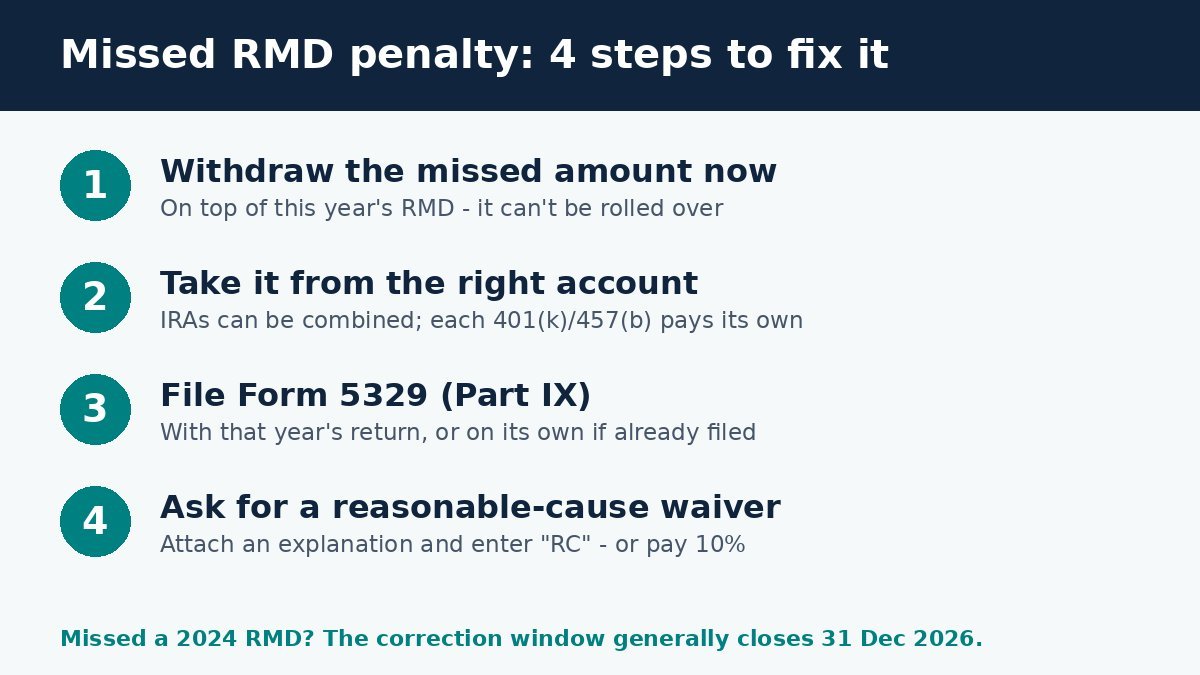
How to fix a missed RMD, step by step
1. Take the missed amount out now
Work out what you should have taken. The IRS FAQs explain that an RMD is generally the prior 31 December balance divided by the life-expectancy factor in Publication 590-B. Your custodian may have the old figure on a past statement. Withdraw the missed amount on top of this year’s RMD. Under the IRS FAQs, RMD amounts can’t be rolled over into another tax-deferred account, and extra withdrawn in one year can’t be applied to a future year.
2. Take it from the right account
You can add up the RMDs for all your IRAs and take the total from one or more of them. For 401(k) and 457(b) plans, you must take each plan’s RMD from that plan. Multiple 403(b)s can be totalled together. Inherited IRAs can only be combined with other IRAs inherited from the same person. Our 401(k) vs IRA comparison covers how the two account types differ.
3. File Form 5329
Report the shortfall in Part IX of Form 5329, filed with your Form 1040 for the year the RMD was due. If you’ve already filed that return and have nothing else to change, the instructions say to file that year’s version of Form 5329 on its own. If you have other changes, file it with Form 1040-X. A Form 5329 filed by itself can’t be e-filed.
4. Ask for a waiver if the mistake was reasonable
The IRS can waive “part or all” of the tax if the shortfall “was due to reasonable error” and you’re “taking reasonable steps to remedy” it. To ask, attach a statement of explanation and write “RC” with the amount you want waived next to line 54a/54b, following the instructions. You still pay any tax shown on line 55. The IRS reviews the request and contacts you if it isn’t granted. In the CNBC piece, Baird’s Tim Steffen said, “If you don’t ask, you’re not going to get it.”
Inherited IRAs: the 10-year rule trap
From 2021 to 2024, the IRS waived the penalty for many heirs who skipped annual withdrawals (Notice 2024-35). The final regulations apply from 2025. Under them, a non-spouse designated beneficiary on the 10-year rule generally must take annual RMDs if the original owner died on or after their required beginning date. They must also empty the account by the end of year 10.
That relief didn’t extend the 10-year deadline, and it didn’t require heirs to make up the waived years. But it means 2026 is the second year in a row that a skipped inherited-IRA RMD can bring the 25% tax.
How to avoid the penalty before 31 December 2026
- Request withdrawals early. Fidelity recommends getting your request in before the holidays to avoid processing delays.
- List every account. CNBC’s sources say overlooked accounts and calculation errors are among the most common mistakes.
- Consider a QCD if you give to charity. A qualified charitable distribution counts toward your RMD (Form 5329 instructions). CNBC reports the 2026 limit as $111,000.
- Automate next year. Fidelity suggests working out your RMD in January and setting up regular automatic withdrawals.
If markets have been rough, our piece on protecting retirement savings in a sell-off looks at the bigger picture. A falling market doesn’t cancel this year’s RMD, which is based on last year’s 31 December balance.
FAQ
Is the missed RMD penalty still 50%?
No. Since the SECURE 2.0 Act it’s 25%, or 10% if you correct the shortfall in time. The IRS can also waive it for reasonable error.
Can I fix a missed RMD without paying anything?
Possibly. Take the missed amount, file Form 5329 with a reasonable-cause statement and ask for a full waiver. If the IRS refuses, it will tell you what you owe.
Does my IRA custodian get the penalty if they calculated it wrong?
No. The IRS says the account owner “is ultimately responsible for taking the correct RMD amount,” even if the custodian calculates it.
Do UK pensions have RMDs?
No. RMDs are a US tax rule for US retirement accounts. UK pensions follow different HMRC rules.
Disclaimer: This article is general information, not financial or tax advice. RMD rules depend on your age, account type and beneficiary status. Check the IRS sources linked above or talk to a qualified tax professional before acting.