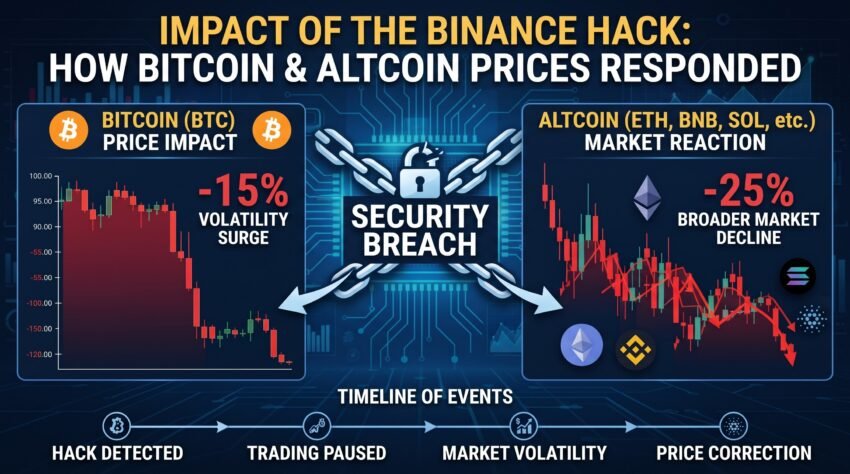
The October 2026 Binance security breach triggered a sharp reaction across the cryptocurrency market. Bitcoin fell below $77,000, several major altcoins suffered significant losses, and leveraged traders faced billions of dollars in liquidations. However, the incident also raised an important question: was the market reacting to a failure of blockchain technology or a loss of confidence in a centralized cryptocurrency exchange?
How the Binance Hack Affected Bitcoin and Altcoin Prices in 2026
The Binance hack in October 2026 sent shockwaves through the cryptocurrency market, putting renewed pressure on Bitcoin (BTC), Ethereum (ETH), BNB, Solana (SOL), and other digital assets.
On October 30, Bitcoin dropped to approximately $76,000, reaching its lowest level in around six weeks. The decline occurred as investors reacted to reports of a major security breach at Binance, one of the world’s largest cryptocurrency exchanges.
According to reporting published by Reuters and other financial news organizations, the incident involved approximately $6.3 billion in affected cryptocurrency assets. The scale of the reported breach intensified concerns about exchange security, liquidity, and the potential consequences for the broader digital asset industry.
Bitcoin was not the only cryptocurrency affected. Ethereum also declined, while BNB and several other altcoins experienced substantial selling pressure. Crypto-related stocks, including companies connected to cryptocurrency trading and Bitcoin investments, also fell.
However, the price movements cannot automatically be attributed entirely to the hack. The cryptocurrency market was already facing pressure from broader financial market weakness, monetary policy uncertainty, and leveraged trading positions.
The key takeaway: The Binance security breach acted as a catalyst for selling in an already vulnerable market, amplifying existing concerns and forcing traders to reassess their exposure to cryptocurrency risk.
Bitcoin Price After the Binance Hack: Why BTC Fell Below $77,000
Bitcoin’s price reaction demonstrated how a security incident involving a centralized exchange can influence the entire cryptocurrency market, even when the Bitcoin blockchain itself has not been compromised.
Bitcoin fell to approximately $76,000 on October 30, 2026, according to market reports published during the sell-off. This decline followed the disclosure of the Binance security incident and came amid broader weakness in risk-sensitive assets.
Several factors help explain why Bitcoin experienced selling pressure.
1. Investor Confidence Weakened
Binance plays a significant role in global cryptocurrency trading. When a major exchange reports a security breach involving billions of dollars in assets, investors may question whether their funds are adequately protected when held on centralized platforms.
Some traders respond by reducing their exposure to cryptocurrency altogether. Others move funds into stablecoins, withdraw assets to self-custody wallets, or temporarily avoid opening new positions.
This behavior can increase selling pressure, especially when market participants are already uncertain about the direction of Bitcoin prices.
2. Leveraged Bitcoin Positions Were Liquidated
Leverage was another important factor behind the Bitcoin price decline.
Cryptocurrency traders frequently use borrowed capital to increase their exposure to price movements. While leverage can magnify profits, it also increases the risk of forced liquidation when the market moves against a position.
CoinDesk reported that cryptocurrency futures liquidations surged to approximately $1.57 billion during the market turmoil associated with the Binance hack. Falling prices forced many leveraged traders to close their positions, adding further selling pressure.
This creates a feedback loop:
- Negative news triggers initial selling.
- Bitcoin prices fall and approach leveraged traders’ liquidation levels.
- Exchanges automatically close undercollateralized positions.
- Forced selling adds pressure to market prices.
- Additional liquidations can accelerate the decline.
This mechanism helps explain why cryptocurrency prices can fall much faster than the initial news might suggest.
3. Broader Financial Market Weakness Added Pressure
The Binance hack did not occur in isolation. Financial market conditions were already contributing to uncertainty, including weakness in technology stocks and concerns about interest rates.
When investors become more cautious about risk, speculative assets such as cryptocurrencies can face additional selling pressure.
Original analysis: The distinction between a catalyst and an underlying weakness is important. A security breach can trigger a sell-off, but the size and duration of the decline depend heavily on market positioning, liquidity, and investor confidence before the incident.
If Bitcoin had entered the event with lower leverage and stronger spot demand, the same news might have produced a smaller price reaction. Conversely, excessive leverage can turn a temporary confidence shock into a broader market correction.
How the Binance Hack Affected Altcoin Prices
Altcoins often experience greater volatility than Bitcoin during periods of market stress. The Binance hack demonstrated how concerns about exchange security can spread beyond BTC and affect assets with different use cases, liquidity levels, and risk profiles.
Several major cryptocurrencies experienced price declines during the October 30 sell-off.
Ethereum (ETH)
Ethereum declined alongside Bitcoin as traders reduced risk exposure. Market reports placed ETH near $2,170 at its intraday low during the sell-off, although prices fluctuated as trading conditions changed.
Ethereum’s role in decentralized finance also made developments involving the movement of stolen assets relevant to market participants. Investigators and blockchain analytics firms reported that some funds connected to the incident were moved or converted through different crypto networks and protocols.
However, a security breach at a centralized exchange should not automatically be interpreted as evidence that the Ethereum blockchain itself has failed.
BNB (BNB)
BNB faced particular scrutiny because of its connection to the Binance ecosystem.
When an exchange experiences a major security incident, investors may reassess the risks associated with its affiliated digital assets. These concerns can affect market sentiment toward BNB even when the token’s underlying blockchain continues to operate.
BNB experienced significant selling pressure during the initial market reaction. Nevertheless, its subsequent performance depends on factors such as Binance’s recovery efforts, user confidence, token demand, liquidity, and overall market conditions.
Solana (SOL)
Solana also declined during the market sell-off. Like other major altcoins, SOL can be affected by broad reductions in cryptocurrency exposure, leveraged liquidations, and changes in risk appetite.
Importantly, a decline in SOL following the Binance hack does not establish that Solana’s network was compromised. Market-wide selling and network-specific security problems are different events and should be analyzed separately.
XRP and Other Altcoins
XRP and numerous other digital assets also faced selling pressure during the incident. Smaller altcoins can be especially vulnerable because they often have thinner order books and less liquidity than Bitcoin.
When large traders attempt to exit positions quickly, limited liquidity can cause prices to move sharply. Some tokens may experience temporary price dislocations even when there is no new negative information about their individual projects.
For investors researching altcoin news and token analysis, this distinction is essential: a market-wide decline does not necessarily mean that every affected project has experienced a deterioration in its fundamentals.
Why the Binance Hack Triggered Billions of Dollars in Crypto Liquidations
One of the most important consequences of the Binance hack was the increase in cryptocurrency derivatives liquidations.
According to CoinDesk’s October 30, 2026, market report, total cryptocurrency futures liquidations reached approximately $1.57 billion during the turmoil.
Liquidations are especially important in crypto markets because derivatives trading can create exposure far greater than the amount of capital traders initially deposit.
For example, a trader using 10x leverage can control a position worth $10,000 with approximately $1,000 in initial margin. A relatively small adverse price movement can therefore put the position at risk, depending on maintenance margin, fees, and the exchange’s liquidation rules.
When thousands of leveraged positions are liquidated simultaneously, the resulting orders can increase volatility across Bitcoin and altcoin markets.
Does a Liquidation Spike Mean Investors Are Abandoning Crypto?
Not necessarily.
Liquidations can reflect forced position closures rather than a deliberate decision by every affected trader to abandon cryptocurrency permanently.
Some investors may continue holding their spot assets while leveraged traders are forced out of the market. Others may use the volatility to rebalance their portfolios or wait for clearer conditions.
Original analysis: A useful way to assess a crypto sell-off is to separate forced selling from voluntary selling. If prices decline sharply while open interest falls and liquidation volume rises, leverage reduction may be playing a significant role. If sustained spot selling continues afterward, the market may be experiencing a deeper deterioration in demand.
Neither indicator guarantees a recovery. They simply help explain the forces driving price movements.
Did the Binance Hack Damage Bitcoin’s Long-Term Fundamentals?
The Binance security breach renewed concerns about cryptocurrency security, but it is important to distinguish between an exchange’s internal infrastructure and the Bitcoin network itself.
Bitcoin operates through a decentralized network of nodes and miners that validate transactions according to the protocol’s rules. A compromise of a centralized exchange does not, by itself, mean that Bitcoin’s consensus mechanism or blockchain has been compromised.
This distinction matters because investors sometimes interpret negative cryptocurrency headlines as evidence that the entire industry has failed.
In reality, the incident primarily raised questions about the security of centralized custody, internal operational systems, transaction authorization, and the concentration of assets on major trading platforms.
Why Exchange Security Still Matters to Bitcoin
Although the Bitcoin network and a centralized exchange are different systems, exchanges remain important to market liquidity and price discovery.
Major exchanges facilitate trading, provide access to derivatives, and connect cryptocurrency markets with fiat currencies and stablecoins. A serious disruption at a large platform can therefore influence market prices even when the underlying blockchain continues functioning normally.
The long-term impact on Bitcoin will depend on whether the incident changes investor confidence, institutional participation, trading activity, and perceptions of cryptocurrency custody.
If the breach is contained and confidence returns, the impact on Bitcoin’s long-term fundamentals could be limited. If it leads to persistent concerns about exchange solvency or the safety of customer assets, the consequences could be more prolonged.
Binance’s Response and Its Potential Impact on Market Recovery
The market’s recovery depends partly on how Binance responds to the incident and communicates with users.
Reuters reported on October 31, 2026, that Binance said it had replenished approximately 90% of the affected cryptocurrency assets using company resources and funds from its protection and insurance arrangements. The company also said customers would not bear the financial loss.
These reported recovery measures are important because uncertainty about customer losses can intensify withdrawal concerns and undermine confidence in centralized exchanges.
However, investors should distinguish between a company’s announced recovery measures and the full resolution of a security incident. The final assessment requires verified information about asset replacement, the status of affected funds, customer withdrawals, and the results of security investigations.
Three Developments That Could Support a Recovery
- Verified customer asset protection: Clear evidence that affected customer balances are covered could reduce fears of direct losses.
- Restored withdrawals and normal operations: A return to reliable services could help reduce uncertainty surrounding exchange liquidity.
- Transparent security reporting: Independent verification, updated proof-of-reserves information, and credible explanations of corrective measures could help rebuild trust.
These developments could improve market sentiment, but they would not automatically cause Bitcoin or altcoin prices to rise. Broader economic conditions, capital flows, derivatives positioning, and spot market demand would remain important.
Could Bitcoin and Altcoins Recover After the Binance Hack?
A recovery is possible, but its timing and strength depend on several variables.
Markets sometimes rebound after a major security incident when investors conclude that the financial damage is contained and the initial wave of forced selling has passed. However, uncertainty can persist when the investigation remains incomplete or when market liquidity deteriorates.
Bitcoin and altcoins may also recover at different rates. Bitcoin generally has deeper liquidity than most alternative cryptocurrencies, while individual altcoins can experience larger percentage movements in either direction.
Bullish Scenario
A bullish scenario would involve Binance demonstrating that customer assets are protected, restoring normal operations, and providing credible security updates. At the same time, Bitcoin would need to stabilize, selling pressure would need to ease, and spot demand would need to strengthen.
Under these conditions, a reduction in forced liquidations could help prices recover. Altcoins with strong liquidity, active development, and sustained user demand might participate in the rebound.
Bearish Scenario
A bearish scenario would involve additional security revelations, persistent uncertainty about withdrawals, renewed selling across financial markets, or another wave of leveraged liquidations.
In this situation, Bitcoin could face further downside pressure, while smaller altcoins might underperform because of their lower liquidity and greater sensitivity to risk appetite.
Investors should not assume that a large price decline automatically means a cryptocurrency has reached its bottom.
Original Analysis: What the Binance Hack Reveals About Crypto Market Structure
The most important lesson from the Binance hack may be less about predicting the next Bitcoin price and more about understanding how risks move through the cryptocurrency market.
Three mechanisms deserve particular attention.
1. Centralized Infrastructure Can Create Market-Wide Risk
Cryptocurrency is often described as a decentralized financial system, yet a substantial portion of trading activity still depends on centralized exchanges, custodians, and service providers.
This creates a structural contradiction: decentralized blockchain networks can operate independently, while the companies connecting investors to those networks can become major points of operational risk.
A serious breach at a large exchange can therefore affect assets that have no direct technical connection to the compromised system.
The implication is that investors should evaluate not only the security of individual blockchains but also the security of the platforms used to buy, sell, and store their assets.
2. Bitcoin Can Fall Even When Its Network Is Not Compromised
Bitcoin’s price is determined by supply, demand, liquidity, expectations, and market positioning. It does not depend solely on whether the Bitcoin protocol is functioning correctly.
When a major exchange suffers a security breach, traders may reduce their exposure because they fear financial losses, market disruption, or broader contagion.
This can push Bitcoin prices lower without any corresponding failure in Bitcoin’s underlying technology.
Key insight: A Bitcoin price decline following an exchange hack should not automatically be interpreted as a Bitcoin network failure. Market confidence and blockchain security are related, but they are not identical.
3. Altcoin Performance May Depend More on Liquidity Than Headlines Alone
During a market-wide shock, investors often focus on which cryptocurrencies have the strongest narratives. However, short-term performance can depend heavily on order-book depth, trading volume, derivatives exposure, and the availability of buyers.
A fundamentally promising altcoin can still experience severe price volatility when liquidity disappears. Conversely, an asset may recover quickly because of temporary trading flows without any meaningful improvement in its fundamentals.
For this reason, token analysis should consider liquidity and market structure alongside project development, tokenomics, adoption, and real-world utility.
What Crypto Investors Should Watch Next
Following the Binance hack, investors monitoring Bitcoin and altcoin prices should pay attention to several measurable developments instead of relying entirely on headlines.
- Bitcoin spot volume: Determine whether buying demand returns or selling pressure remains dominant.
- Bitcoin derivatives open interest: Monitor whether excessive leverage is being removed from the market.
- Liquidation data: Check whether forced position closures continue to amplify price movements.
- BNB performance: Compare BNB’s recovery with Bitcoin and other major cryptocurrencies to assess whether Binance-specific concerns remain elevated.
- Exchange withdrawal status: Follow verified announcements concerning withdrawals, customer balances, and operational recovery.
- Stablecoin liquidity: Monitor whether trading liquidity remains available across major exchanges and trading pairs.
- Altcoin relative strength: Identify which tokens are outperforming or underperforming Bitcoin after accounting for the broader market direction.
- Official investigation updates: Distinguish verified findings from speculation about the attackers, the breach mechanism, and the final financial impact.
These indicators cannot predict prices with certainty. Their value lies in helping investors distinguish a temporary volatility event from a more persistent deterioration in market conditions.
Frequently Asked Questions (FAQ)
How did the Binance hack affect Bitcoin prices?
The Binance hack contributed to selling pressure as investors reassessed exchange security and cryptocurrency market risks. Bitcoin fell to approximately $76,000 on October 30, 2026, amid the incident and broader market weakness.
Why did altcoin prices fall after the Binance hack?
Altcoin prices fell as traders reduced risk exposure, leveraged positions were liquidated, and concerns about exchange security affected market sentiment. Lower-liquidity tokens can experience larger price swings during these events.
Was the Bitcoin blockchain hacked in October 2026?
The reported Binance incident concerned the exchange’s systems and cryptocurrency assets. It should not be confused with a confirmed compromise of the Bitcoin blockchain itself.
How much cryptocurrency was affected by the Binance hack?
Reports published in late October 2026 described approximately $6.3 billion in affected cryptocurrency assets. The final status of individual assets and recovery measures should be assessed using verified updates from Binance and independent investigators.
Can Bitcoin recover after the Binance hack?
Bitcoin can recover if investor confidence improves, selling pressure eases, and market demand strengthens. However, recovery is not guaranteed and depends on broader financial conditions, liquidity, and subsequent developments surrounding the incident.
Is BNB more vulnerable than Bitcoin after the Binance hack?
BNB may face additional sentiment risk because of its association with the Binance ecosystem. Bitcoin has a different risk profile, although both assets can decline during a broad cryptocurrency market sell-off.
Does a crypto market crash create buying opportunities?
Some investors view sharp declines as potential buying opportunities, but falling prices can continue falling when uncertainty, leverage, or liquidity problems persist. Investors should evaluate fundamentals, liquidity, volatility, and their own risk tolerance before making decisions.
Conclusion: The Binance Hack Changed Crypto Market Sentiment
The October 2026 Binance hack demonstrated how a major security incident at a centralized cryptocurrency exchange can affect Bitcoin, Ethereum, BNB, Solana, XRP, and the wider digital asset market.
Bitcoin’s decline below $77,000, widespread altcoin selling, and a surge in derivatives liquidations showed how quickly negative news can spread through a highly interconnected trading environment.
However, the incident also highlighted an important distinction: a security breach at a centralized exchange does not automatically mean that Bitcoin or other underlying blockchain networks have failed.
The next phase of the market will depend on verified recovery measures, the restoration of investor confidence, liquidity conditions, and the balance between buyers and sellers.
For investors, the most useful response is to examine market data, understand the difference between exchange risk and blockchain risk, and avoid making decisions based solely on fear or short-term price movements.
Disclaimer: This article is for informational and educational purposes only. It does not constitute financial or investment advice. Cryptocurrency markets are highly volatile, and investors should conduct independent research before making investment decisions.