
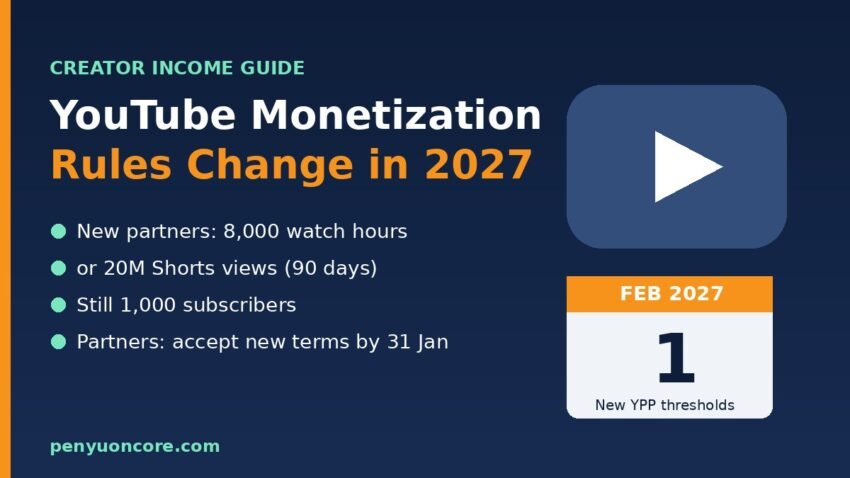
The YouTube monetization requirements 2027 update takes effect on 1 February 2027. From that date, new channels applying to the YouTube Partner Program (YPP) for ad and Premium revenue will need 1,000 subscribers plus either 8,000 qualified watch hours in the last 365 days or 20 million qualified Shorts views in the last 90 days. That doubles both the watch-hour and Shorts targets. Channels already in YPP keep their status, but they must accept updated terms in YouTube Studio by 31 January 2027 and stay “active” under new rules.
YouTube announced the changes on 10 August 2026 on the official YouTube Blog, and the details are on its Changes to the YouTube Partner Program help page. With about two months left, here’s what changes, who is affected and what to do before the deadline. All figures below come from YouTube’s own help pages (checked 27 November 2026).
YouTube monetization requirements 2027: old vs new thresholds
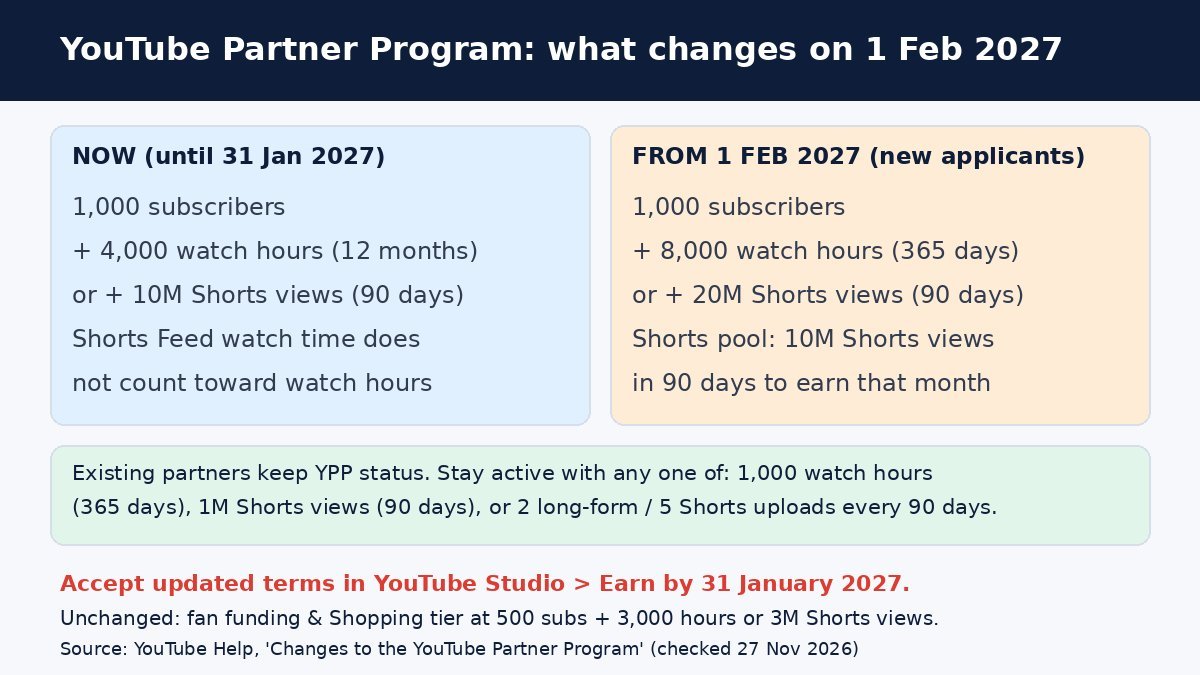
Right now, the YPP eligibility page lets a channel qualify for ad revenue sharing in one of two ways:
- 1,000 subscribers and 4,000 qualified public watch hours in the last 12 months, or
- 1,000 subscribers and 10 million qualified Shorts views in the last 90 days.
From 1 February 2027, the entry thresholds for new applicants become:
- 1,000 subscribers and 8,000 qualified watch hours in the last 365 days, or
- 1,000 subscribers and 20 million qualified Shorts views in the last 90 days.
As The Verge put it, you’ll need “twice as many watch hours” to start earning from ads and subscriptions. The subscriber count doesn’t change.
What counts as a qualified watch hour or Shorts view
YouTube’s current eligibility page says only watch hours from public long-form videos count. Hours from private, unlisted or deleted videos, ad campaigns, Shorts, and livestreams that are unlisted, deleted or not converted to video on demand don’t count. Shorts views only count when they come from public Shorts in the Shorts Feed. Image posts in the Shorts Feed and paid ad views are excluded. Watch time from Shorts in the Shorts Feed never counts toward the watch-hour target.
The lower tier is not changing
YouTube says there are “no changes to the eligibility requirements for fan funding, YouTube Creator Partnerships, or YouTube Shopping.” Those features still open at 500 subscribers plus either 3,000 qualified watch hours in the last year or 3 million qualified Shorts views in the last 90 days. A smaller channel can still earn from channel memberships, Super Chat, Super Thanks, Shopping and brand deals well before it reaches the new ad-revenue threshold.
What changes for creators already in YPP
If you’re already a partner, the higher entry thresholds don’t apply to you. YouTube says your “status is not impacted by this update.” Three other changes do affect you.
1. Accept the new terms by 31 January 2027
Existing partners have to review and accept the updated Watch Page Monetization Module, the Shorts Monetization Module and, where relevant, the Commerce Product Module. If you switched on fan funding (memberships or Supers) before 2023, you’re being moved from the old Commerce Product Addendum to the current Commerce Product Module. YouTube says eligibility, how the products work and the revenue share stay the same.
If you miss the deadline, you’re not removed from YPP. You do stop earning from the features whose terms you haven’t accepted from 1 February 2027, until you accept them in YouTube Studio. To accept, YouTube’s help page says:
- Sign in to YouTube Studio on desktop or mobile.
- Find the terms notification on your dashboard or in the Earn tab.
- Select Review for each updated module.
- Tick the box to accept and select Next.
- Select Submit once you’ve reviewed every module.
For channels owned and operated by a multi-channel network (MCN), the network has to accept on the channel’s behalf by 31 January.
2. New “active channel” rules
From 1 February 2027, YouTube treats a partner channel as active if it meets any one of these:
- 1,000 qualified watch hours in the past 365 days
- 1 million qualified Shorts views in the last 90 days
- 2 long-form videos or 5 Shorts uploaded every 90 days
If a channel drops below these, YouTube gives it an extended 90-day window to get back to either 1,000 watch hours or 1 million Shorts views and stay in the program. YouTube’s current overview page also says monetization may be turned off for channels that haven’t uploaded or posted for six months or more. In practice, posting regularly is the easiest way to stay safe.
3. A minimum for Shorts revenue
To earn from the Shorts Creator Pool in a given month, a channel will need 10 million qualified Shorts views over the last 90 days. Missing it doesn’t remove you from YPP and doesn’t affect long-form earnings. According to the YouTube Blog, Shorts revenue sharing resumes automatically once you’re back above 10 million. This is the change most likely to hit small partners who mainly post Shorts.
New ways to earn that come with the update
YouTube describes the changes as a trade-off, with tighter thresholds on one side and new income streams on the other:
- Premium Lite everywhere Premium is sold. Creators share in a pool of 60% of net Premium Lite subscription revenue (30% for full Premium). The blog says this pool is split by watch time and views, and creators get a 55% share for long-form and 45% for Shorts.
- Targeted Shorts ads. When an advertiser targets five or fewer channels, eligible creators get a direct 45% revenue share on top of their normal pool earnings.
- Shorts incentive programs. These are planned bonuses for YouTube Shopping, production credits for brand deals and earnings boosts for trend activations. YouTube says eligible creators will be notified when each one launches. It hasn’t published amounts.
YouTube says that on average creators “earn more per user from Premium than from ads,” based on 2026 performance. That’s an average, though, and it says nothing about what any one channel will earn.
What to do before 1 February 2027
If you’re close to 4,000 hours or 10 million Shorts views
Check the Earn tab in YouTube Studio now. You can select Get notified to get an email as soon as you’re eligible. Under the current rules, YouTube says it sends a channel for review once it meets the threshold and completes every signup step (accepting the base terms and linking an AdSense for YouTube account), and “it doesn’t matter” if your numbers drop while you wait. Reviews typically take about a month. YouTube hasn’t published a separate transition rule for applications that are still pending on 1 February, so don’t assume a late application will be judged under the old thresholds. If you qualify, finish signup early and keep an eye on the Earn tab.
Before you apply, make sure 2-Step Verification is on, the channel has advanced features access and has no active Community Guidelines strikes, and you live in a country where YPP is available. The US and UK both qualify.
If you’re far from the new targets
Don’t let the ad-revenue threshold stop you. The 500-subscriber tier, brand deals and selling your own products still work. Skills like video editing can also earn money before your own channel does. Our short-form video editing side hustle guide covers how to do that, and written platforms such as the Medium Partner Program are another creator income stream to consider.
Avoid “monetization” shortcuts
Watch hours and views from paid ad campaigns don’t count toward the threshold, and every application is reviewed against YouTube’s channel monetization policies. A higher bar may bring more offers selling “guaranteed monetization.” Treat them as a risk to your channel, not a shortcut.
Remember tax on creator income
YouTube income is taxable like any other side income. UK creators should read our explainer on the trading allowance increase. US creators should remember that information-return thresholds, like the new 1099-NEC threshold, only decide when a payer has to send a form. They don’t make income tax-free.
FAQ
When do the new YouTube monetization requirements start?
1 February 2027. Existing partners must accept the updated terms in YouTube Studio by 31 January 2027.
Will I lose monetization if I’m already in YPP?
Not because of the new 8,000-hour or 20 million Shorts entry thresholds. Those only apply to new applicants. You do need to accept the new terms and meet the activity rules, and you need 10 million Shorts views in 90 days to keep earning from the Shorts Creator Pool.
Do Shorts watch hours count toward 8,000 hours?
No. Under YouTube’s current rules, watch time from Shorts in the Shorts Feed doesn’t count toward the watch-hour threshold. Shorts have their own separate views route.
Is the 1,000-subscriber requirement changing?
No. New applicants still need 1,000 subscribers. Only the watch-hour and Shorts-view targets go up.
Disclaimer: This article is general information, not financial, tax or legal advice, and doesn’t predict how much any channel will earn. YouTube can update its policies at any time, so check the linked YouTube Help pages and your YouTube Studio Earn tab for the latest rules.