
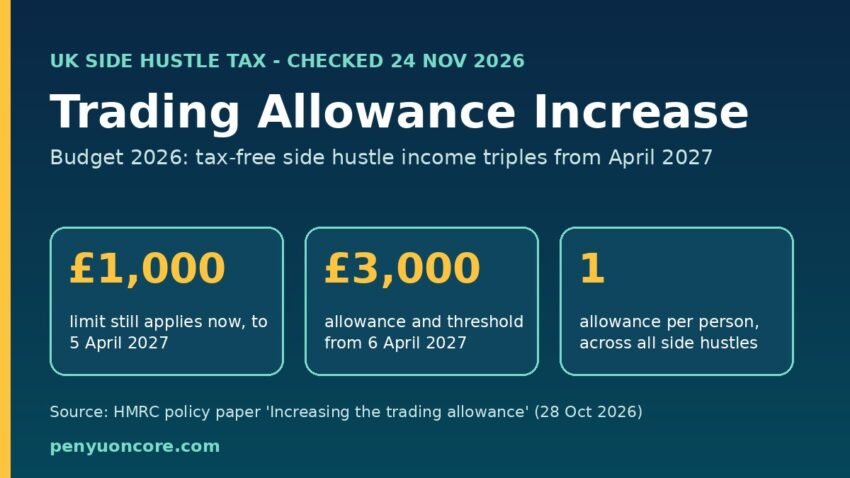
The trading allowance increase announced in Budget 2026 will triple the UK’s tax-free allowance for side hustle income, from £1,000 to £3,000, from 6 April 2027. The Self Assessment reporting threshold for trading income goes up to £3,000 on the same date. The catch is timing: for the current 2026 to 2027 tax year the limit is still £1,000, and that matters if you’re planning to sell, resell or freelance around Black Friday (27 November) and Cyber Monday (30 November).
Short answer: From the 2027 to 2028 tax year, if your total gross income from side hustles is £3,000 or less, it’s normally tax-free and you won’t need to report it to HMRC just because of that income. Until 5 April 2027, the old £1,000 limit still applies, and anything above it must still be reported through Self Assessment.
The GOV.UK, HMRC and Hansard pages linked below were checked on 24 November 2026.
What is the trading allowance increase?
The trading allowance lets individuals earn a small amount of trading or “miscellaneous” income each tax year without paying tax on it. It has been £1,000 since it was introduced in April 2017, according to HMRC’s guide to tax-free allowances on property and trading income.
At the Budget on 28 October 2026, the government announced it would raise the allowance to £3,000. HMRC’s policy paper, Increasing the trading allowance, says the change “will have effect from 6 April 2027, for the tax year 2027 to 2028 onwards”, alongside “increasing the Income Tax Self Assessment reporting threshold to £3,000.”
HMRC estimates that up to 1.4 million people could benefit. Of those, about 400,000 are expected to see their tax bill fall by £380 on average, and about 100,000 will no longer need to report their trading income at all.
It isn’t law yet. The change is in the Finance Bill 2026-27, and the Treasury minister confirmed during the bill’s Second Reading on 23 November 2026 that it “increases the trading allowance from £1,000 to £3,000”. The measure is widely expected to pass, but the final details could still change before it becomes law.
What counts as trading income?
HMRC says the allowance covers income from:
- self-employment, such as freelancing, making and selling crafts or reselling goods for a profit
- casual services, such as babysitting, gardening or food delivery
- hiring out personal equipment, such as power tools
HMRC’s “Hobby or hustle?” side hustle guide also lists content creation, tutoring, delivery driving and dog walking. Selling things you’ve bought or made to sell at a profit usually counts as trading. Clearing out your own unwanted things now and then usually doesn’t. HMRC says “you probably don’t need to tell HMRC” if you only sell personal belongings occasionally. If you’re selling digital products, our guide to Etsy fees for digital downloads explains what comes out of each sale before you get paid.
The allowance is applied to your gross income, meaning everything you take in before expenses, not your profit. It’s also one allowance per person, not one per side hustle. HMRC’s own example: £800 from content creation plus £500 from selling crafts is £1,300, which is over today’s £1,000 limit.
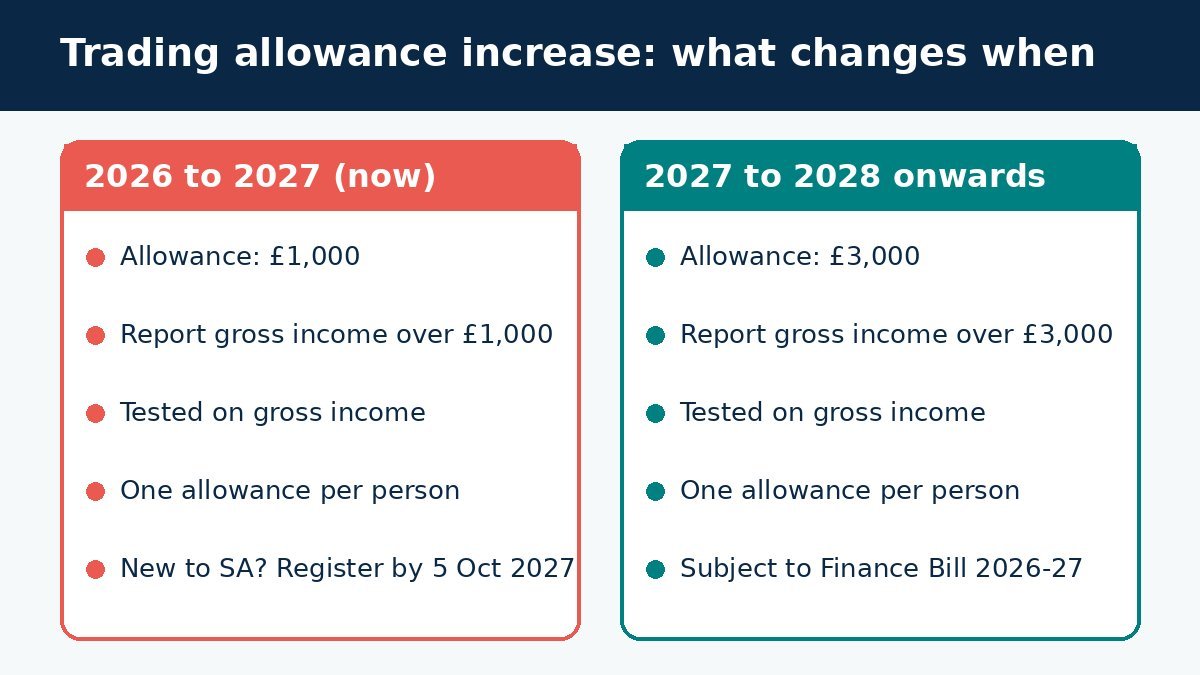
Trading allowance increase: £1,000 now vs £3,000 from April 2027
| Rule | 2026 to 2027 (now to 5 April 2027) | 2027 to 2028 onwards (from 6 April 2027) |
|---|---|---|
| Tax-free trading allowance | £1,000 | £3,000 (subject to the Finance Bill) |
| Self Assessment reporting threshold for trading income | Gross trading income over £1,000 | Gross trading income over £3,000 |
| Tested on | Gross income, before expenses | Gross income, before expenses |
| Allowances per person | One, across all side hustles | One, across all side hustles |
| Property allowance | Separate £1,000 | Not part of this Budget measure |
HMRC is clear that nothing changes yet. Its side hustle page answers the rumour directly: “I heard that I don’t need to do anything until I’m earning over £3,000? That’s not true. If you’re earning over £1,000 from side hustles, you’ll still need to tell HMRC.”
Full relief vs partial relief: a worked example
HMRC describes two ways the allowance works:
- Full relief: if your gross trading income is at or below the allowance, it’s all covered. You don’t pay tax on it, and in most cases you don’t have to tell HMRC about it. You still have to keep records.
- Partial relief: if your income is above the allowance, you can deduct the allowance instead of your actual expenses. You can’t deduct both. If your expenses are higher than the allowance, claiming them is usually better.
Hypothetical example: say you resell clothes and gadgets online and take in £2,500 in a tax year, with £400 of costs.
- In 2026 to 2027, £2,500 is over the £1,000 limit, so you have to report it. Deducting the £1,000 allowance leaves £1,500 of taxable profit. Deducting your actual £400 of costs would leave £2,100, so the allowance is the better choice. If you’re a basic-rate taxpayer whose Personal Allowance is already used up by your job, Income Tax at 20% on £1,500 is £300. That’s the rate on GOV.UK’s Income Tax rates page; Scottish bands are different, and National Insurance may also apply.
- In 2027 to 2028, the same £2,500 is under the new £3,000 allowance. That’s full relief: no Income Tax on it, and no need to report it to HMRC just because of that income.
Now say your costs were £3,500 against £5,000 of income. Claiming the real expenses (taxable profit £1,500) beats the allowance (£2,000), even after April 2027.
Who can’t use the trading allowance
According to HMRC, you can’t use the allowance for a tax year if you have any trading income from:
- a company that you, or someone connected to you, owns or controls
- a partnership where you, or someone connected to you, is a partner
- your employer, or your spouse’s or civil partner’s employer
That first rule matters for contractors who work through their own limited company. Also, the allowance doesn’t apply to trading income from a partnership.
Even if you’re under the limit, HMRC says you must still register for Self Assessment and file a return if you want to claim relief for a loss, pay voluntary Class 2 National Insurance, or claim Tax-Free Childcare or Maternity Allowance based on your self-employment. If HMRC sends you a notice to file a return, you have to file it.
Will eBay, Vinted or Etsy tell HMRC anyway?
Possibly. Since 1 January 2024, UK digital platform operators have had to collect sellers’ details and report their earnings to HMRC every year by the following 31 January, according to HMRC’s guide to selling goods or services on a digital platform. If you sell goods, you won’t be reported if you make fewer than 30 sales and receive less than €2,000 (about £1,700) in a calendar year.
HMRC stresses that “a platform reporting your details to HMRC does not automatically mean you owe tax.” Platforms report by calendar year, but the trading allowance works on the tax year (6 April to 5 April), so use your own records to work out your figures. US sellers face a separate system. See our explainer on the eBay 1099-K threshold.
What to do before the next deadlines
- Add up your gross side income for 2025 to 2026. If it was over £1,000 and you haven’t told HMRC, GOV.UK’s Self Assessment deadlines page says the registration deadline was 5 October 2026. Register now anyway: online returns and payment are due by 11:59pm on 31 January 2027.
- Keep records for 2026 to 2027. Black Friday reselling, holiday craft fairs and freelance work done now all fall in the current tax year, when the limit is still £1,000. HMRC suggests keeping invoices, a spreadsheet of income, platform statements and bank statements.
- Compare the allowance with your actual expenses. If your costs are low, the allowance usually gives a bigger deduction. If you hold stock or have big costs, your actual expenses may beat it.
- Use HMRC’s free checker. The Check if you need to tell HMRC about additional income tool is anonymous and covers selling online, casual jobs and content creation.
- Be wary of “easy money” offers. Holiday side hustle searches attract fake job schemes. If anyone asks you to pay to unlock earnings, read our task scam warning first.
FAQ
When does the £3,000 trading allowance start?
From 6 April 2027, the start of the 2027 to 2028 tax year, subject to the Finance Bill 2026-27 becoming law.
Is the trading allowance still £1,000 right now?
Yes. For the 2026 to 2027 tax year, which runs to 5 April 2027, it’s £1,000. Income from that year is reported in returns due by 31 January 2028.
Is it £3,000 for each side hustle?
No. It’s one allowance per person, covering all your trading and miscellaneous income added together.
Does the increase apply to rental income?
No. The Budget measure covers only the trading allowance. The separate property allowance, which is £1,000 under current HMRC guidance, isn’t part of it.
Do I pay tax if I sell my own old stuff?
Usually not. Occasionally selling personal belongings isn’t normally trading, though selling assets for a profit can sometimes mean Capital Gains Tax.
Disclaimer: This article is general information, not tax or financial advice. Tax rules depend on your circumstances and the trading allowance increase still needs to pass through Parliament. Check GOV.UK or speak to a qualified tax adviser before making decisions.