
An HMRC crypto letter is a “nudge” from HM Revenue & Customs asking you to check that you’ve paid the right tax on your cryptoassets, such as bitcoin. HMRC is sending these letters, along with emails and text messages, between July 2026 and March 2027. A nudge letter is not a tax investigation, but don’t ignore it. If you owe tax, you either amend your Self Assessment return or use HMRC’s cryptoasset disclosure service. If you’re sure you owe nothing, check what your letter asks you to do, because some versions ask you to reply with evidence.
Below, we explain how to tell a genuine message from a scam, what the letter usually says, how to work out whether you owe anything, and which route to use. Every rule here comes from GOV.UK, HMRC or professional bodies, and we checked them all on 27 November 2026.
Why HMRC is sending crypto letters now
According to ICAEW, HMRC’s Wealthy and Mid-sized Business Compliance team will contact people it believes may have underpaid Income Tax or Capital Gains Tax on crypto between July 2026 and March 2027. Contact may come by letter, email or SMS, and HMRC is also looking at sending messages through the HMRC app. KPMG notes that earlier waves were based on data HMRC already gets from exchanges.
HMRC will soon have much more of that data. Since 1 January 2026, the Cryptoasset Reporting Framework (CARF) has required crypto service providers to collect user details. GOV.UK says providers must submit their first report by 31 May 2027, covering 1 January to 31 December 2026. As a user, you must give each platform your full name, date of birth, address and National Insurance number or UTR. If you give inaccurate details, or don’t give them to a UK provider, you could face a penalty of up to £300.
Is the HMRC crypto letter genuine or a scam?
The campaign is real. HMRC’s list of genuine contact that uses more than one communication method (last updated 12 November 2026) includes a “Cryptoassets” entry. It says HMRC may contact crypto traders by letter, email or text. The letter or email links to guidance on declaring crypto correctly, and the text message “will direct you to guidance on GOV.UK”.
Criminals copy campaigns like this, though, so check before you act:
- Don’t click links or call numbers in a message you’re unsure about. Type gov.uk into your browser yourself, or sign in to your HMRC online account.
- Know what HMRC won’t do. GOV.UK says HMRC will never email, text or call you to tell you about a tax rebate or penalty, or to ask for your personal or payment information.
- Never share a seed phrase or private key. A tax letter has no reason to need wallet access. Anyone who asks for it is trying to steal your coins.
- Report fakes. Forward suspicious texts to 60599 and emails to phishing@hmrc.gov.uk. If you think you’ve shared personal details, tell HMRC’s security team.
Parcel-delivery scams use the same tricks. Our guide to the fake delivery text explains what to do if you’ve already clicked a link.
What the letter says and what it asks you to do
The Chartered Institute of Taxation published HMRC’s one-to-many crypto letter template in July 2024. It opens: “We’re writing to you as our records show you have disposed of cryptoassets. However, you haven’t declared everything correctly. This means you may have tax to pay.” It explains what counts as a disposal and gives you three options: amend your return, make a disclosure, or contact HMRC with information showing why no tax is due. That template asked for a response within 60 days of the letter’s date. Wording in the current wave may be different, so go by the date and instructions on your own letter.
Other versions are softer. ICAEW says that for the 2026-27 campaign, “no action is required where the taxpayer believes they do not have any income or gains to report”. In short, a letter saying HMRC’s records show undeclared disposals needs a reply. A general educational letter may need nothing if your tax affairs are already correct.
Do you actually owe tax on your crypto?
Start by listing every disposal in each tax year (6 April to 5 April). GOV.UK’s guide to tax when you sell cryptoassets says you dispose of tokens when you:
- sell them for pounds or another currency
- exchange them for a different cryptoasset, for example bitcoin for ether
- use them to pay for goods or services
- give them away, unless the gift goes to your spouse, civil partner or a charity
Simply moving coins between your own wallets is not a disposal. Gifts often catch people out, so read our guide on whether gifting bitcoin is taxable before giving crypto this Christmas. Giving to charity works differently, as our donating bitcoin to charity guide explains.
How to work out the gain
HMRC requires “pooling”. You put each type of token in a pool, and each sale uses a proportional share of the pool’s average cost. Tokens bought on the same day as a sale, or within 30 days after it, are matched separately under share-matching rules. You can deduct allowable costs such as transaction fees. Exchange reports can help, but HMRC warns that they “are not tax calculations” and don’t track pooled costs, so you need your own records.
Allowance, rates and the £50,000 rule
| Rule (2026-27) | What it means |
|---|---|
| Capital Gains Tax allowance | The first £3,000 of total net gains in the tax year is tax-free |
| Basic-rate taxpayer | 18% on gains within your remaining basic-rate band, 24% above it |
| Higher or additional-rate taxpayer | 24% on gains |
| Reporting with gains under the allowance | If you’re registered for Self Assessment, you must still report if your total disposal proceeds were more than £50,000 |
| Losses | Report losses to reduce gains. You can claim up to 4 years after the end of the tax year |
Income from staking, mining, lending or being paid in crypto falls under Income Tax rather than Capital Gains Tax. The 2024 letter template mentions it too.
Losses are especially relevant this year. Bitcoin dropped to around $57,500 on 25 November, according to CoinDesk, so many holders have losses that can legitimately reduce taxable gains. You only get the benefit if you report them.
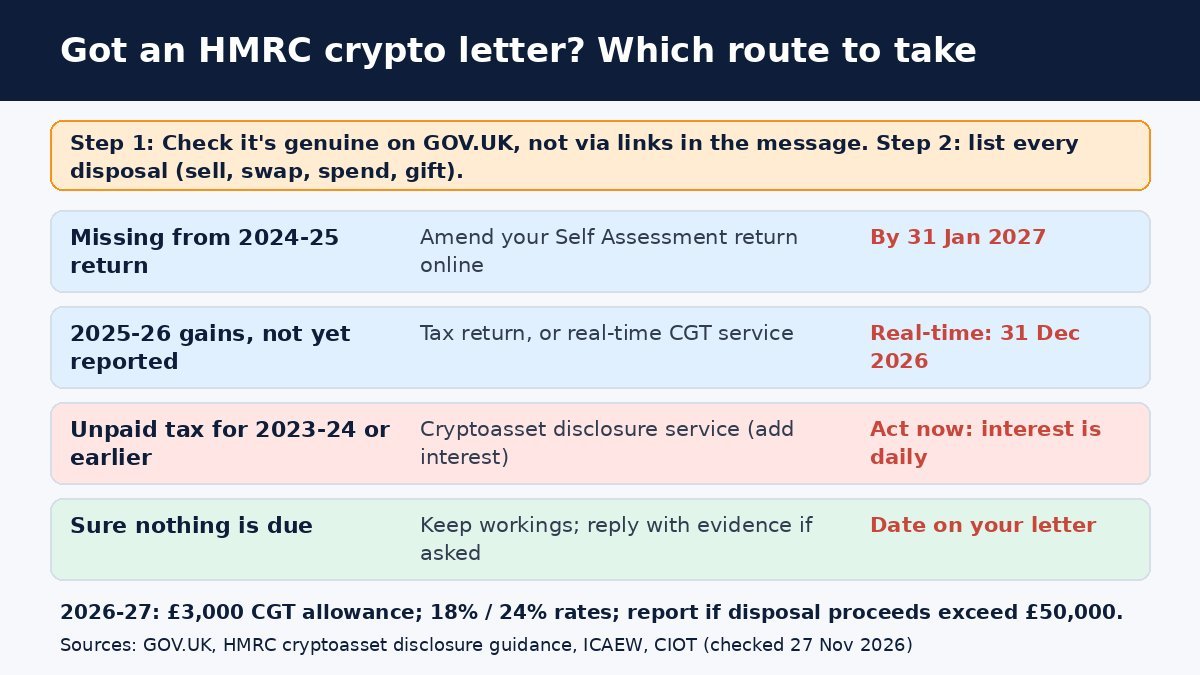
HMRC crypto letter: which route should you use?
| Your situation | What to do | Key date |
|---|---|---|
| Gain or income missing from your 2024-25 return | Amend the return online (the crypto section is on returns from 2024-25) | By 31 January 2027 |
| Crypto gains in 2025-26, not yet reported | Include them on your 2025-26 Self Assessment return, or use the real-time Capital Gains Tax service if you don’t file a return | Real-time report by 31 December 2026, pay by 31 January 2027 |
| Unpaid tax for 2023-24 or earlier | Use the cryptoasset disclosure service | As soon as possible. Interest runs daily |
| You’re confident nothing is due | Keep your calculations. Reply with evidence if your letter asks for it | The date on your letter |
How the disclosure service works
Before you start, you need to work out the tax, interest and penalty yourself. HMRC says it will reject a disclosure that doesn’t include the right interest. How many years you must cover depends on your behaviour:
- 4 years if you took reasonable care but still underpaid
- 6 years if you were careless
- 20 years if the underpayment was deliberate
HMRC’s penalties and interest calculator can help with the numbers. ICAEW notes that penalties can reach up to 100% of the tax due when income and gains weren’t reported. Telling HMRC before it challenges you generally keeps penalties lower. If your history covers several exchanges, DeFi or many years, it’s worth paying for a crypto tax specialist.
Practical steps this week
- Check the letter is genuine, using GOV.UK rather than any link in the message.
- Note the response date, if there is one.
- Download full transaction histories from every exchange and wallet you’ve used, including closed accounts.
- Rebuild your pooled costs, or use a crypto tax calculator, and keep the workings.
- Choose a route: amend, disclose or reply with evidence.
- Diary 31 December 2026 and 31 January 2027.
If you hold bitcoin exposure through an exchange-traded product instead, our bitcoin ETN ISA guide explains which ISA can now hold crypto ETNs tax-free after the April 2026 rule change.
FAQ
Does an HMRC crypto letter mean I’m under investigation?
No. It’s a one-to-many “nudge”, not a formal enquiry. HMRC can still raise an assessment, charge interest and consider penalties if tax turns out to be due.
I only bought and held bitcoin. Do I need to do anything?
Buying and holding isn’t a disposal, so there’s usually no Capital Gains Tax to pay. If your letter says HMRC’s records show disposals, reply with evidence as it asks.
What if I ignore the letter?
If tax is due, HMRC may assess it with interest and possibly penalties. Coming forward yourself is generally treated more favourably.
Can HMRC see my overseas exchange accounts?
HMRC increasingly can. CARF is an international framework, and GOV.UK says you must give your details to every crypto provider you use, even ones based outside the UK.
This article is general information, not financial or tax advice. Crypto tax depends on your circumstances. Check GOV.UK or speak to a qualified tax adviser before you amend a return or make a disclosure.