
If your HMRC statement shows a bigger bill than you expected for 31 January, payments on account are usually the reason. They are advance payments towards your next tax bill, and in your first year they can make the January total roughly 50% bigger than the tax you actually owe for the year just gone.
Quick answer: Payments on account are two advance instalments towards next year’s Self Assessment bill. Each one is usually half of last year’s bill, and they are due by midnight on 31 January and 31 July. You have to make them unless last year’s bill was under £1,000 or more than 80% of your tax was already collected at source, for example through PAYE.
This guide uses current GOV.UK guidance to explain how the January 2027 bill is built up, what “first payment on account for 2026-27” means on your statement, and what you can legally do to bring the bill down.
What payments on account are and who has to make them
HMRC says payments on account are “payments towards your next tax bill (including Class 4 National Insurance if you’re self-employed).” The idea is to spread the cost over two instalments rather than collecting everything in one go after the tax year has ended.
According to HMRC’s guidance, you must make the two payments unless either of these applies:
- the tax you owed through Self Assessment last year was less than £1,000
- you paid more than 80% of the tax you owed outside Self Assessment, for example through your tax code or because your bank had already taken tax off your savings interest
That is why many employees who file a return only for a small side income never see payments on account, while sole traders, landlords and people with large untaxed investment income usually do. If your side income is small, it is worth checking whether the trading allowance means you need to report it at all.
How payments on account are calculated
Each payment is usually half of the tax you owed the previous year. HMRC bases them on your estimated earnings, which normally just means it assumes this year will look like last year.
If you end up earning more, you pay the difference as a balancing payment by 31 January after the tax year ends. If you earn less, you may be able to claim a refund. HMRC also notes that the balancing payment includes anything you owe for capital gains or student loans. Those amounts are not split into advance instalments.
The 2026-27 timeline
For most people filing now, the relevant dates are:
| Deadline | What is due |
|---|---|
| 30 December 2026 | Last day to file online if you want an amount under £3,000 collected through your PAYE tax code |
| 31 January 2027 | Online return for 2025-26, balancing payment for 2025-26 and first payment on account for 2026-27 |
| 31 July 2027 | Second payment on account for 2026-27 |
| 31 January 2028 | Balancing payment for 2026-27 (if any) and first payment on account for 2027-28 |
These dates match HMRC’s Self Assessment deadlines page, which confirms that the 2025-26 online return and any tax owed are due by 11:59pm on 31 January 2027.
What “first payment on account for 2026-27” means
If you see this line on your statement, it is not a mistake and it is not a second charge for the same tax. It is the first advance instalment towards the tax year that started on 6 April 2026 and ends on 5 April 2027. HMRC works it out as half of your 2025-26 bill.
The surprise is biggest in your first year. Because you made no payments on account last year, January’s bill includes both the full tax for 2025-26 and the first instalment for 2026-27. HMRC’s own example uses a £3,000 bill and gives a total of £4,500 due in January.
Here is the same logic with an illustrative £4,000 bill:
- 31 January 2027: £4,000 tax for 2025-26 plus a £2,000 first payment on account for 2026-27, so £6,000 in total
- 31 July 2027: a £2,000 second payment on account
- 31 January 2028: a balancing payment only if your 2026-27 tax ends up above £4,000, plus the first payment on account for 2027-28
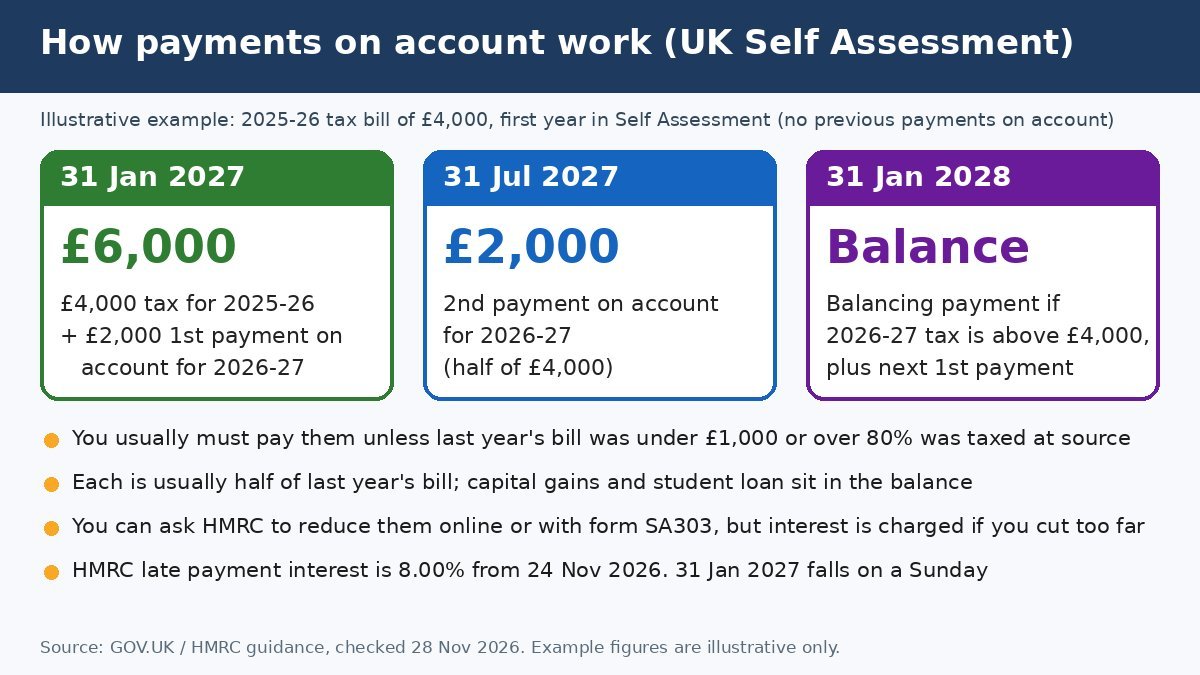
After the first year, each January covers any balance for the previous year plus the first instalment for the current one, and each July covers the second instalment.
How to reduce payments on account
If you know your income has fallen, HMRC lets you ask for smaller payments on account. Its claim guidance says you can apply if your business profits or other income go down, the tax relief you are entitled to goes up, or the tax deducted at source is more than in the previous year.
You can apply in two ways:
- Online: sign in to your HMRC online account, open your latest Self Assessment return and choose “Reduce payments on account”. You will need to give the amount you expect to earn.
- By post: fill in form SA303 on screen, print it and send it to HMRC.
The claim must be made by 31 January after the end of the tax year it relates to.
The catch: interest if you reduce too much
HMRC warns that if you reduce your payments on account and your final bill turns out higher, you will be charged interest on the difference. Reduce them only when you have a realistic, evidence-based estimate, not just to ease January cash flow.
What happens if you pay late
- Interest applies straight away. HMRC’s Self Assessment legal framework manual confirms that interest is charged on any payment on account paid late. The late payment interest rate is 8.00% from 24 November 2026, set at the Bank of England base rate plus 4%.
- Late payment penalties normally do not apply to payments on account themselves. HMRC’s Self Assessment Manual says the penalties apply to balancing payments and assessments, but not to payments on account. However, any part of a payment on account still unpaid at the balancing payment due date becomes part of the amount that can be penalised.
- The balancing payment does attract penalties. According to GOV.UK, unpaid tax gets a 5% penalty at 30 days, 6 months and 12 months, on top of interest. If you use Making Tax Digital for Income Tax, different penalties apply.
Put simply, a late payment on account is not free, even when no penalty is added.
Ways to make the January bill easier to manage
Mind the weekend deadline
31 January 2027 falls on a Sunday. GOV.UK says that if the deadline falls on a weekend or bank holiday, your payment must reach HMRC on the last working day before, unless you pay by Faster Payments or by debit or credit card. Bacs takes 3 working days, and a new Direct Debit takes 5 working days, according to the pay your Self Assessment bill page.
Pay through your tax code if you qualify
If you are employed or get a workplace pension, owe less than £3,000 and file online by 30 December 2026, HMRC can collect what you owe through your PAYE tax code in equal instalments over 12 months. You cannot make a part payment to get under the £3,000 limit.
Use a Budget Payment Plan for next time
If you are up to date with your payments, you can set up a Budget Payment Plan and pay weekly or monthly by Direct Debit towards your next bill. You can pause it for up to 6 months. Setting money aside regularly, as you would for an emergency fund, also makes January far less stressful.
If you genuinely cannot pay
If you have missed the deadline or cannot pay the full amount, HMRC may agree a payment plan, also called Time to Pay, so you can clear the debt in monthly instalments. HMRC checks whether the plan is affordable and expects you to use savings or assets to reduce the debt where you can. Contacting HMRC early is usually better than waiting for penalties to build up.
If savings interest is what pushed you into Self Assessment, our guide to tax on savings interest in 2027 explains the rate changes that are coming.
FAQ
Are payments on account compulsory?
Yes, if HMRC asks for them and neither exemption applies. You can apply to reduce them if you expect lower income, but you will pay interest if the reduction turns out to be too large.
Do payments on account include capital gains or student loan repayments?
No. HMRC says those amounts go into the balancing payment due on 31 January after the tax year ends.
Can I reduce payments on account to zero?
You can apply for a reduction if your income has fallen, your reliefs have gone up or more tax is being deducted at source. You need a realistic estimate, because HMRC charges interest on any shortfall.
What if I overpaid through payments on account?
If your actual bill comes in lower than your payments on account, HMRC says you may be able to claim a refund.
Disclaimer: This article is general information based on HMRC guidance as of 28 November 2026. It is not tax or financial advice. Check your own HMRC online account or speak to a qualified adviser about your situation.