

If your Bitcoin is worth less than you paid for it, you may be able to claim Bitcoin losses on taxes – but only once the loss is realized. In the US, the IRS treats Bitcoin as property, so a loss counts when you sell, trade or spend it, not when the price simply drops. This guide walks US readers through the forms, the limits and the year-end timing, with a short section for UK readers.
Quick answer: Sell, swap or spend the Bitcoin by December 31 so the loss is realized in that tax year. Then report each disposal on Form 8949 and total it on Schedule D. Net capital losses first offset your capital gains, then up to $3,000 of ordinary income a year ($1,500 if married filing separately), and anything left over carries forward to future years.
This is timely. Bitcoin hit roughly a two-year low near $55,300 on November 21, according to Investing.com, and it was down about 32% year-to-date at the end of the Thanksgiving week. That leaves plenty of holders with paper losses and questions about what they can actually deduct.
Can you claim Bitcoin losses on taxes if you haven’t sold?
Generally, no. The IRS says digital assets are treated as property, not currency, so the normal capital gain and loss rules apply. Under those rules, a loss is the difference between your basis (usually what you paid in US dollars) and what you received when you disposed of the asset (IRS Topic 409).
An unrealized drop doesn’t count. In Chief Counsel Advice 202302011, the IRS concluded that a holder whose crypto had fallen sharply in value had not sustained a deductible loss, because the coins hadn’t been sold or abandoned and still had some value. Bitcoin clearly still has a market value, so a worthlessness claim won’t work.
According to the IRS, all of these count as disposals that can realize a gain or loss:
- Selling Bitcoin for US dollars or another currency
- Trading Bitcoin for another digital asset (for example, BTC to ETH or to a stablecoin)
- Using Bitcoin to pay for goods or services
Moving Bitcoin between wallets you own is not a disposal, although paying the network fee in crypto is itself a digital asset transaction, according to the IRS digital assets page.
How much of a Bitcoin loss can you deduct?
Capital losses are netted against capital gains first. Short-term means you held the coins for one year or less; long-term means more than one year. Per Topic 409, the holding period starts the day after you acquired the asset. Your Bitcoin losses can offset gains from stocks, funds and other capital assets too, not just crypto.
If you end up with a net capital loss, you can deduct the lesser of your net loss or $3,000 ($1,500 if married filing separately) against other income such as wages. Any loss above that limit carries forward to later years. The Schedule D instructions include a Capital Loss Carryover Worksheet that tracks short-term and long-term carryovers separately.
A simple illustration
These figures are hypothetical. Say you bought 0.5 BTC for $45,000 more than a year ago and sold it in December 2026 for $30,000, which gives you a $15,000 long-term loss. If you had $4,000 of stock gains in 2026, the loss wipes those out. You can then deduct $3,000 against ordinary income and carry the remaining $8,000 into 2027.
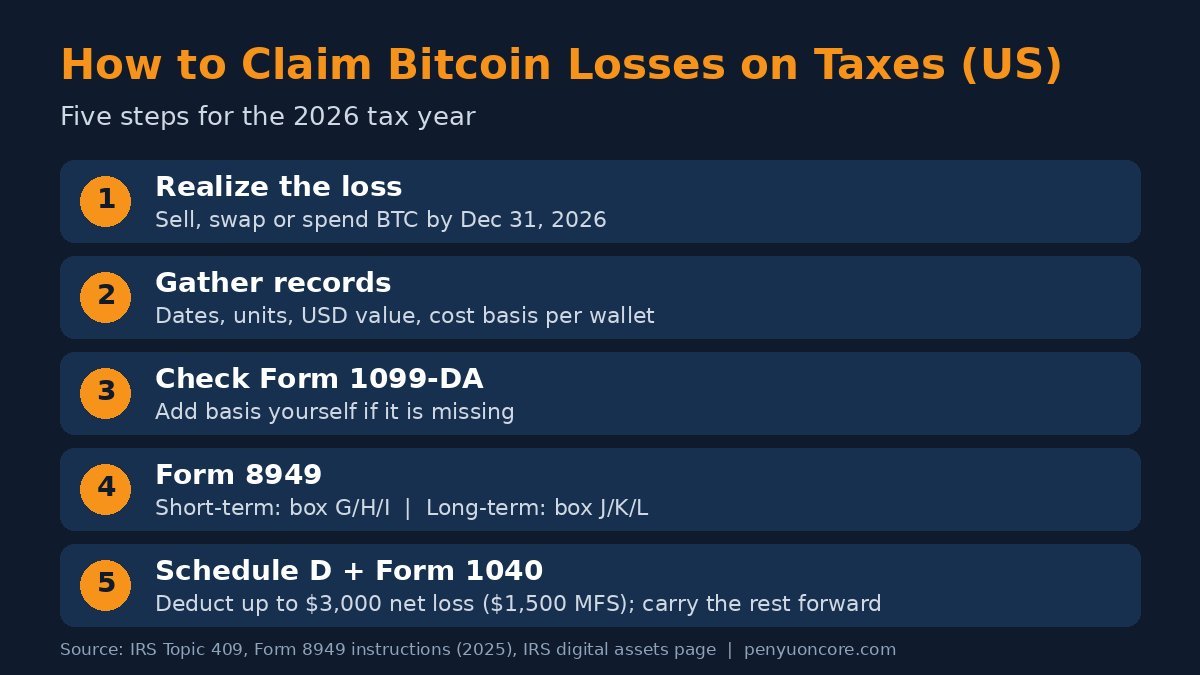
Step by step: how to claim Bitcoin losses on taxes (US)
1. Realize the loss by December 31
For a loss to count on your 2026 return, the sale, trade or purchase with Bitcoin has to happen in 2026. Our tax loss harvesting deadline guide covers the year-end timing in more detail.
2. Gather your records and cost basis
To calculate each gain or loss, the IRS says you need the type of asset, the date and time of the transaction, the number of units, the fair market value in US dollars, and your basis. Since January 1, 2025, basis has to be tracked wallet by wallet or account by account. Revenue Procedure 2024-28 offered transition guidance for allocating basis as of that date. Which lots you sell can change the size of your loss, so keep lot-level records.
3. Check your Form 1099-DA
Custodial platforms must report gross proceeds on Form 1099-DA for transactions on or after January 1, 2025, and must report basis on certain transactions from January 1, 2026, according to the IRS. If your form has no basis, you still have to supply it yourself. Our guide to 1099-DA missing cost basis explains what to do. You must report taxable transactions even if you never received a form (IRS virtual currency FAQ, Q42).
4. Fill in Form 8949 using the digital asset boxes
The current Form 8949 instructions (2025 tax year) added separate checkboxes for digital assets and tell filers not to use boxes C or F for them. Check the 2026 instructions when they’re released in case anything changes.
| Your situation | Short-term (Part I) | Long-term (Part II) |
|---|---|---|
| 1099-DA shows basis reported to the IRS | Box G | Box J |
| 1099-DA with no basis, or basis not reported to the IRS | Box H | Box K |
| No 1099-DA received (e.g. self-custody wallet) | Box I | Box L |
The 1099-DA itself has an “Applicable checkbox on Form 8949” field that tells you which box to use.
5. Carry the totals to Schedule D and Form 1040
Schedule D summarizes your Form 8949 totals and works out your net gain or loss. The deductible part of a net loss goes on Form 1040, line 7a, per Topic 409. You’ll also need to answer “Yes” to the digital asset question on Form 1040 if you sold or exchanged any Bitcoin during the year.
Common mistakes when claiming Bitcoin losses
- Claiming a paper loss. A falling price alone isn’t deductible.
- Leaving out small trades. The IRS says you must report digital asset transactions whether or not they result in a gain or loss.
- Mixing up holding periods. If short-term and long-term lots are labeled wrong, your netting will be wrong.
- Ignoring possible rule changes. The wash sale rule doesn’t currently cover Bitcoin held directly, but a pending bill could change that. See our Bitcoin wash sale rule explainer.
- Assuming scam or theft losses work the same way. Those follow separate, narrower rules, so get professional advice.
UK readers: claiming crypto losses with HMRC
In the UK, selling, swapping or spending Bitcoin is also a disposal for Capital Gains Tax, and HMRC uses pooled average cost along with same-day and 30-day matching rules (GOV.UK). You have to report a loss to HMRC before you can use it, and you can claim up to 4 years after the end of the tax year in which you disposed of the asset. Unused losses can be carried forward. For more, see crypto losses and UK tax.
FAQ
Can I claim Bitcoin losses if I didn’t sell?
Generally no. In the US you need a disposal, such as a sale, a trade or a purchase made with Bitcoin, to realize the loss.
Is there a limit on crypto losses I can deduct?
Losses offset capital gains without limit. After that, up to $3,000 a year ($1,500 married filing separately) can offset ordinary income, and the rest carries forward.
Do I have to report Bitcoin losses if I didn’t get a 1099-DA?
Yes. You report taxable transactions whether or not you received a form. Without a 1099-DA, use box I or L on Form 8949.
Can Bitcoin losses offset stock gains?
Yes. Both are capital assets, so they’re netted together on Schedule D.
Disclaimer: This article is general information, not financial, tax or investment advice. Tax rules change and personal situations differ, so check the latest IRS or HMRC guidance or speak to a qualified tax professional before acting.