
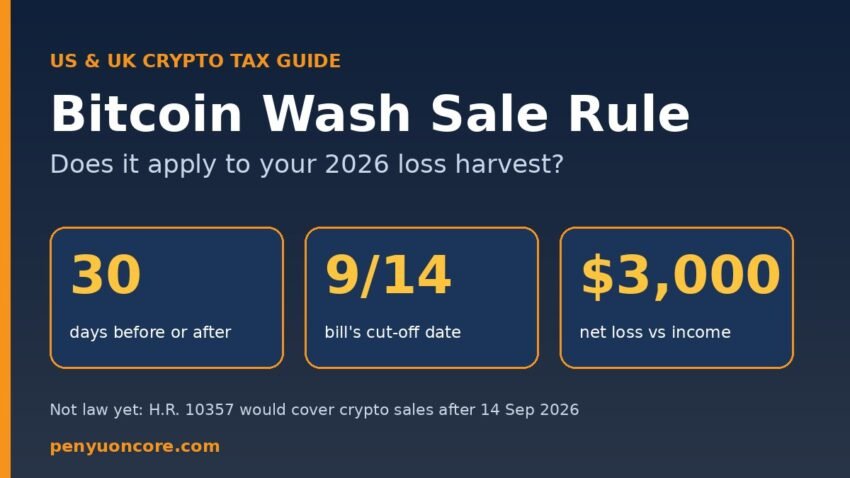
The Bitcoin wash sale rule question comes down to this: in the US, the federal wash sale rule (IRC section 1091) is written for “stock or securities”, and as of 24 November 2026 it does not expressly cover bitcoin you hold directly. You can generally sell bitcoin at a loss, buy it back, and still claim the loss. But a bill approved by a House committee in September would extend the rule to crypto sales made after 14 September 2026, so this year’s harvest comes with a catch.
Short answer: under current US law, selling bitcoin at a loss and rebuying it within 30 days is not a wash sale under section 1091. That could change if H.R. 10357, the Digital Asset Tax Certainty Act, becomes law in its current form, because it would reach back to sales after 14 September 2026. Spot bitcoin ETF shares are a grey area. In the UK there is no “wash sale” rule as such, but HMRC’s 30-day matching rule stops a quick sell-and-rebuy from creating a loss in the first place.
Sources below (IRS, Congress.gov, the Joint Committee on Taxation, the Congressional Research Service and HMRC) were checked on 24 November 2026.
Bitcoin wash sale rule: where things stand in 2026
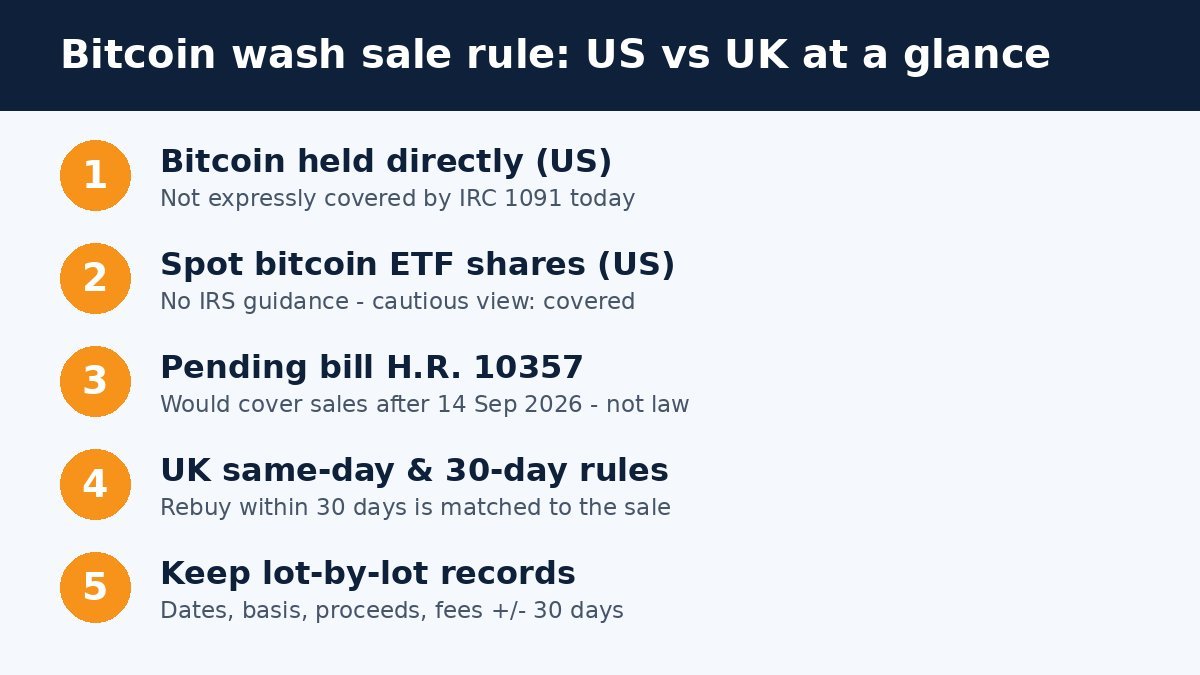
| What you hold | US position (24 Nov 2026) | UK position |
|---|---|---|
| Bitcoin held directly (exchange or wallet) | Section 1091 covers “stock or securities”; the IRS treats digital assets as property. No IRS guidance applies the wash sale rule to them. | Same-day and 30-day matching rules apply to tokens of the same type. |
| Spot bitcoin ETF shares (e.g. IBIT, FBTC) | Unsettled. The shares trade like stock, so the cautious approach is to treat them as covered. | Shares and securities have their own same-day and 30-day rules. |
| Shares in bitcoin-related companies | Stock, so the wash sale rule applies. | Share matching rules apply. |
| Pending change | H.R. 10357 would cover “traded digital assets” for sales after 14 Sep 2026. Not law yet. | No change announced in the HMRC guidance checked. |
What the wash sale rule actually says
According to IRS Publication 550, you can’t deduct a loss from selling “stock or securities” in a wash sale. A wash sale happens when you sell at a loss and, within 30 days before or after the sale, you buy substantially identical stock or securities, acquire them in a fully taxable trade, acquire a contract or option to buy them, or buy them in your IRA or Roth IRA. A purchase by your spouse or a corporation you control also counts.
The loss isn’t lost for good. In most cases it’s added to the cost basis of the replacement shares, and their holding period includes the time you held the shares you sold. The deduction is postponed, not erased. (If you reinvest stock dividends automatically, see our guide to dividend reinvestment and the wash sale rule, because a small reinvested dividend can trigger it.)
Publication 550 also says the rules “do not apply to losses from sales or trades of commodity futures contracts and foreign currencies.” Its wash sale section doesn’t mention digital assets.
Why bitcoin isn’t covered today
The IRS digital assets page says: “For U.S. tax purposes, digital assets are considered property, not currency.” Bitcoin is not a share of stock, and the IRS has not issued guidance treating it as a security for wash sale purposes. The Congressional Research Service put it plainly in its 20 November 2026 brief on crypto taxation: wash sale rules disallow the loss for securities, “but they do not apply to digital assets, which are characterized as property.”
That is why crypto investors have been able to sell a losing position before 31 December and buy back straight away. Under IRS Topic 409, net capital losses offset capital gains, and up to $3,000 of any excess ($1,500 if married filing separately) can reduce other income, with the rest carried forward.
A loss still has to be genuine, so if you’re harvesting a large one, get advice on your own facts.
The bill that could change the Bitcoin wash sale rule retroactively
H.R. 10357, the Digital Asset Tax Certainty Act, was introduced on 14 September 2026. Section 301 would rewrite section 1091 to cover “specified assets”, defined as any stock or security and “any traded digital asset other than a qualified U.S. dollar stablecoin.”
The date is what matters for 2026. The introduced text applies to “dispositions after the date of the introduction of this Act.” The Joint Committee on Taxation’s description of the chairman’s amendment (JCX-50-26) says the committee version changes that wording to “after September 14, 2026.” If the bill became law in that form, a loss sale made after 14 September 2026 could be caught even though the law passed later.
The bill also has two exceptions. Coins acquired “in connection with the validation of digital asset transactions” (which covers staking and mining) or through a regular, periodic series of acquisitions taxed as ordinary income would not count as replacement purchases. There’s a reporting transition rule as well: for sales before 1 January 2028, brokers could report your basis without applying section 1091. In practice, your Form 1099-DA might not flag a crypto wash sale even if the rule applied. Our guide to a 1099-DA with missing cost basis explains why your own records matter.
Where the bill is now
Congress.gov’s action log shows the House Ways and Means Committee ordered the bill reported, as amended, by 38 votes to 5 on 16 September 2026. That is the latest action listed. It has not passed the House or the Senate. The Block reported on 20 November that Rep. Steven Horsford said Chairman Jason Smith agreed there was an opportunity to pass it in the House before this Congress ends, but no date for a vote was given. Nobody can tell you whether it will pass, so plan for both outcomes.
What about spot bitcoin ETFs?
If you own bitcoin through an ETF such as IBIT or FBTC in a brokerage account, you hold exchange-traded shares, not coins. The IRS has not issued guidance on whether section 1091 covers shares of a spot bitcoin trust, or whether two different bitcoin ETFs are “substantially identical”. Publication 550 says that question depends on “all the facts and circumstances.” The cautious approach is to assume buying back the same ETF within 30 days creates a wash sale. For the wider trade-offs, see Bitcoin ETF vs buying bitcoin.
Harvesting a bitcoin loss before 31 December: practical options
- Sell and rebuy immediately. This works under current law. If H.R. 10357 passes as approved in committee, the loss could be deferred into the new coins’ basis.
- Sell and wait more than 30 days. This avoids the bill’s window either way, but you’re out of the market for a month and carry the price risk.
- Don’t rely on wrapped BTC. Under the bill, a wrapped or tokenized coin that is economically equivalent would count as substantially identical to the coin.
- Keep records lot by lot. Note the date, quantity, cost basis, proceeds and fees for every sale and every purchase within 30 days either side. If the law changes, you’ll need them to work out the adjustment.
Remember that the window runs 30 days before the sale as well as after. For securities, purchases in your IRA or by your spouse also count.
UK: the 30-day rule does the same job
UK investors don’t have a “wash sale” rule by name, but HMRC’s Cryptoassets Manual (CRYPTO22200) sets out the matching rules. Tokens of the same type normally sit in a “section 104 pool”. Tokens bought on the same day as a sale are matched to it first. If you buy the same type of token within the next 30 days, those tokens are matched to the earlier disposal, not the pool. This stops a “bed and breakfast” sell-and-rebuy from crystallising the loss on your pool: the gain or loss is worked out against what you paid to buy back.
Real losses are still useful. GOV.UK’s guidance on losses says losses are deducted from gains in the same tax year and unused losses can be carried forward. You can claim up to 4 years after the end of the tax year of the disposal. The annual exempt amount is £3,000. The UK tax year ends on 5 April, not 31 December.
FAQ
Does the wash sale rule apply to bitcoin in 2026?
Not under current US law for bitcoin held directly. Section 1091 covers stock and securities, and the IRS treats digital assets as property. H.R. 10357 would change that for sales after 14 September 2026, but it isn’t law.
Can I sell bitcoin at a loss and buy it back the same day?
In the US, section 1091 doesn’t currently block it, though the pending bill could. In the UK, the same-day rule matches the purchase to the sale, so there’s little or no loss.
Would the bill disallow my loss permanently?
No. A disallowed wash sale loss is generally added to the replacement asset’s basis and used when you sell it later.
Does the rule apply to bitcoin ETFs?
There’s no IRS guidance, so the cautious approach is to treat them as covered.
Disclaimer: This article is general information, not tax, legal or financial advice. Crypto is volatile and tax rules, including the pending bill, can change. Check the linked official sources or speak to a CPA, enrolled agent or UK tax adviser before you trade for tax reasons.