
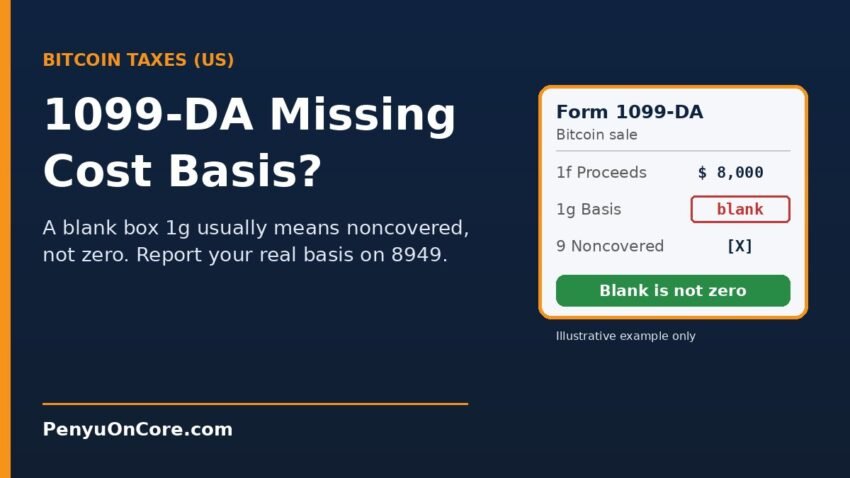
If your Form 1099-DA shows a blank cost basis for a Bitcoin sale, that is usually normal, and it does not mean your basis is zero. A 1099-DA missing cost basis almost always means the broker treated your Bitcoin as a “noncovered” asset, for example because you bought it before 2026 or moved it in from your own wallet. You still report the sale, but you enter your real cost basis on Form 8949 using your own records.
This guide explains why the basis box is empty, how to tell a blank box from a reported zero, and how to rebuild your basis for Bitcoin that went through a self-custody wallet. It is written for US taxpayers. It is general information, not tax advice.
Why your 1099-DA is missing cost basis
Form 1099-DA is the IRS form that US custodial crypto brokers use to report your digital asset sales. The rules were phased in. According to the IRS digital assets page, brokers must report gross proceeds for transactions on or after 1 January 2025, and must report basis only for certain transactions on or after 1 January 2026.
That “certain” matters. The 2026 Instructions for Form 1099-DA say brokers must report basis only for covered securities. A digital asset counts as covered only if it was acquired after 2025 in an account where that broker provided custodial services, and stayed in that account until the broker sold it. Anything else is noncovered, including:
- Bitcoin acquired before 2026.
- Bitcoin transferred in to the broker, for example from a hardware wallet, Sparrow, Electrum or another exchange.
- Any digital asset the broker did not hold in custody when it was acquired.
For a noncovered asset, the broker may check box 9 (“noncovered security”) and leave the basis fields blank. It may also choose to report basis voluntarily. So for most long-term Bitcoin holders, a blank basis box is what you should expect for some time.
Tax year 2025 forms: proceeds only
If you are looking at a form for 2025 sales, no basis was required on any transaction. Coinbase, for example, says its 2025 Form 1099-DA reports only proceeds, with the basis section shown as “noncovered”. It also says crypto you transfer in from an external wallet stays noncovered because the exchange does not have the original purchase records.
Blank is not zero: read box 1g carefully
Box 1g is “Cost or other basis”. The IRS instructions tell brokers to leave box 1g blank if they check box 9 and choose not to report basis, and to enter -0- only if the asset actually had a basis of zero. As accounting firm Forvis Mazars puts it, a blank basis field reflects the reporting rules, not a finding that your basis is zero.
The two cases need different handling:
| What box 1g shows | What it usually means | What to do |
|---|---|---|
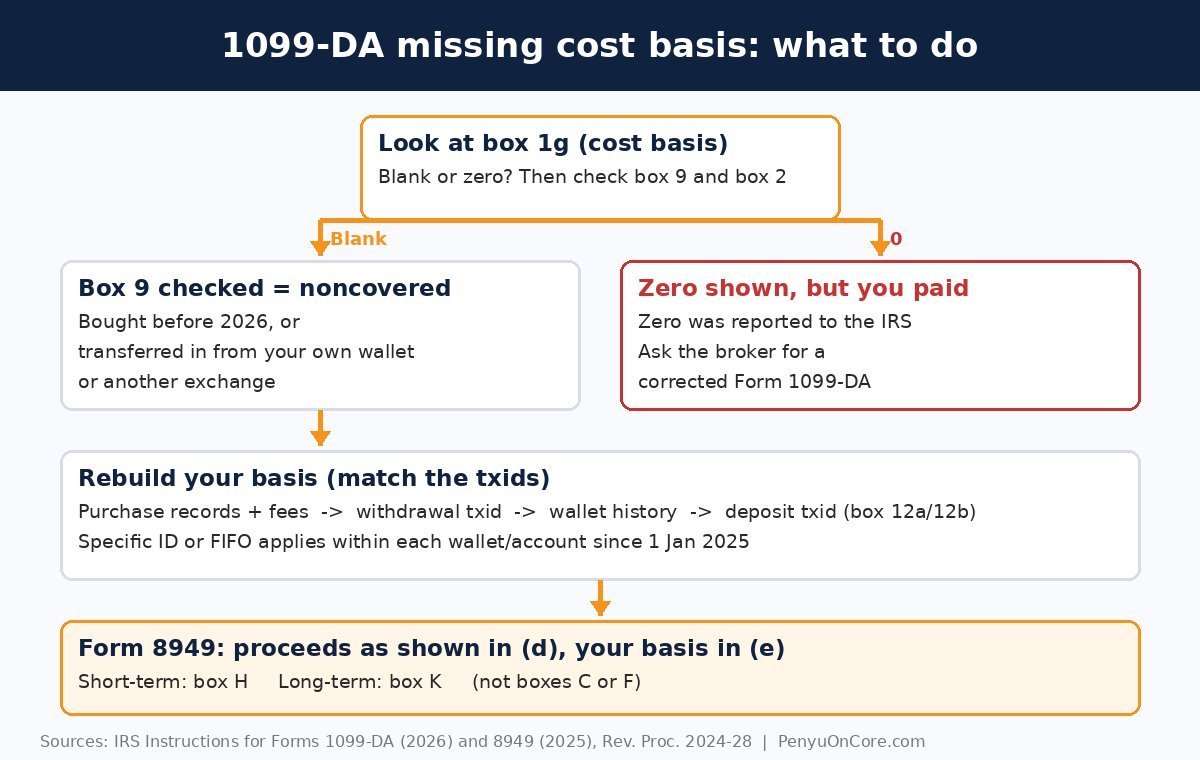
| Blank, box 9 checked | Noncovered Bitcoin, basis not reported to the IRS | Enter your own documented basis on Form 8949 |
| An amount, box 2 not checked | Basis shown to you but not reported to the IRS | Check it against your records; report the correct basis |
| An amount, box 2 checked | Covered asset, basis reported to the IRS | Use it, or make an adjustment if it is wrong |
| 0 when you did pay for the coins | A zero basis was reported to the IRS | Ask the broker for a corrected Form 1099-DA |
Forvis Mazars also notes that one sale can produce more than one Form 1099-DA when some of the units sold were covered and some were not. Many brokers bundle these into one consolidated statement, so read every line.
How to fix a 1099-DA missing cost basis on Form 8949
You do not need a new form from the broker just because basis is blank. The Instructions for Form 8949 say that for noncovered securities you enter the correct basis in column (e) when no basis is shown, or when the basis shown was not reported to the IRS. Here is the usual order of work.
1. Copy the proceeds exactly
Always report the proceeds shown on the form in column (d) of Form 8949, as the instructions require. Fix the basis side, not the proceeds side.
2. Pick the right digital asset box
Form 8949 now has separate boxes for digital assets. For a short-term sale reported on a 1099-DA without basis, or with basis not reported to the IRS, use box H. For a long-term sale in the same situation, use box K. Boxes G and J are for sales where basis was reported to the IRS. Boxes I and L are for sales with no 1099-DA at all. The IRS says not to use the old boxes C and F for digital assets. Your 1099-DA may also show an “Applicable checkbox on Form 8949” code that points you to the right box.
3. Work out the holding period yourself
If box 9 is checked, the broker may leave the acquisition date and the short-term/long-term box empty. You decide whether you held the coins for more than a year, based on when you acquired them. That is not the date they arrived at the exchange.
4. Enter your documented basis in column (e)
Basis is generally what you paid, including fees. The Form 8949 instructions say the basis of a digital asset includes transaction fees, commissions, transfer taxes and other acquisition costs. If you received the Bitcoin as a gift or inheritance, different basis rules apply and you should attach an explanation.
Rebuilding basis for Bitcoin that went through your own wallet
This is where most Bitcoin holders get stuck. You bought on exchange A, withdrew to a hardware wallet, and later sent the coins to exchange B to sell. Exchange B only sees a deposit, so it reports proceeds and leaves basis blank. On 2026 forms, brokers report the number of units transferred in (box 12a) and the transfer-in date (box 12b), unless the coins arrived on many dates. That date is your starting clue.
To connect the sale back to the purchase, gather:
- Purchase records from the original exchange: trade confirmations or a full history export showing date, amount, price and fees.
- Withdrawal records showing the transaction ID (txid) and the address the coins went to.
- Wallet history from your self-custody wallet, ideally exported to CSV, covering the coins in and out.
- Deposit records from the selling exchange, with the txid of the incoming transfer.
- Bank statements showing the money you paid in, as backup evidence.
Match the txids along the chain on a block explorer. Expect some amounts not to line up exactly. A wallet often sends leftover funds back to itself, as explained in our guide to the Bitcoin change address, and network fees reduce what arrives. If an old wallet no longer shows its history after a restore, our article on a restored Bitcoin wallet showing zero covers the common causes.
Which coins did you sell?
Since 1 January 2025, the final IRS regulations apply specific identification or FIFO within each wallet or account, not across all your holdings. Revenue Procedure 2024-28 lets taxpayers who used a “universal” approach before 2025 make a reasonable allocation of their unused basis to each wallet or account as of 1 January 2025. If you hold Bitcoin across several wallets and exchanges, this is a good point to bring in a tax professional or crypto tax software.
Records the IRS expects you to keep
The IRS virtual currency FAQs say you must keep records good enough to support the positions on your return, such as records of receipts, sales, exchanges and fair market value. They also say you must report taxable crypto transactions even if you never receive a 1099. Be especially careful with gifts: the FAQs say that if you cannot document the donor’s basis, your basis is zero.
Bitcoin you hold in a spot ETF is a different setup with different paperwork. Our Bitcoin ETF vs buying Bitcoin comparison covers the trade-offs.
FAQ
Does a blank cost basis on Form 1099-DA mean the IRS thinks my gain is 100%?
No. A blank box 1g means the broker did not report basis. You report your real basis on Form 8949, and the IRS instructions say brokers should enter zero only when the basis really was zero.
Will my 1099-DA ever show basis for Bitcoin I bought years ago?
Not necessarily. Bitcoin acquired before 2026, or transferred in from another wallet, is noncovered, so the broker is not required to report its basis. Some brokers report it voluntarily, so check box 2 and box 9.
Can I just use zero basis to be safe?
You can, but it may mean paying tax on your full sale proceeds rather than on your gain. It is usually better to rebuild your basis from purchase, withdrawal and deposit records.
My broker reported a basis that is wrong. What now?
For basis reported to the IRS, the Form 8949 instructions explain how to enter the reported figure and make an adjustment in columns (f) and (g). If a zero was reported by mistake, ask the broker for a corrected form.
Disclaimer: This article is for general educational purposes only and is not financial, tax or legal advice. Tax rules and forms change, so check the current IRS instructions or speak to a qualified tax professional about your situation.