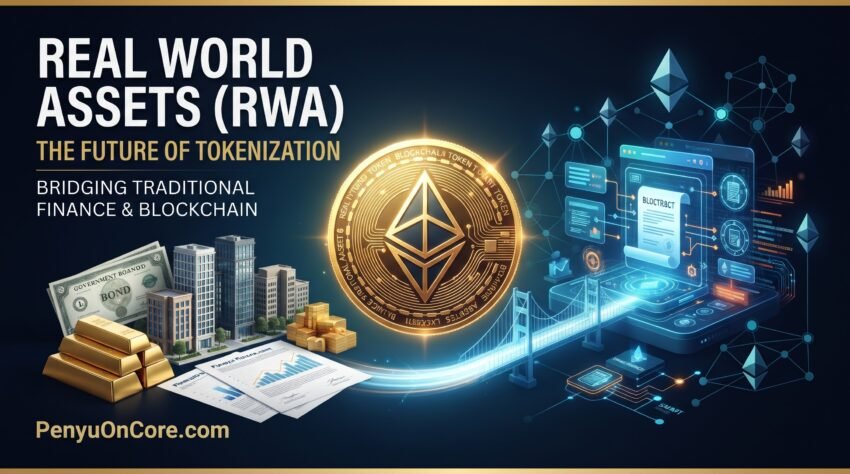
The cryptocurrency industry is evolving beyond digital currencies and decentralized finance. One of the most important developments attracting attention from traditional financial institutions and blockchain companies is Real World Asset (RWA) tokenization.
From government bonds and money market funds to gold, stocks, and real estate, tokenization is creating new ways to represent traditional assets on blockchain networks. This development could change how assets are issued, transferred, managed, and accessed around the world.
As institutional adoption continues to develop, RWA tokenization is becoming an important narrative in the broader digital asset market. But what exactly is RWA tokenization, why does it matter, and what challenges could slow its growth?
What Is Real World Asset (RWA) Tokenization?
Real World Asset tokenization is the process of representing ownership rights, financial interests, or claims related to real-world assets through digital tokens recorded on a blockchain.
These tokens can represent different types of assets, including:
- Government bonds: Tokenized representations of government debt securities.
- Real estate: Digital tokens representing interests in property or property-related investment structures.
- Gold and commodities: Blockchain-based tokens backed by physical commodities.
- Stocks and equities: Digital representations of shares or economic exposure to publicly traded companies.
- Money market funds: Tokenized fund shares that can be recorded and transferred using blockchain infrastructure.
- Private credit: Digital representations of interests in private lending and credit-related assets.
Instead of relying entirely on traditional financial infrastructure, tokenization uses blockchain technology to record and manage digital representations of assets.
However, not every token connected to a real-world asset provides direct legal ownership of that asset. The rights depend on the issuer, legal structure, custody arrangements, and applicable regulations.
Why Is RWA Tokenization Becoming Important?
Traditional financial markets often depend on multiple intermediaries, separate databases, and settlement systems. These processes can create operational complexity and delays.
Blockchain technology offers an alternative infrastructure that could make certain financial processes more efficient.
1. Faster Settlement
One of the main advantages of tokenization is the potential to settle transactions more quickly.
Traditional financial transactions may require multiple institutions to verify and process transfers. Blockchain-based systems can coordinate asset transfers and settlement through digital infrastructure, depending on the asset and network design.
In October 2026, BNY announced a tokenized U.S. Treasury transaction with Citadel Securities. The transaction demonstrated how a tokenized Treasury representation could be settled and subsequently used as collateral in an institutional financing workflow.
2. Greater Transparency
Public blockchains allow transactions to be recorded on distributed ledgers. Depending on the design, authorized participants can verify transactions and track the movement of digital assets.
This transparency could improve reporting and operational processes. Nevertheless, blockchain records do not automatically guarantee that the underlying physical asset exists or that the issuer has sufficient reserves. Independent verification and reliable custody remain essential.
3. More Flexible Access
Tokenization could make certain asset classes accessible through digital platforms and blockchain-based applications.
In some structures, assets can be divided into smaller digital units, potentially lowering the minimum participation amount. However, fractional ownership is not automatically available for every tokenized asset, and access may be restricted by investor eligibility rules and local regulations.
4. Integration With Decentralized Finance
Tokenized assets may also connect traditional financial products with decentralized finance applications.
Depending on their legal and technical structure, tokenized assets could potentially be used in lending markets, collateral systems, trading platforms, and other blockchain-based financial services.
This creates an opportunity for traditional assets to become part of a more interconnected digital financial ecosystem.
Institutional Adoption Is Moving Beyond Experiments
One reason RWA tokenization is attracting attention is the increasing involvement of established financial institutions.
Several major developments demonstrate how traditional finance is exploring blockchain-based infrastructure.
BlackRock and Tokenized Funds
BlackRock has expanded its tokenization activities through blockchain-based fund products. Its BUIDL fund, launched in 2024, represents an important example of traditional financial products being brought onto public blockchain infrastructure.
In August 2026, BlackRock also introduced Ethereum-based tokenized share classes for selected European money market funds in collaboration with Kinexys by JPMorgan.
These developments demonstrate how established asset managers are exploring blockchain as an additional infrastructure for distributing and managing financial products.
DTCC Launches Tokenization Service
A significant milestone occurred on October 28, 2026, when the Depository Trust & Clearing Corporation (DTCC) announced the launch of its Tokenization Service.
The service enables tokenized representations of securities held in DTC custody. According to DTCC, the system is designed to support greater liquidity, collateral mobility, and capital efficiency while maintaining the rights and protections associated with the underlying securities.
DTCC also reported that its subsidiary DTC has more than $114 trillion in assets under custody. The initial service supports integration with the Canton Network and a private Besu network, with additional blockchain networks expected to be considered in 2027.
This development is important because it connects blockchain-based tokenization with established financial market infrastructure.
BNY and Tokenized U.S. Treasuries
On October 13, 2026, BNY announced that it had completed a tokenized U.S. Treasury triparty repo workflow with Citadel Securities.
The transaction used a tokenized representation of a two-year U.S. Treasury note. After settlement, the tokenized security was used as collateral in an overnight financing transaction.
This illustrates how tokenization could extend beyond simply issuing digital assets. It may also support collateral management, financing, and other institutional financial activities.
RWA Market Growth and Key Developments
Market data suggests that tokenized real-world assets have experienced significant growth.
According to CoinGecko’s RWA Report 2026, the market capitalization of tokenized RWAs increased to approximately $19.32 billion by March 31, 2026, representing growth of more than 250% from the beginning of 2025.
Tokenized U.S. Treasuries remained the largest segment. CoinGecko also highlighted the expansion of tokenized commodities and tokenized stocks.
Separately, The Block reported that tokenized U.S. Treasuries reached approximately $15.86 billion across issuers as of September 6, 2026.
These figures use different reporting dates and market definitions, so they should not be treated as directly interchangeable. Nevertheless, they illustrate the growing activity in blockchain-based representations of traditional assets.
Which Blockchains Could Benefit From RWA Adoption?
RWA tokenization does not depend on a single blockchain. Different networks can support different requirements, including security, transaction costs, scalability, privacy, interoperability, and regulatory compliance.
Ethereum
Ethereum has become an important network for tokenized financial products because of its established smart contract ecosystem, developer infrastructure, and integration with decentralized finance applications.
Its ecosystem provides infrastructure for issuing digital tokens, managing financial applications, and connecting tokenized assets with other blockchain services.
Solana
Solana is another blockchain attracting attention for tokenized assets. Its focus on high transaction throughput and relatively low transaction costs may support applications that require frequent transfers and active trading.
Polygon
Polygon provides blockchain infrastructure designed to support scalable applications and Ethereum-compatible development.
Its technology may be useful for businesses looking to build tokenization platforms with connections to the broader Ethereum ecosystem.
Other Blockchain Networks
Other networks, including private and permissioned blockchain systems, also play a role in institutional tokenization.
The DTCC Tokenization Service, for example, initially integrates with the Canton Network and a private Besu network. This highlights that institutional adoption may involve multiple blockchain architectures rather than relying exclusively on public networks.
Major Opportunities for the Crypto Market
The growth of RWA tokenization could create several opportunities across the digital asset industry.
- New financial products: Tokenization could support the development of blockchain-based bonds, funds, commodities, and other financial instruments.
- Institutional participation: Traditional financial institutions may increasingly use blockchain infrastructure for asset management and settlement.
- DeFi expansion: Eligible tokenized assets could create new collateral and liquidity opportunities for decentralized finance.
- Blockchain infrastructure demand: Networks that provide secure, scalable, and compliant infrastructure may attract more developers and institutions.
- Global digital markets: Tokenization could support more connected financial markets with extended operating hours and digital settlement capabilities.
However, these opportunities depend on actual adoption, sustainable business models, regulatory clarity, and the ability to connect blockchain systems with traditional financial institutions.
Risks and Challenges Facing RWA Tokenization
Despite its potential, RWA tokenization still faces important challenges.
1. Regulatory Uncertainty
Tokenized securities and other financial products may be subject to securities laws, financial regulations, and licensing requirements.
Regulatory frameworks differ between countries. A token that is permitted in one jurisdiction may face restrictions in another.
2. Custody and Asset Verification
Token holders need confidence that the underlying assets are properly held, accounted for, and protected.
If an issuer fails to maintain sufficient reserves or a custodian experiences operational problems, token holders could face significant risks.
3. Liquidity Limitations
Putting an asset on a blockchain does not automatically create a liquid market.
Some tokenized products may have limited trading activity, restricted redemption options, or a small number of eligible participants.
4. Smart Contract Security
Tokenization platforms rely on software and smart contracts. Vulnerabilities, incorrect configurations, or compromised administrative keys could result in financial losses.
Security audits, operational controls, and reliable infrastructure are therefore essential.
5. Legal Ownership and Redemption Rights
Investors must understand exactly what a token represents. It may represent direct ownership, a beneficial interest, a contractual claim, or simply economic exposure to an underlying asset.
These structures are not equivalent. The legal documentation and redemption terms should always be reviewed before participating.
What Could Happen Next for the RWA Sector?
The next stage of RWA development may focus on connecting tokenized assets with established financial infrastructure.
Rather than simply issuing digital representations of traditional assets, financial institutions may increasingly explore how tokenized securities can be transferred, used as collateral, integrated into financing workflows, and connected across multiple blockchain networks.
Developments involving DTCC, BNY, BlackRock, and other financial institutions suggest that tokenization is becoming a practical infrastructure discussion rather than only a theoretical blockchain concept.
However, the long-term success of this sector will depend on regulatory approval, investor protection, operational reliability, interoperability, and genuine market demand.
Conclusion: Why RWA Tokenization Matters for the Future of Crypto
Real World Asset tokenization represents one of the most important connections between traditional finance and blockchain technology.
By bringing digital representations of traditional assets onto blockchain networks, tokenization could improve settlement processes, create new financial products, and expand the ways institutions interact with digital markets.
The involvement of major financial institutions and the launch of new tokenization infrastructure in 2026 demonstrate that the sector is continuing to develop.
Nevertheless, RWA adoption is not guaranteed. Legal rights, asset custody, liquidity, regulation, and technology risks remain important factors that investors and businesses must evaluate.
For the cryptocurrency industry, the RWA narrative is worth watching because it could help shape the next phase of blockchain adoption and the future relationship between traditional financial markets and decentralized technology.
References
- CoinGecko – RWA Report 2026
- DTCC – Tokenization Service Goes Live, October 28, 2026
- BNY – Tokenized U.S. Treasury Triparty Repo Workflow, October 13, 2026
- The Block – BlackRock Tokenized European Money Market Funds
- The Block – Tokenized Treasuries Grew 75% in 2026
Disclaimer
This article is for informational and educational purposes only. It does not constitute financial, investment, legal, or tax advice. Tokenized assets and cryptocurrencies involve risks, including market volatility, regulatory uncertainty, liquidity limitations, custody risks, and smart contract vulnerabilities. Always conduct independent research before making financial decisions.