
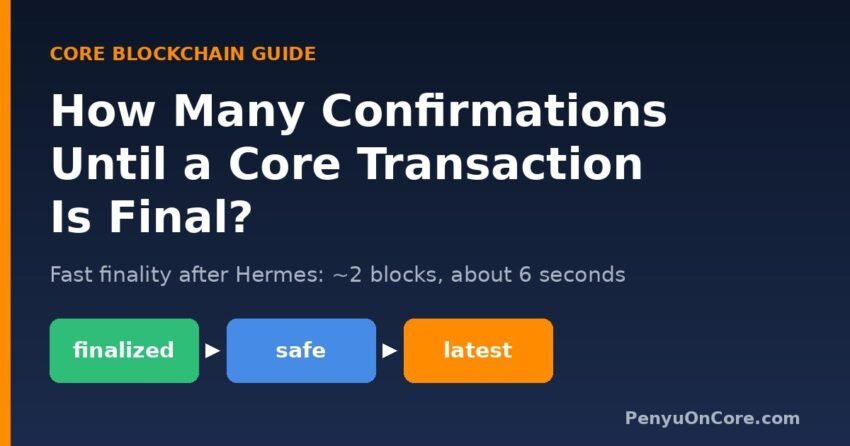
Short answer: since the Hermes hard fork went live on Core mainnet on 25 November 2025, a Core transaction is final after 2 blocks, roughly 6 seconds. Core produces a block about every 3 seconds, and a block counts as finalized once it and the block after it have both collected votes from at least two-thirds of the validators. You don’t need to guess a confirmation count, because you can ask any Core RPC node for the latest "finalized" block and check whether your transaction’s block number is at or below it.
This guide covers what “final” means on Core, why some older pages still say 12 blocks, and how to check finality yourself with a wallet, Core Scan or a few lines of code.
What “Finality” Means on Core
A transaction can be included, confirmed or final, and those mean different things:
- Included (1 confirmation): the transaction is in the newest block. On most chains a block this fresh can still, in theory, be replaced if the network briefly forks.
- Confirmed (N confirmations): more blocks have been built on top, so a reversal gets less and less likely. This is probabilistic security. It gets stronger with time but never becomes absolute.
- Final: the protocol itself guarantees the block will not be reverted. Core’s fast-finality design, inherited from BNB Smart Chain’s BEP-126, states that “once the block is finalized, it would not be reverted anymore.”
How a Core block becomes final
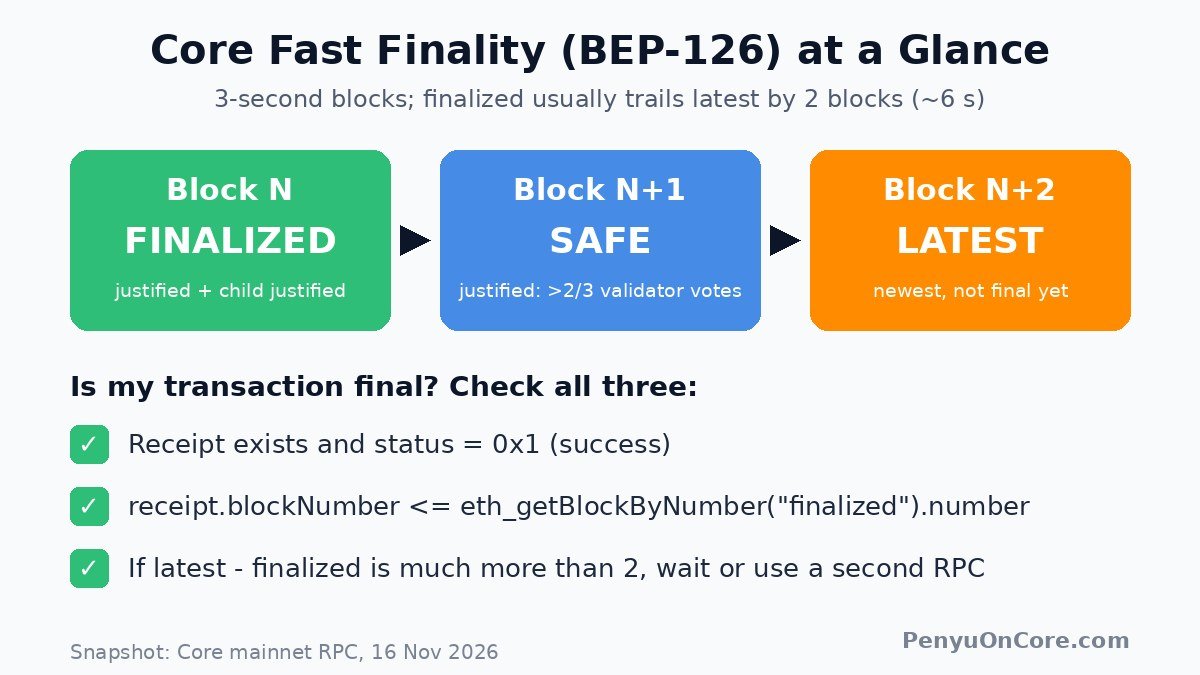
Under BEP-126, validators sign each new block with a BLS key as a vote. When the next block is proposed, the proposer bundles those votes into its header as an “attestation.” The process then has two steps:
- Justified: a block is justified once its direct child carries an attestation from more than two-thirds of validators.
- Finalized: a block is finalized when it is justified and its direct child is justified too.
So in normal conditions the finalized block trails the newest block by about two blocks. According to Core’s architecture docs, each slot is 3 seconds, which is where the “~6 seconds” figure in Core’s Hermes hard fork announcement and the core-chain v1.0.22 release notes comes from.
What I Saw on Core Mainnet (16 November 2026)
To check the theory, We queried the official public RPC (https://rpc.coredao.org, chain ID 0x45c / 1116), which reported client version Geth v1.0.27. We also queried the Ankr and dRPC endpoints listed in Core’s RPC list. Here is a typical reading from the official endpoint:
| Block tag | Block number | Gap to latest | What it means |
|---|---|---|---|
latest | 40,490,322 | 0 | Newest block the node has. Not final yet. |
safe | 40,490,321 | 1 | Latest justified block |
finalized | 40,490,320 | 2 | Protocol-final; will not be reverted |
Over five back-to-back checks, the gap between latest and finalized was 2 blocks every time. The last 1,000 blocks had an average block time of exactly 3,000 ms. All three providers returned the same finalized block when We queried them at the same moment. These readings come from a single session, so treat them as a snapshot, not a guarantee.
Why Some Pages Still Say 12 Blocks
If you search this question, you may see the figure “12 blocks.” That comes from Core’s own FAQ, which still says “the average transaction confirmation time on the Core network is 12 blocks” at the time of writing. That answer comes from the older confirmation-count way of thinking, before fast finality existed. Since Hermes, the chain itself tells you when a block is final, so counting to 12 is no longer the best test. Some exchanges and apps may still use their own, larger confirmation counts for deposits, so always follow the number shown on the platform you’re using.
How to Check If Your Core Transaction Is Final
Option 1: Wallet and Core Scan (no code)
- Copy the transaction hash from your wallet’s activity list.
- Look it up on Core Scan and note its status and block number. Our guide to using Core Scan explains each field.
- If it shows Success and a few more blocks have been produced since, it is almost certainly final. On today’s 3-second blocks, that takes under 10 seconds.
If the transaction has no block number at all, it hasn’t been included yet. That is a pending or stuck transaction, not a finality question. See how to fix a pending Core transaction in MetaMask.
Option 2: Compare against the finalized block (RPC)
The standard Ethereum JSON-RPC block parameter accepts "safe" and "finalized" as well as "latest" (see the ethereum.org JSON-RPC reference), and Core nodes support both. Ask for the finalized block:
curl -s https://rpc.coredao.org -H "Content-Type: application/json" \
  -d '{"jsonrpc":"2.0","id":1,"method":"eth_getBlockByNumber","params":["finalized",false]}'
Then get your transaction’s receipt with eth_getTransactionReceipt. The transaction is final when all three of these hold:
- the receipt exists,
- its
statusis0x1(success), and - its
blockNumberis less than or equal to the finalized block number.
To guard against chain reorganizations, also check that the receipt’s blockHash matches the hash of the block at that height.
A minimal ethers v6 check
import { JsonRpcProvider } from "ethers";
const provider = new JsonRpcProvider("https://rpc.coredao.org");

async function isFinal(txHash) {
  const receipt = await provider.getTransactionReceipt(txHash);
  if (!receipt) return false;                 // not mined yet
  const finalized = await provider.getBlock("finalized");
  return receipt.status === 1 && receipt.blockNumber <= finalized.number;
}
The same idea works in web3.py (w3.eth.get_block("finalized")) or viem (getBlock({ blockTag: "finalized" })). Reads, balances and eth_call can use the "finalized" tag too. That’s useful for back-end jobs like crediting deposits, where you only want to act on state that can’t change.
BSC-style helper: eth_getFinalizedHeader
Core is a BNB Smart Chain fork, and in my test the official RPC also answered eth_getFinalizedHeader. It takes a single number. The node accepted 3, but rejected 21 with an error saying the value must be in the range 1 to 10 or -3 to -1. This is a non-standard method, so for portable code, stick with the standard "finalized" tag.
When Finality Can Slow Down
BEP-126 keeps block production and finalization separate. More than two-thirds of validators must vote to move the finalized block forward, but only more than half are needed to keep producing blocks. If many validators go offline, the chain can keep growing while the finalized block stops advancing. Two practical takeaways:
- Watch the gap. If
latestminusfinalizedis much larger than 2, something unusual is happening. Wait, or fall back to a conservative confirmation count, rather than assuming finality. - Use more than one RPC. Any single public endpoint can lag or rate-limit you, so compare a second provider before acting on a large transfer.
Also keep in mind that finality protects against reversal, not mistakes. A final transfer to the wrong address, or a final approval to a malicious contract, is permanent. Use our guide on revoking token approvals to clean up risky permissions.
FAQ
How long does a Core transaction take to be final?
Normally about 6 seconds, or 2 blocks after the block that includes it. Core’s Hermes documentation and my mainnet test both showed this, with 3-second blocks.
Is 1 confirmation enough on Core?
One confirmation means the transaction is included but not yet final. For anything that matters, wait until its block is at or below the finalized block. On Core that’s usually just a few seconds more.
Why is an exchange asking for more confirmations?
Exchanges set their own deposit rules and may wait longer than the protocol requires. The platform’s displayed requirement is what decides when your deposit is credited.
Does a final transaction mean it succeeded?
No. A failed (reverted) transaction can also be final, and you still pay its gas fee. Check that the receipt’s status is 1. See our “execution reverted” fix guide if it isn’t.
Disclaimer: This article is for educational purposes only and is not financial or investment advice. Crypto transactions are irreversible and carry risk. Network behaviour can change after upgrades, so verify details with official Core sources before relying on them.