
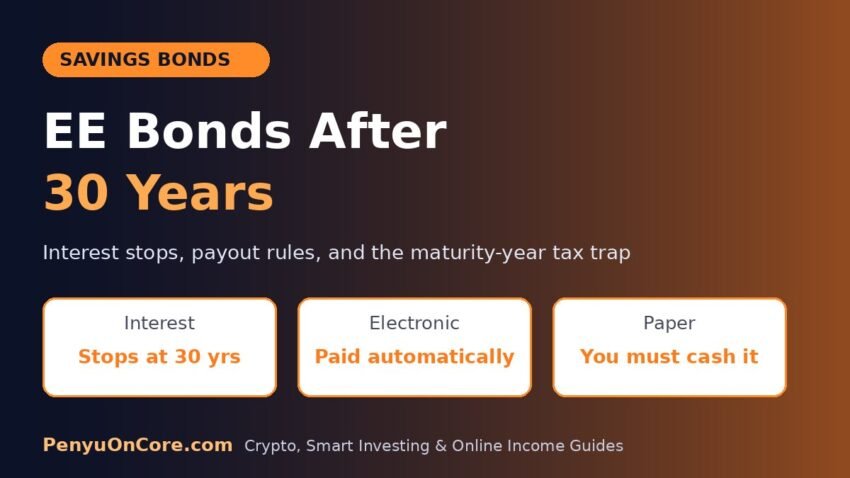
Short answer: A Series EE savings bond stops earning interest at final maturity, 30 years after its issue date, and its value is frozen from that point on. Electronic EE bonds in TreasuryDirect are paid out automatically, but paper EE bonds are not: you have to cash them yourself. Either way, if you deferred the tax, all the interest becomes federally taxable in the year the bond matures, even if a paper bond is still in a drawer.
Below: what the 30-year mark means, which bonds have hit it, how to collect, and the tax trap that catches people with forgotten bonds.
What “final maturity” means for an EE bond
Federal regulations say Series EE bonds have a total maturity period of 30 years from the issue date, and “the interest on an outstanding bond ceases to accrue 30 years after its issue date” (31 CFR Part 351, Subpart B). TreasuryDirect says the same thing in plainer words: EE bonds earn interest for 30 years, unless you cash them before then.
It helps to separate two dates that people often mix up:
- Original maturity. Depending on the issue date, this is 17 or 20 years. For EE bonds issued since June 2003, Treasury guarantees the bond will be worth at least twice what you paid at 20 years (TreasuryDirect). The bond keeps earning after this point.
- Final maturity. Always 30 years after the issue date. After this, the bond earns nothing.
The bond doesn’t expire and you don’t lose its value. It just stops growing, so every extra month you hold it earns 0%.
Which EE bonds have already stopped earning?
Series EE bonds were first sold in January 1980 (IRS Publication 550), so the earliest ones reached final maturity in 2010. Because a bond’s issue date is always the first of a month, the simple rule as of November 2026 is:
- EE bonds issued in or before November 1996 have reached 30 years and no longer earn interest.
- EE bonds issued in December 1996 reach final maturity in December 2026, and bonds from 1997 mature during 2027.
- Older Series E bonds (and series A–D, F, G, H, J, K and savings notes) no longer earn interest at all.
Check the issue date printed on a paper bond, or the issue date shown under Current Holdings for an electronic one. Don’t go by the year you think it was bought.
Paper vs. electronic EE bonds at 30 years
What happens next depends mostly on the form of the bond.
| Question | Electronic EE bond | Paper EE bond |
|---|---|---|
| Paid automatically? | Yes, at maturity | No, you must submit the bond |
| Where does the money go? | Your primary bank account on file (since 24 Aug 2026) | Your bank, or the account named on FS Form 1522 |
| Still earning interest? | No | No |
| Who sends the 1099-INT? | TreasuryDirect, in your account by 31 January | The bank that cashes it, or Treasury by mail the following January |
| When is the interest taxable? | Year of maturity | Year of maturity, even if you haven’t cashed it yet |
Electronic EE bonds: paid automatically
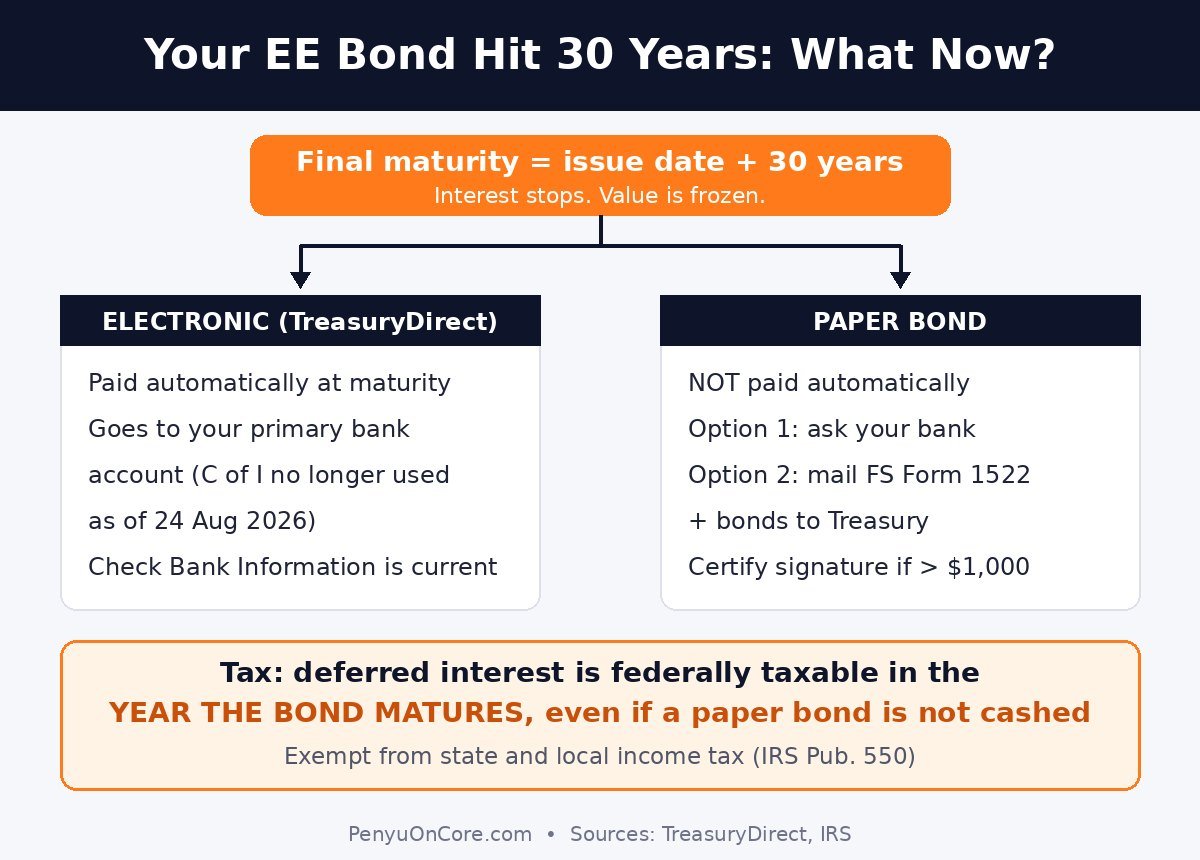
For bonds held in TreasuryDirect, Treasury pays the value automatically when the bond reaches final maturity, if you haven’t cashed it earlier (EE bonds page). In the past, the proceeds often went to the zero-interest Certificate of Indebtedness (C of I) inside your account. That changed in 2026. According to the C of I FAQ, as of 24 August 2026 the C of I is no longer a payment destination, and payments now go to your primary bank account. Treasury also says it is automatically redeeming existing C of I balances to customers’ primary bank accounts on a rolling basis through fall 2026.
What to do: log in, open Account Info → Bank Information, and make sure your primary bank account is current. If an old account is closed, a maturity payment can bounce. If you still see a C of I balance, you can redeem it yourself under ManageDirect → Redeem Securities.
Paper EE bonds: you have to act
Treasury will not mail you a check just because a paper bond turned 30. Per TreasuryDirect’s cashing page, you have two routes:
- Your own bank. Ask first whether it cashes savings bonds, how much it will cash at one time, and what ID it needs. Policies vary, and some banks don’t cash them at all.
- Treasury by mail. Fill out FS Form 1522, get your signature certified if the total value is over $1,000, and mail the form and bonds to the address on the form. Treasury has no limit on how many bonds or how much value you can cash at once.
A paper bond has to be cashed for its full value, because you can’t cash part of one. (Partial cashing only works for electronic bonds; see our guide to partial redemption of I bonds, which follows the same rules as EE.) If you have a stack of paper bonds and some are still earning interest, it may make more sense to convert paper savings bonds to electronic and keep those in TreasuryDirect. Note that during conversion, bonds that have stopped earning interest are cashed rather than converted.
The tax trap: interest is due in the year the bond matures
This is the part most people miss. Savings bond interest is exempt from state and local income tax but subject to federal income tax (TreasuryDirect). Most cash-method taxpayers use what the IRS calls Method 1, which postpones reporting the interest “until the earlier of the year you cash or dispose of the bonds or the year in which they mature” (IRS Publication 550). IRS Topic 403 says the same thing.
So the deferral ends at maturity, whether or not you cash the bond. The problem for paper bonds is the paperwork. A 1099-INT is created only when the interest is actually paid to you (TreasuryDirect glossary). If a paper bond matured in 2024 and you cash it in 2026, you’ll get a 1099-INT for 2026, but the IRS rule ties the income to 2024. A tax professional can tell you whether an amended return is needed.
For electronic bonds this mostly sorts itself out, because the payout and the 1099-INT happen in the maturity year. To find that form, see our walkthrough of where to find your TreasuryDirect 1099. If you reported the interest every year (Method 2), the final 1099-INT still shows the total, and Publication 550 explains how to adjust for interest you’ve already reported.
What about the education exclusion?
TreasuryDirect notes that if you use bond money for qualified higher education expenses, you may not have to pay tax on the earnings. Strict eligibility rules apply, so check with a tax adviser before counting on it.
Lost, inherited or forgotten EE bonds
- Treasury Hunt is gone. Treasury’s search tool for matured unredeemed bonds closed on 30 September 2025.
- Lost, stolen or destroyed bonds. Use FS Form 1048, listed on TreasuryDirect’s savings bond forms page, to request payment or replacement.
- Not sure whether a bond was already cashed? TreasuryDirect says to ask your bank first. If the bank can’t tell you, the owner can write to Treasury Retail Securities Services with the serial numbers. Don’t send the bonds themselves.
- Bonds from someone who died. These follow a separate process. Start at the “Death of a savings bond owner” link on the cashing page.
What to do with the money afterward
Once a bond stops earning, the cash is just cash. You can’t roll a matured EE bond into a new bond automatically, and new electronic EE bonds are capped at $10,000 per Social Security number per calendar year. If you want to compare where to park short-term cash, our SGOV vs. high-yield savings breakdown covers the trade-offs.
FAQ
Do EE bonds expire after 30 years?
No. They stop earning interest, but you can still cash them for their final value. There is simply no benefit to waiting.
Will Treasury send me money for my matured paper EE bond?
No. Only electronic bonds in TreasuryDirect are paid automatically. Paper bonds have to be cashed at a bank or by mailing FS Form 1522 with the bonds.
Do I owe tax if I never cashed my matured EE bond?
Under IRS Publication 550, deferred interest becomes reportable in the year the bond matures, even if you haven’t cashed it. It is federally taxable but exempt from state and local income tax.
How do I know if my EE bond has reached 30 years?
Add 30 years to the issue date. As of November 2026, any EE bond issued in or before November 1996 has stopped earning interest. TreasuryDirect’s Savings Bond Calculator shows the current value of a paper bond.
Can a bank refuse to cash my savings bonds?
Yes. Banks set their own policies and limits. If yours won’t cash them, you can always cash them through Treasury with FS Form 1522.
Disclaimer: This article is general information, not financial or tax advice. Rules and TreasuryDirect procedures can change; check the official sources linked above or talk to a qualified tax professional about your situation. Information verified 17 November 2026.