

Quick answer: TreasuryDirect does not mail your 1099 for electronic securities. It posts it inside your account by January 31 of the following year. Log in, open the ManageDirect tab, choose the tax year under Manage My Taxes, then click the link near the top of the “Taxable Transaction Summary” page to view and print the actual 1099. If no 1099 shows up, the usual reason is that you had no reportable interest that year. Buying or holding savings bonds alone doesn’t create one.
Many TreasuryDirect users only find out at tax time that the form isn’t in the mailbox. This guide covers where the form is, what each section means, why it might be missing, and how the numbers usually end up on your return.
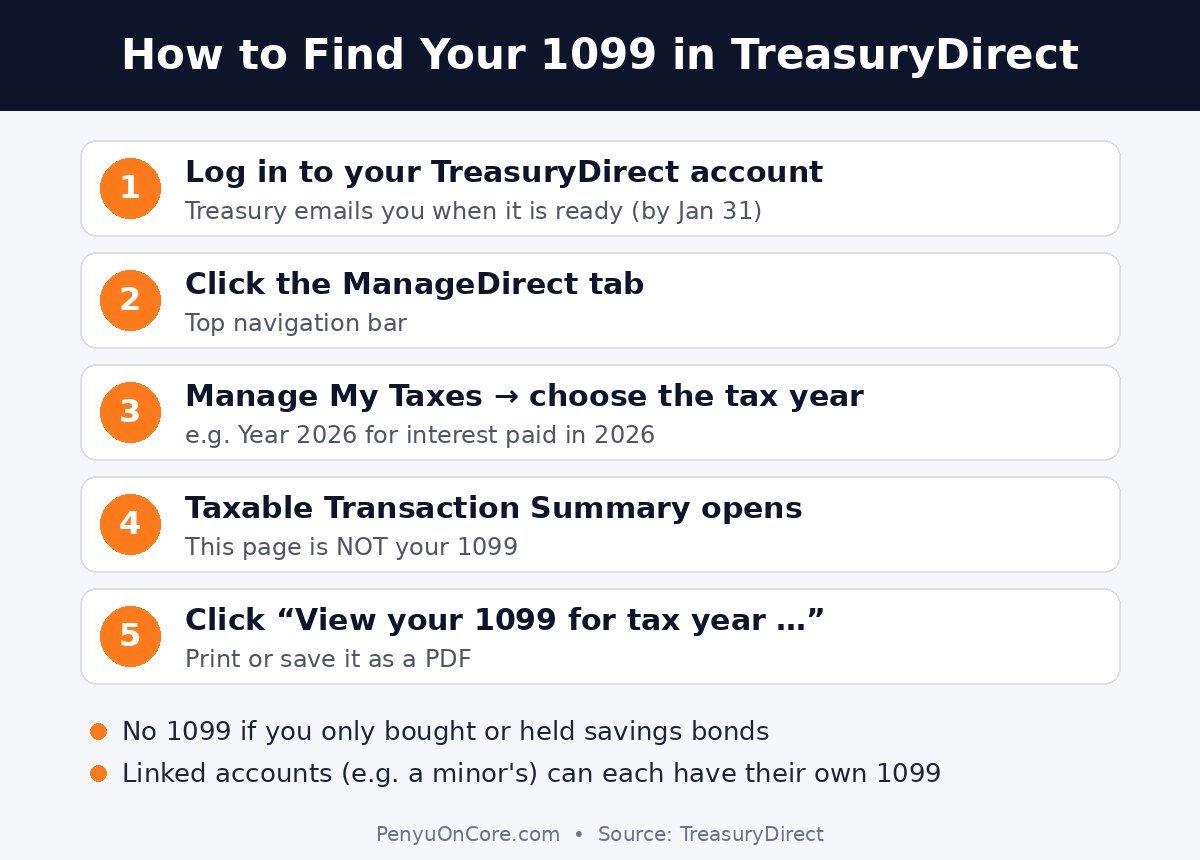
Step by step: how to find your 1099 in TreasuryDirect
These are the steps from TreasuryDirect’s own tax forms page and its 1099 help page:
- Log in to your TreasuryDirect account.
- Click the ManageDirect tab at the top.
- Under Manage My Taxes, click the year you need (for example, “Year 2026” for interest you received in 2026).
- That opens the Taxable Transaction Summary. Near the top, click “View your 1099 for tax year …”.
- Print it or save it as a PDF for your records, your tax software or your preparer.
Watch out for one common mix-up. TreasuryDirect says plainly that the Taxable Transaction Summary is NOT your 1099. The summary is only the page that links to the form. You want the printable form itself. According to the TreasuryDirect user guide, the form shows Treasury’s federal ID number as payer, your name, address, account number and taxpayer ID, plus totals for interest, amount and any federal income tax withheld.
When is the TreasuryDirect 1099 available?
Treasury says it places 1099s in accounts by January 31 of the following year. When yours is ready, TreasuryDirect sends an email to your personal address and a message to your TreasuryDirect InBox. So the form for interest received during 2026 should appear by January 31, 2027.
If you cashed paper savings bonds, timing and delivery work differently. The table below sums up the cases described on TreasuryDirect’s 1099 page and tax forms page:
| Your situation | Who gives you the 1099 | How you get it |
|---|---|---|
| Electronic I or EE bond cashed in TreasuryDirect | Treasury | Online in your account, by January 31 |
| T-bills, notes, bonds, TIPS or FRNs held in TreasuryDirect | Treasury | Online in your account, by January 31 |
| Paper savings bond cashed at a local bank | The bank that paid it | From the bank |
| Paper bond cashed by mailing it to Treasury Retail Securities Services | Treasury | Mailed by January 31 (duplicates by phone from February 15) |
| Securities still in Legacy Treasury Direct | Treasury | Mailed at the start of the year |
| Treasuries held at a bank or broker | That bank or broker | Through your brokerage tax documents |
The last row matters if you moved bills out of TreasuryDirect during the year (see our guide to transferring T-bills from TreasuryDirect to a brokerage). After the transfer, the broker handles tax reporting for anything it pays you. TreasuryDirect’s page tells you to talk to your bank, broker or dealer about tax forms for securities they hold, so you may end up with forms from both places for the same year.
Why your TreasuryDirect 1099 is missing
1. You only bought or held savings bonds
This is the most common reason. Electronic I and EE bonds pay all their interest at once, either when you cash them or when they reach final maturity after 30 years (TreasuryDirect’s savings bond tax page). Treasury says directly: “We don’t provide a 1099 if you only buy or hold a savings bond.” If you didn’t cash anything during the year, there’s normally nothing to report and no form to find.
Cashing part of a bond does count. If you did a partial redemption of an I bond, the interest in that portion shows up on that year’s 1099.
2. The form is in a linked account
Treasury notes that linked accounts, such as a minor’s account or an account where you converted paper bonds, can each have their own 1099. If you cashed bonds held in a child’s linked account, look in that account’s tax section, not just your main one.
3. It’s not January 31 yet, or your securities are elsewhere
Forms post by the January 31 deadline, not on January 1. And if your Treasuries sit at a broker, the 1099 comes from the broker, not TreasuryDirect.
4. A gifted bond hasn’t been delivered yet
Bonds bought as gifts sit in your account’s gift box until you deliver them (see how the I bond gift box works). Holding bonds there isn’t cashing them, so it doesn’t trigger a 1099.
What the sections on your TreasuryDirect 1099 mean
Treasury issues one 1099 covering all your Treasury securities in the account. It can have up to three sections, each listed in date order with the confirmation and CUSIP number of each security:
- 1099-INT: interest you received during the year. This covers interest from cashed savings bonds, note and bond coupons, and the T-bill “interest”, meaning the gap between the discounted price you paid and the face value you got at maturity.
- 1099-B: proceeds from maturing securities that you didn’t buy at original issue. The section is split into covered and non-covered securities.
- 1099-OID: TIPS only. It reports the yearly inflation increase or deflation decrease in principal. Treasury reports this every year, even if the TIPS hasn’t matured and you haven’t been paid.
On the 1099-INT, the IRS tells payers to put interest on US savings bonds, Treasury bills, notes and bonds in Box 3, not Box 1 (IRS Instructions for Forms 1099-INT and 1099-OID). That separation matters for state taxes, covered below.
How the interest is taxed
Treasury interest is subject to federal income tax but exempt from state and local income taxes. TreasuryDirect says so for marketable securities, and IRS Publication 550 says the same for US savings bonds. Tax software usually treats Box 3 interest as state-exempt, but it’s worth checking your state return to confirm. The same state-tax angle comes up with some funds (see which money market funds are state-tax exempt).
A few timing details from Treasury and the IRS:
- T-bills: you generally report the interest when the bill is paid at maturity (Publication 550). If a bill matures on December 31 and that day falls on a weekend or holiday, Treasury pays on the next business day but still shows the payment on the 1099-INT on the maturity date.
- Notes, bonds and TIPS with a December 31 interest date: if that date is a weekend or holiday, Treasury pays the interest on the first business day of the new year and reports it as earned then.
- Savings bonds: most people defer reporting until they cash the bond. You can choose to report interest every year instead, but you still get only one 1099-INT at the end, showing all the interest. Publication 550 explains how to adjust for interest you already reported.
- Education use: interest on qualified EE or I bonds cashed to pay qualified higher education expenses may be partly or fully excludable under the Education Savings Bond Program (Form 8815). Income limits apply.
If your total taxable interest and ordinary dividends are over $1,500, or you’re claiming the savings bond education exclusion, you’ll also need Schedule B (Form 1040).
Withholding: avoiding a surprise bill next year
TreasuryDirect can withhold federal tax from interest payments on securities it holds, up to 50 percent of the interest. You set the percentage in your account, and the 1099 shows both what you earned and what was withheld. This can help if a big batch of bills or a large bond redemption would otherwise leave you owing at filing time.
Need an older or duplicate 1099?
- TreasuryDirect account: pick the earlier year under Manage My Taxes and open that year’s 1099.
- Legacy Treasury Direct, current year: call 844-284-2676 (toll-free), or +1-304-480-6464 from outside the US.
- Legacy Treasury Direct, earlier years: write to Treasury Retail Securities Services, P.O. Box 9150, Minneapolis, MN 55480-9150.
FAQ
Does TreasuryDirect mail a 1099?
Not for electronic securities in a TreasuryDirect account. The form is posted online by January 31. Treasury mails 1099s only for Legacy Treasury Direct holdings and for paper bonds cashed by mail.
I bought I bonds this year. Why is there no 1099?
Because you haven’t received any interest yet. Savings bond interest is reported when you cash the bond or when it matures, unless you choose to report it yearly yourself.
Is the Taxable Transaction Summary the same as the 1099?
No. Treasury says the summary is not your 1099. Click the “View your 1099” link near the top of that page.
Do I pay state tax on T-bill or I bond interest?
Not state or local income tax. Interest on Treasury securities and US savings bonds is federally taxable but exempt from state and local income taxes.
Disclaimer: This article is for general information only and is not tax, legal or financial advice. Tax rules and TreasuryDirect’s menus can change, so check with the IRS, TreasuryDirect or a qualified tax professional for your situation.