
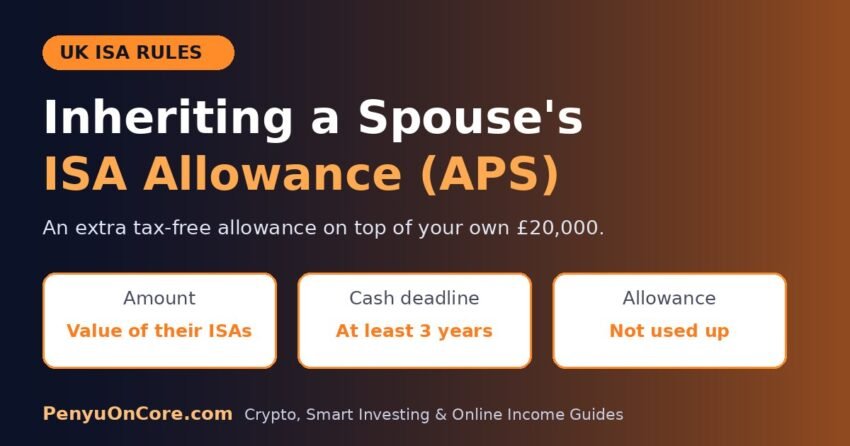
Short answer: If your husband, wife or civil partner died with money in an ISA, you can usually pay an extra amount into your own ISA equal to the value of their ISAs, on top of your normal £20,000 allowance. This one-off extra allowance is called an Additional Permitted Subscription (APS). You don’t need to have inherited the ISA itself, and in most cases you have at least three years from the date of death to use it.
Below we cover who qualifies, how the amount is worked out, the deadlines, and the steps to claim it. Everything is based on GOV.UK, HMRC’s guidance for ISA managers and the ISA Regulations 1998, regulation 5DDA.
Who can inherit a spouse’s ISA allowance
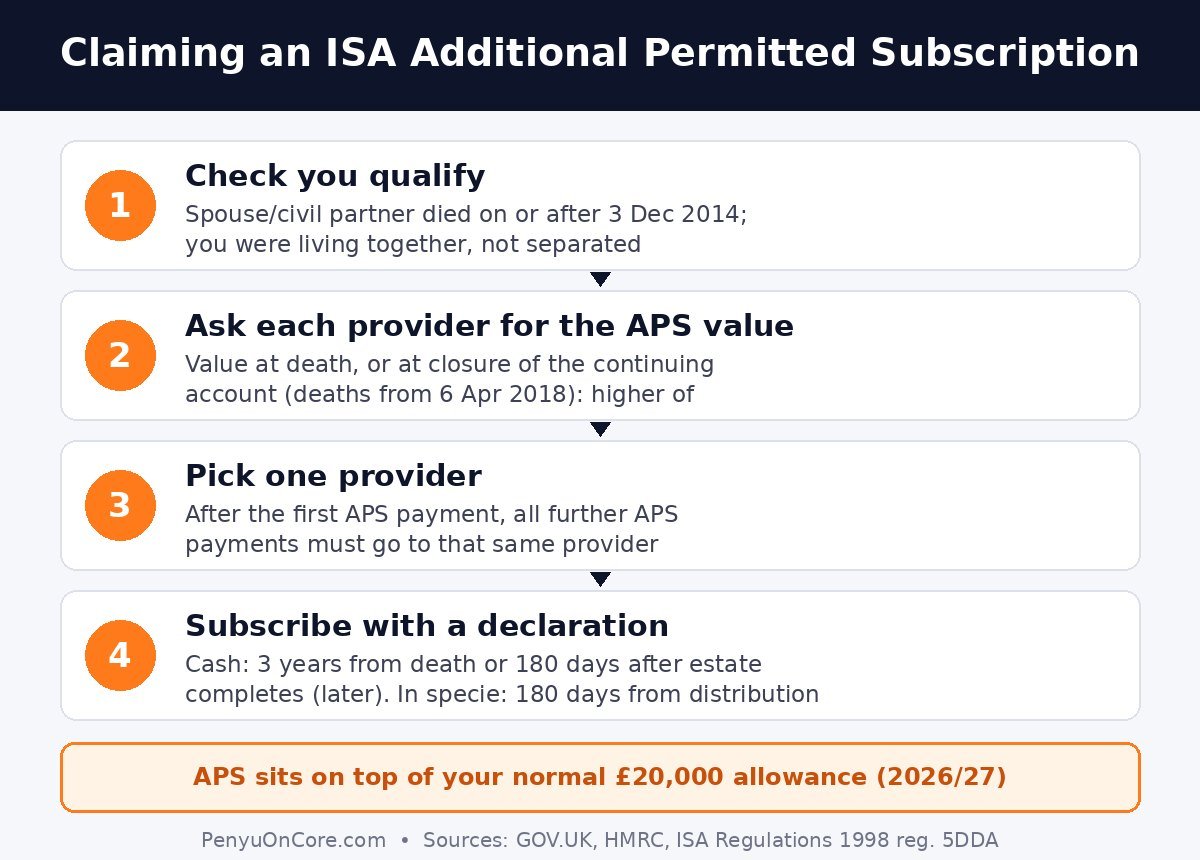
The APS is for the surviving spouse or civil partner of an ISA holder who died on or after 3 December 2014. If the death was before that date, GOV.UK says the allowance can’t be inherited.
According to HMRC’s guidance, you also have to have been living together on the date of death. You don’t qualify if you were separated under a court order, under a deed of separation, or because the marriage or civil partnership had broken down.
Some details people often miss:
- You don’t need to inherit the ISA. The APS exists whether or not the ISA assets were left to you. If the will left the investments to your children, you can still pay in up to the APS amount from your own savings.
- Non-residents can use it. HMRC confirms an APS can be made even if you no longer live in the UK. Normally a non-resident can’t pay into an ISA at all.
- Junior ISAs don’t count. Money the deceased held in a Junior ISA is left out of the calculation, and you can’t pay an APS into (or out of) a Junior ISA.
How much is the APS?
The basic figure is the value of your spouse’s ISAs on the date they died. For deaths on or after 6 April 2018 there is a second option. The ISA becomes a “continuing account of a deceased investor” and keeps its tax-free status until one of three things happens: the executor closes it, the administration of the estate is completed, or three years pass since the death (GOV.UK). Your APS can be the higher of the value at death or the value when the account stops being a continuing account.
Barclays calls these “APS 1” and “APS 2”. In a rising market the later value can be bigger, and in a falling market the date-of-death value may be the better choice. There is one catch. HMRC says that if you start paying in using the date-of-death figure, you can’t then switch to the later figure with that provider. If you think the closure value might end up higher, it can be worth waiting until the account is closed before you subscribe.
If your spouse had ISAs with more than one provider, each provider gives you its own figure and the values are added together into a single APS limit. HMRC lets you pick the date-of-death value from one provider and the closure value from another. With any one provider, though, you can’t mix the two valuation points.
It sits on top of your own allowance
The APS doesn’t use up any of your regular allowance. HMRC treats APS money as “previous year subscriptions”, so you can still pay in your own £20,000 for the 2026 to 2027 tax year. If your spouse held £30,000 in ISAs, you could pay in £50,000 this tax year in total. The cash ISA limit is also staying put. At the Budget on 28 October 2026, the Chancellor confirmed the annual cash ISA limit will remain £20,000 and the planned cut was cancelled (UK Parliament Treasury Committee).
Deadlines for using the APS
How long you have depends on whether you pay in cash or move the actual inherited investments (“in specie”). These limits come from regulation 5DDA(4):
| How you pay in | Deadline | Notes |
|---|---|---|
| Cash (inherited money or your own savings) | 3 years from the date of death, or 180 days after the estate administration is complete, whichever is later | Can go to any provider that agrees to accept APS money |
| Inherited ISA investments (in specie) | Within 180 days of the assets being distributed to you | Only possible with the deceased’s ISA provider; each interim distribution gets its own 180-day window |
Moving the investments themselves means they never leave the ISA wrapper, so you don’t have to sell and buy back. GOV.UK points out that a stocks and shares ISA can only be moved straight into the surviving spouse’s ISA if you both use the same provider. If you don’t, you’ll usually be paying in cash.
How to claim the APS, step by step
1. Ask each provider for the APS value
Write to every provider your spouse held an ISA with. HMRC’s guidance says the request should include the deceased’s name and address, National Insurance number (if known), date of birth, date of death and the date of your marriage or civil partnership. You also confirm that you’re the surviving spouse or civil partner and that you were living together. For investment ISAs, Barclays notes that a probate valuation can take a couple of weeks.
2. Pick one provider for the APS
You can use the deceased’s provider or any other provider willing to take APS money. Choose carefully. HMRC states that after you make your first APS payment with a provider, every later APS payment has to go to that same provider, and any unused balance can’t be taken elsewhere. Providers don’t have to accept APS money at all, so check before you open an account. If the platform’s own safety is a worry, our guide on what happens if your broker goes bankrupt explains how FSCS protection works.
3. Make the declaration each time you pay in
With your first payment you confirm that you’re the surviving spouse or civil partner and that you lived with the deceased. Every payment also needs a declaration that it’s made under regulation 5DDA and falls within the time limit. A provider can accept money provisionally, but if the paperwork doesn’t arrive within 30 calendar days, the money has to be removed or it will count against your normal annual allowance.
4. Choose the ISA type
An APS can go into a cash, stocks and shares or innovative finance ISA. It can go into a Lifetime ISA only if you’re eligible to pay into one (under 40 and UK resident, per GOV.UK), and it then counts towards the £4,000 Lifetime ISA limit. Once the APS is in, HMRC says you can transfer that ISA under the normal transfer rules.
Tax points to keep in mind
- Inheritance Tax: ISA investments form part of the estate for Inheritance Tax (GOV.UK). There’s normally no Inheritance Tax on what is left to a spouse or civil partner (GOV.UK Inheritance Tax), but the ISA still counts towards the estate’s value.
- Income and gains during administration: For deaths from 6 April 2018, there’s no Income Tax or Capital Gains Tax on the ISA while it remains a continuing account, for up to three years.
- Other tax-free products: NS&I Premium Bonds have their own rules after a death. See Premium Bonds after death.
If the APS money may be needed for bills over the next few months, consider leaving part of it in an easy-access cash ISA rather than investing all of it. Our emergency fund guide explains how to work out how much to keep handy.
FAQ
Do I have to use the APS all at once?
No. You can pay it in as one lump sum or in several smaller payments, as long as the total stays within your APS limit, you stay with the same provider and you meet the deadline.
Can unmarried partners use the APS?
No. The rules only cover a surviving spouse or civil partner who was living with the deceased on the date of death.
Does the APS reduce my normal ISA allowance?
No. It’s treated as a previous-year subscription, so your full annual allowance is still available.
What if my spouse died between December 2014 and April 2018?
You can still get an APS, but it’s based only on the value of the ISA on the date of death. Under the older rules the ISA ended when your spouse died, so there’s no continuing account value to use instead.
Disclaimer: This article is general information, not financial, tax or legal advice. ISA rules can change and your situation may differ. Check with your ISA provider, HMRC or a regulated adviser before acting.