

Short answer: If your broker goes bankrupt, your stocks usually do not disappear. In both the US and the UK, regulated brokers must keep customer assets separate from the firm’s own money, so in most failures your holdings are simply moved to another broker or returned to you. Compensation schemes (SIPC in the US, the FSCS in the UK) only step in if assets are actually missing, and neither protects you from a falling share price.
The catch: “protected” does not mean “instantly available,” the limits are lower than many assume, and some things held at an app or exchange are not covered at all. Here is what really happens for US and UK investors.
Step one: your assets are supposed to be ring-fenced
The first line of defence is not an insurance scheme. It is the rule that a broker cannot treat your shares as its own property.
In the US: the SEC Customer Protection Rule
SEC Rule 15c3-3, known as the Customer Protection Rule, requires broker-dealers that hold customer securities and cash to keep fully paid customer securities in their possession or control and to set aside customer cash in a special reserve bank account for the exclusive benefit of customers. FINRA explains the practical result: should a brokerage firm cease operations, “in virtually all cases, customer assets are safe and typically are transferred in an orderly fashion to another registered brokerage firm” (FINRA).
FINRA also notes that a failing firm that complies with the Customer Protection Rule and the Net Capital Rule can usually self-liquidate or find a buyer, with regulators overseeing the transfer of accounts. A full SIPC liquidation is described as a rarer event, typically where customer assets appear to be missing, for example because of fraud or theft.
In the UK: the FCA’s client assets (CASS) rules
UK firms that hold client money or investments must follow the FCA’s Client Assets Sourcebook (CASS). The FCA says the purpose of these rules is “to keep client money and assets safe if firms fail and exit the market.” In practice your shares and funds on a platform are usually held in a nominee account for you, separate from the platform’s own balance sheet, and an insolvency practitioner’s job is to identify client assets and return them or move them to another provider.
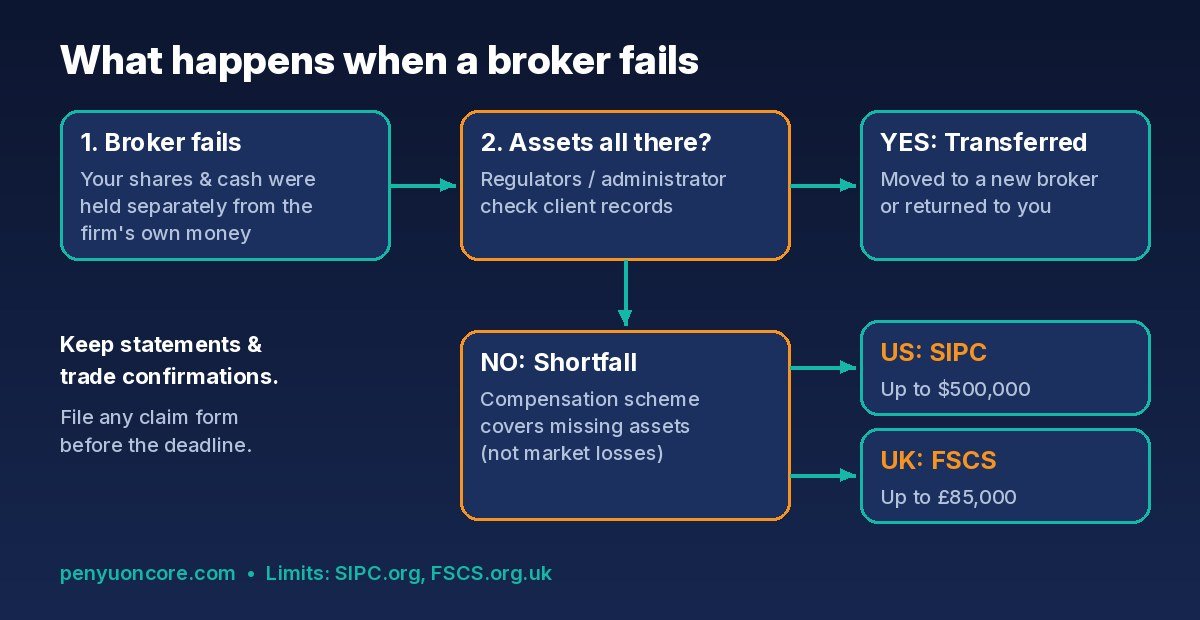
Step two: compensation if something is actually missing
Compensation schemes are the safety net under the ring-fence. They matter when records are wrong, money has been misused, or there is a shortfall in what the failed firm holds.
SIPC (United States)
According to SIPC, it protects against the loss of cash and securities held by a customer at a financially troubled SIPC-member brokerage, up to $500,000, including a $250,000 limit for cash. SIPC says it only protects the custody function of the broker-dealer: it works to restore the securities and cash that were in your account when the liquidation began.
Some key details from SIPC and the SEC:
- Limits apply per “separate capacity,” not per account. SIPC’s multiple accounts page explains that two individual accounts in your own name at the same firm are combined, while an individual account, a joint account, a traditional IRA and a Roth IRA are each protected separately.
- You don’t have to be American. SIPC states there is no requirement that a customer reside in or be a citizen of the US.
- SIPC is not a government agency. Investor.gov describes it as a non-government entity that, when a member becomes insolvent, asks a court to appoint a trustee to supervise the liquidation and process claims.
- You may get shares back, not just cash. The US Courts explain that a SIPC trustee is required to distribute securities to customers “to the greatest extent practicable,” aiming to preserve your portfolio as it stood on the filing date.
FSCS (United Kingdom)
The FSCS says it may be able to protect you if an investment provider goes out of business and there is a shortfall in the money or assets it is holding for you. For firms that failed after 1 April 2019, compensation is up to £85,000 per eligible person, per firm. The firm must be authorised by the FCA or PRA, and the activity it carried out for you must be a regulated one.
Don’t confuse this with the bank savings limit. FSCS deposit protection for UK banks, building societies and credit unions rose to £120,000 on 1 December 2025, but the FSCS is clear that only the deposits and savings limit is £120,000; investments have their own limit.
SIPC vs FSCS at a glance
| Feature | SIPC (US) | FSCS investments (UK) |
|---|---|---|
| Main limit | $500,000 per separate capacity | £85,000 per eligible person, per firm (failures after 1 Apr 2019) |
| Covers market losses? | No | No (no claims for poor investment performance) |
| Ring-fencing rule | SEC Rule 15c3-3 | FCA CASS rules |
| How to check your firm | SIPC member list / FINRA BrokerCheck | FCA Financial Services Register |
What is NOT protected
This is where most misunderstandings happen. FINRA’s list of things SIPC does not cover includes ordinary market loss, commodity futures, fixed annuities, currency, hedge funds and investment contracts not registered with the SEC (FINRA). SIPC adds that it does not protect people who are sold worthless stocks or who lose money because of bad investment advice.
For crypto investors, SIPC is explicit that it does not protect digital asset securities that are investment contracts not registered with the SEC, even if held by a SIPC-member brokerage. If you keep coins on an exchange, the main protection is the exchange’s own solvency and custody practices, which is why our crypto security guide covers self-custody basics.
On the UK side, the FSCS says it “can’t accept any claims that are for poor investment performance.” If your fund drops 20% because markets fell, that is investment risk, not a failure claim. If falling prices are what is really worrying you, read our piece on what to do with retirement savings in a market sell-off.
What about the cash in your brokerage account?
US investors should check where their uninvested cash actually sits. The SEC’s investor bulletin on cash sweep programs explains three common setups:
- Bank sweep: cash goes into deposit accounts at one or more banks and gets FDIC insurance up to $250,000 per customer at each participating FDIC-insured bank.
- Money market fund sweep: cash buys a money market fund, which has no FDIC insurance but may be protected by SIPC.
- Free credit balance: cash simply stays at the broker and is generally covered by SIPC.
The same bulletin notes that many firms default to a bank sweep and that sweep rates can vary significantly. If you hold a lot of cash for safety, compare options; our breakdown of SGOV vs high-yield savings looks at that trade-off, and our emergency fund guide covers how much cash to keep somewhere easy to reach.
What to do if your broker fails
- Don’t panic-sell. Your account may be frozen briefly anyway. FINRA warns there may be a window when you cannot trade or transfer your account.
- Save your records. Download recent statements, trade confirmations and records of deposits. FINRA says SIPC advises gathering exactly these documents and checking them for accuracy.
- Watch for official letters. In a SIPC liquidation you will be notified that a trustee or a direct payment procedure has started. File any claim form completely and on time; FINRA notes that under federal law no one can satisfy claims filed late.
- UK investors: follow the administrator and FSCS. Check the FSCS website for the failed firm’s page and any instructions. If you accept FSCS compensation, the FSCS explains that your legal rights against the firm transfer to it.
How to lower your risk before anything goes wrong
- Confirm your US broker is a SIPC member and check it on FINRA BrokerCheck; in the UK, confirm the firm on the FCA register.
- If your account value is well above the compensation limits, consider whether spreading across separately authorised firms (UK) or separate account capacities (US) makes sense for you.
- Understand which entity actually holds your assets, especially with newer apps that use a partner broker or custodian.
FAQ
Will I lose my stocks if my broker goes bankrupt?
Usually not. US and UK rules require customer assets to be kept separate, and they are normally transferred to another firm. SIPC or the FSCS may compensate you, up to their limits, if assets are missing.
Is SIPC the same as FDIC insurance?
No. FINRA points out that FDIC insures bank deposits if a bank fails and does not cover stocks or bonds. SIPC restores missing cash and securities at a failed broker but does not protect their market value.
Does the UK £120,000 FSCS limit cover my stocks and shares ISA?
No. £120,000 is the deposit limit for banks, building societies and credit unions. Investment claims against a failed firm are capped at £85,000 per eligible person, per firm, for failures after 1 April 2019.
Are crypto holdings at a broker covered by SIPC?
SIPC says it does not protect digital asset securities that are unregistered investment contracts, even at a SIPC member. Treat exchange-held crypto as unprotected by these schemes.
Disclaimer: This article is for general educational purposes only and is not financial, legal or tax advice. Protection rules and limits can change; confirm details with SIPC, the FSCS, your broker or a qualified professional before making decisions.