
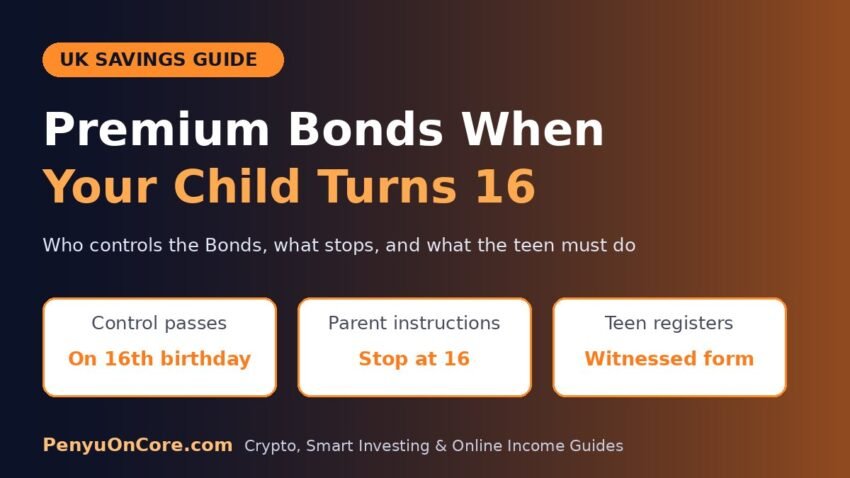
Quick answer: When a child turns 16, control of their Premium Bonds passes from the parent or guardian to the child. The Bonds always belonged to the child, but from the 16th birthday the teenager manages them, and NS&I says any instructions a parent set on the child’s behalf (such as how prizes are paid) only last until the child turns 16. To take over, the teen registers with NS&I, either online or with a witnessed form.
Many UK families buy Premium Bonds for babies and young children, often as gifts from grandparents. Years later, the 16th birthday arrives and nobody is quite sure what happens next. Can the parent still cash them in? Where do prizes go? Does the teen need to fill in anything? This guide goes through what NS&I’s own pages and documents say, so you know what changes and what to do.
Who owns a child’s Premium Bonds before 16?
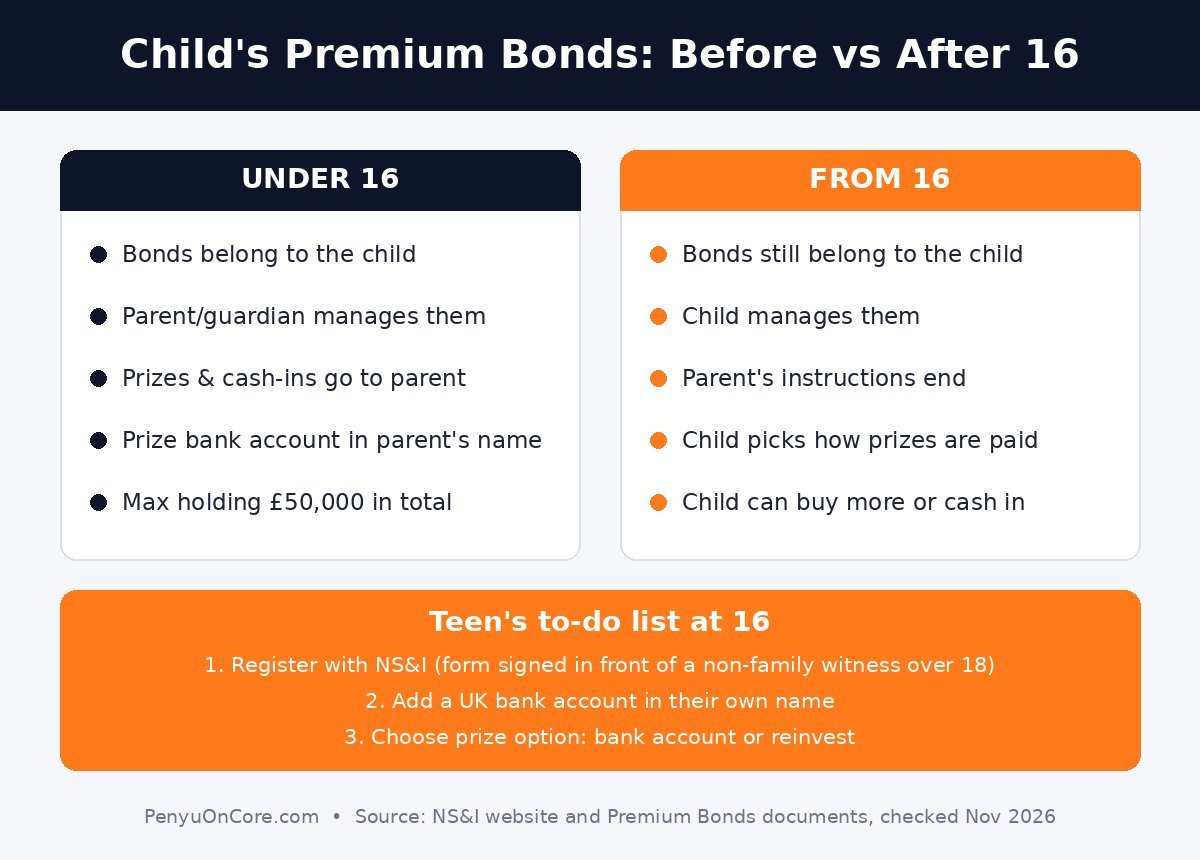
NS&I’s Premium Bonds page is clear that children under 16 can hold Premium Bonds, but the Bonds must be looked after by a parent or guardian. That can be the parent or guardian who bought them, or one nominated by whoever bought them (for example, a grandparent). NS&I calls this adult the “responsible person.”
The key points from NS&I’s terms for under-16s:
- The money is the child’s. “Any Bonds bought and any prizes paid in relation to them will belong to the child.” The parent manages them for the child’s benefit.
- Paperwork and payments go to the parent. NS&I sends documents, prizes and money from cashed-in Bonds to the parent or guardian until the child is 16.
- Prize bank account is in the parent’s name. NS&I’s prize options form says that for children under 16, the bank account for prizes must be in the name of the responsible parent or guardian.
- A gift-giver doesn’t get control. Someone who buys Bonds for another person’s child can’t look after them or have them repaid to themselves. Only the nominated parent or guardian can manage and cash them in.
- The £50,000 cap still applies. A child can have more than one responsible person (each gets a separate holder’s number), but the child can’t hold more than £50,000 of Premium Bonds in total.
What changes on the 16th birthday
NS&I’s help page on owning your account when you turn 16 says: “As soon as you turn 16, you become responsible for your own NS&I account(s).” The Premium Bonds page says the same: “When the child turns 16, they’ll manage their own Bonds.”
In practice, that means three things.
1. The parent’s instructions stop
The prize options form says it in one line: “Instructions made by a parent or guardian on behalf of children only remain in place until the child turns 16.” If prizes were going to a parent’s bank account, or being reinvested on the parent’s instruction, the teenager should set up their own prize option instead of assuming the old one will keep running.
2. The teen can buy, cash in and choose prize options
Once the teen has registered and logged in, NS&I says they’ll see their Premium Bonds and can “buy more Bonds, cash them in, choose how your prizes are paid and update your details.” They can also go paperless. Sixteen is also the age at which anyone can apply for Premium Bonds of their own (NS&I asks applicants to be 16 or over and to have a UK bank account).
3. The parent can’t keep the Bonds
Because the Bonds always belonged to the child, the parent can’t move them into their own name at 16. NS&I’s key features and customer agreement also says you “cannot sell or give your Premium Bond to someone else,” and that Premium Bonds can’t be held jointly or in trust.
How a 16-year-old takes control: step by step
NS&I offers two routes: online, or by post.
Online (the route NS&I recommends)
- Register for NS&I’s online service. NS&I may check the teen’s identity with questions based on credit reference agency data. If that check fails, the teen can finish registration by posting a form instead, and NS&I says it might ask for a witness to sign it.
- Or use the paper registration form. NS&I’s help page links to a registration form. A witness (anyone over 18 who isn’t a family member) writes a short covering letter certifying that they saw the teen sign the form, and adds their name, address and occupation.
- Log in and set prize options. Pick prizes paid to a UK bank account in the teen’s own name or reinvested into more Bonds. NS&I notes that even if you choose reinvestment, it still needs bank details so it can pay prizes once the £50,000 limit is reached.
By post
If the teen doesn’t want to use the online service, they can write to NS&I with the account type, holder’s number, their name, address and date of birth, and their signature. A witness (over 18, not family) signs the bottom of the letter with the wording NS&I specifies, plus their name, address, date of birth and occupation. NS&I’s help page gives the address as NS&I, Sunderland SR43 2SB. After that, the Bonds can be managed by post.
Tip: Before the birthday, the parent should find the child’s holder’s number and a recent Bond record or prize statement. These details are needed for the postal route, and they make it easier to check that every holding has been found, especially if more than one relative set up Bonds for the same child.
Other children’s accounts that change around 16
Premium Bonds aren’t the only savings with a 16th-birthday rule. If your child has several accounts, check each one, because the ages don’t all match:
| Account | What happens at 16 | Access to the money |
|---|---|---|
| Premium Bonds | Child manages the Bonds; parent’s instructions end | Child can cash in from 16 |
| Junior ISA | Child can take control of the account | No withdrawals until 18 (GOV.UK) |
| NS&I Children’s Bonds (closed to new sales) | Child controls Bonds held in their name | Per Children’s Bond terms |
| Adult ISA | Can’t open one yet | Must be 18 or over to open (GOV.UK) |
For an NS&I Junior ISA, the same help page says the teen clicks “Take ownership” after logging in, and at 18 NS&I automatically moves the money into an NS&I adult cash ISA. If you’ve been through the US version of this handover, it’s similar to de-linking a TreasuryDirect minor account at 18, except that in the UK it happens at 16, not 18.
Things worth knowing before handing over
- Prizes are tax-free. NS&I says Premium Bond prizes are free from UK Income Tax and Capital Gains Tax.
- There’s no interest, just a chance of a prize. At the time of writing, NS&I’s page shows an annual prize fund rate of 4.35% and odds of 21,000 to 1 per £1 Bond each month, both variable. NS&I points out that because prizes are random, an individual holder may get more or less than this rate, and that inflation can reduce the real value of money over time.
- Cashing in is flexible. Bonds can be cashed in, in full or in part, at any time (in whole pounds). NS&I says requests made in the last two working days of a month are usually delayed so the Bonds go into the next draw.
- NS&I is backed by HM Treasury. NS&I says it secures 100% of savings, including amounts above the £120,000 that most banks guarantee.
For a teenager, Premium Bonds can work as a first emergency pot because the money isn’t locked away. Our guide to how much emergency fund you need covers the basics. If you’re sorting out a family member’s savings after a bereavement, see what happens to Premium Bonds after death.
FAQ
Does my child have to do anything when they turn 16?
Control passes automatically, but to actually manage the Bonds the teen needs to register with NS&I (online, or by a witnessed form or letter) and set their own prize options, because the parent’s instructions stop at 16.
Can a parent still cash in a child’s Premium Bonds after 16?
NS&I says the child becomes responsible for their own accounts at 16, so cashing in becomes the teenager’s decision, not the parent’s.
Can grandparents keep control of Premium Bonds they bought?
No. Anyone buying for someone else’s child must name a parent or guardian to look after the Bonds, and the buyer can’t have them repaid to themselves.
Who can be the witness?
According to NS&I, anyone over 18 who isn’t a member of the teen’s family.
Disclaimer: This article is general information, not financial advice. NS&I rules, prize rates and odds can change, so check NS&I’s website or contact NS&I before acting. Facts were checked against NS&I and GOV.UK sources in November 2026.