
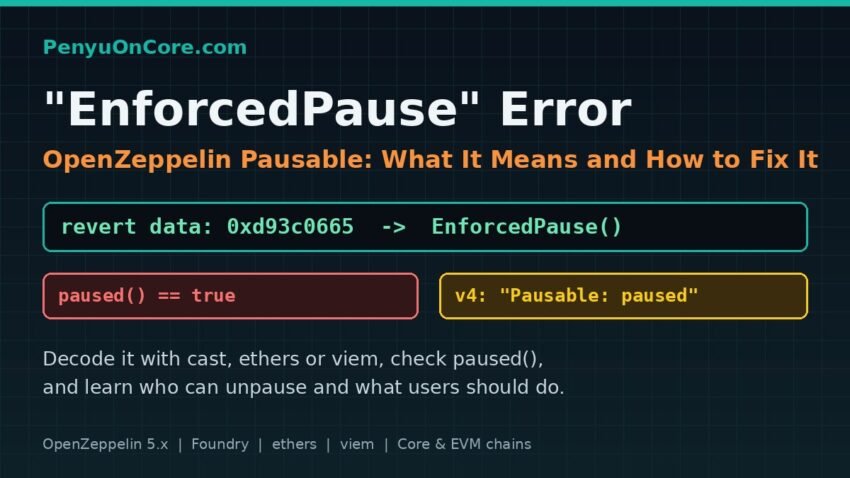
A transfer, swap or deposit fails, and the error says EnforcedPause(), execution reverted: EnforcedPause, or just shows the raw data 0xd93c0665. On older contracts you might see Pausable: paused instead. All of these mean the same thing: the contract has been switched into a “paused” state on purpose, and the function you called is not allowed to run while it is paused.
Quick answer: The EnforcedPause error is OpenZeppelin’s Pausable module (version 5.x) refusing a call because paused() is true. Its 4-byte selector is 0xd93c0665, and the older 4.x equivalent is the string "Pausable: paused". If you are a user, there is nothing to fix on your side, so wait for the project to unpause. If you are the developer, only the account with pause rights (usually the owner or a PAUSER_ROLE holder) can call unpause().
What the EnforcedPause error means
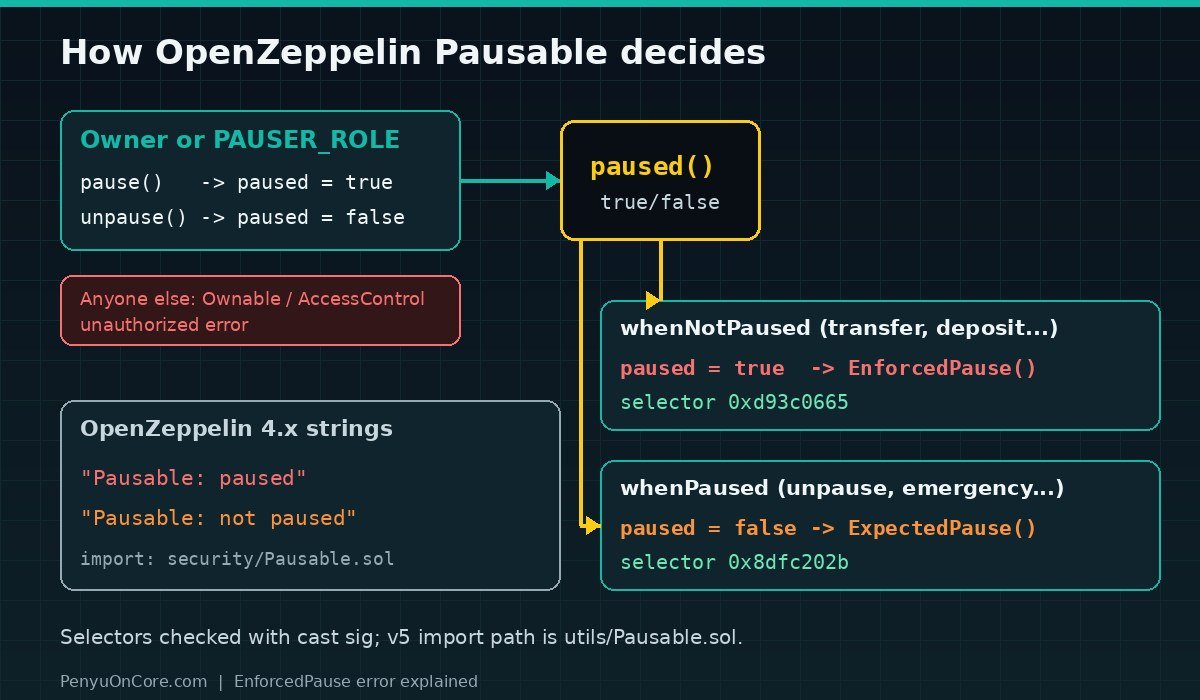
OpenZeppelin’s Pausable.sol is an “emergency stop” that many tokens, vaults and bridges use. It stores one boolean and exposes two modifiers:
whenNotPausedruns_requireNotPaused(), which reverts withEnforcedPause()if the contract is paused. Normal actions such as transfers, deposits and mints use this modifier.whenPausedruns_requirePaused(), which reverts withExpectedPause()if the contract is not paused. Emergency-only functions use this one, and so does_unpause()itself.
The source code describes them as “The operation failed because the contract is paused” and “The operation failed because the contract is not paused”. When the contract is paused it emits a Paused(account) event, and when it is unpaused it emits Unpaused(account). Including Pausable does nothing on its own. The modifiers only apply to functions where the developer adds them, and the contract has to define its own public pause()/unpause() functions with access control. The OpenZeppelin 5.x utils docs and the ERC20Pausable source both point this out.
Verified selectors and v4 equivalents
We computed the selectors with Foundry’s cast sig (forge/cast 1.9.0) and cross-checked them with cast keccak, where the selector is the first 4 bytes of the hash:
$ cast sig "EnforcedPause()"
0xd93c0665
$ cast sig "ExpectedPause()"
0x8dfc202b
$ cast sig "paused()"
0x5c975abb| Situation | OpenZeppelin 5.x | OpenZeppelin 4.x |
|---|---|---|
| Function blocked while paused | EnforcedPause() = 0xd93c0665 |
"Pausable: paused" |
| Function needs paused state, but contract is live | ExpectedPause() = 0x8dfc202b |
"Pausable: not paused" |
| Import path | utils/Pausable.sol |
security/Pausable.sol |
The OpenZeppelin CHANGELOG for 5.0.0 lists both changes: “Replaced revert strings and require statements with custom errors” and “ReentrancyGuard, Pausable: Moved to utils directory”. You can see the older string version in the v4.9.6 security/Pausable.sol. The latest release when we checked was v5.7.0 (published 29 July 2026). In v5.7.0, Pausable.sol is still marked “last updated v5.3.0”. If you upgrade from 4.x and your imports break, change @openzeppelin/contracts/security/Pausable.sol to @openzeppelin/contracts/utils/Pausable.sol.
How to decode the revert
We deployed a small OpenZeppelin v5.7.0 ERC20Pausable token to a local Anvil node, paused it, and tried a transfer. Here is what each tool printed.
Foundry (cast and forge)
$ cast call $TOKEN "transfer(address,uint256)" $TO 1 --from $OWNER --rpc-url $RPC
Error: execution reverted: EnforcedPause
... data: "0xd93c0665"

$ cast decode-error 0xd93c0665
EnforcedPause()

$ cast decode-error 0x8dfc202b
ExpectedPause()
cast send failed before broadcasting, during gas estimation: Failed to estimate gas: ... custom error 0xd93c0665, data: "0xd93c0665": EnforcedPause. In forge test, the failing test showed [FAIL: EnforcedPause()], and -vvvv traced it to PausableToken::transfer. For v4-style data, cast decode-error on the 0x08c379a0... payload returned Error(string) and "Pausable: paused". See the cast decode-error reference for options.
One gotcha: our first cast call skipped --from, so it simulated the call from the zero address. The token returned ERC20InvalidSender(0x000...0) instead of EnforcedPause, because that check runs first. Always simulate from a real sender. Our Foundry cast commands guide covers these flags.
ethers v6 and viem
- ethers 6.17 (
staticCall):code: CALL_EXCEPTION,data: 0xd93c0665. Witherror EnforcedPause()in the ABI,e.revertwas{"name":"EnforcedPause","signature":"EnforcedPause()","args":[]}. Without it, ethers only saidexecution reverted (unknown custom error).Interface.parseError("0xd93c0665")also returnedEnforcedPause. - viem 2.58 (
simulateContract):The contract function "transfer" reverted., witherrorName: EnforcedPauseon the error’scause.decodeErrorResultgave the same name.
The lesson is to add the Pausable errors to your front-end ABI. Otherwise users see a vague “execution reverted”, which our execution reverted guide explains in more detail.
How to check if a contract is paused
paused() is a public view function, so anyone can read it for free with no wallet signature:
cast call 0xYourContract "paused()(bool)" --rpc-url https://rpc.coredao.orgOn Core mainnet (chain ID 1116, which we confirmed with cast chain-id), this read-only call works the same way it does on any EVM chain. Not every token is pausable, though. On 21 Nov 2026, calling paused() on Core’s USDT, USDC and stCORE contracts returned a bare execution reverted. Those contracts simply do not expose paused(), so that result does not mean “paused”. On a block explorer, you can also check the contract’s “Read Contract” tab or look for recent Paused/Unpaused events.
Who can unpause?
_pause() and _unpause() are internal, so each project decides who can call them. In our tests, the two common patterns behaved like this:
- Ownable:
unpause() external onlyOwner. When a different account tried to unpause, the call reverted withOwnableUnauthorizedAccount(address). See our OwnableUnauthorizedAccount guide. - AccessControl:
onlyRole(PAUSER_ROLE), wherePAUSER_ROLE = keccak256("PAUSER_ROLE"). A caller without the role gotAccessControlUnauthorizedAccount(account, role). See the AccessControlUnauthorizedAccount guide.
Many production projects put these rights behind a multisig or timelock. Check the contract’s owner() or role holders on the explorer to see who controls the pause.
What to do if a token or dApp you use is paused
If you are an end user, the pause is the contract working as designed, not a fault in your wallet. A paused call reverts, so the action does not go through and those tokens do not move. You may still pay gas if you force a failed transaction on-chain. Here is what to do:
- Stop retrying. Your wallet’s simulation will keep failing until the contract is unpaused.
- Check official channels. Look at the project’s website, docs, verified social accounts or status page for the reason (often an incident, upgrade or migration) and an expected timeline.
- Watch for the
Unpausedevent or re-checkpaused()later. - Beware “unpause” scams. No website, bot or “support agent” can unpause someone else’s contract for you. Anyone asking you to connect a wallet, sign an approval or share a seed phrase to “fix” a paused token is trying to steal funds.
Developer fixes
EnforcedPause during development
If you didn’t expect the pause, find out who paused the contract and when (look for the Paused event), fix the underlying issue, then call unpause() from the authorized account. Here is a minimal forge script that we ran against a local Anvil node:
function run(address target) external {
    if (!Pausable(target).paused()) return;
    vm.startBroadcast();
    IPausableAdmin(target).unpause();
    vm.stopBroadcast();
}
Run it with forge script script/Unpause.s.sol --sig "run(address)" $TARGET --rpc-url $RPC --broadcast and a signer that holds the owner key or pauser role. Rehearse on a local fork or testnet first.
ExpectedPause
This error means you called a whenPaused function (for example unpause() or an emergency withdrawal) while the contract was live. Pause first, or check your script’s logic.
Test both states
token.pause();
vm.expectRevert(Pausable.EnforcedPause.selector);
token.transfer(alice, 1);

vm.expectRevert(Pausable.ExpectedPause.selector);
token.unpause(); // when not paused
These checks, plus Ownable and PAUSER_ROLE access tests, passed in our Foundry run with OpenZeppelin v5.7.0. For v4 contracts, use vm.expectRevert(bytes("Pausable: paused")). See Foundry’s expectRevert docs. Also remember that ERC20Pausable in v5 hooks _update, so it blocks minting and burning as well as transfers while paused.
FAQ
Is EnforcedPause a bug in my wallet?
No. The contract deliberately rejected the call because it is paused. Your wallet and tokens are unaffected.
What is 0xd93c0665?
It is the 4-byte selector of EnforcedPause(). 0x8dfc202b is ExpectedPause().
Can I bypass a pause?
Not through the paused functions. Only the authorized pauser can unpause. A site that claims otherwise is a red flag.
How long do pauses last?
The contract has no built-in timer. The project decides when to unpause, so follow their official announcements.
Disclaimer: This article is for educational purposes only and is not financial or security advice. Do your own research, verify contract addresses yourself, and get a professional audit before deploying contracts that hold real funds.