
If you need to replace lost savings bonds, the process runs through a single paper form: FS Form 1048, signed in front of a notary or bank certifying officer and mailed to the Treasury. For Series EE and I bonds, the Treasury no longer issues paper replacements, so you either get an electronic substitute in a TreasuryDirect account or ask for the bonds to be cashed by direct deposit.
Below is a walkthrough of who can file, what you need (even without serial numbers), and which options apply to each bond series, based on the Treasury’s pages and FS Form 1048 (Revised March 2026).
Can You Replace Lost Savings Bonds? The Short Answer
Yes. According to TreasuryDirect’s lost, stolen, or destroyed EE and I bond page, you can ask for relief if a paper bond is lost, stolen, destroyed, mutilated, or you never received it.
You have two options for EE and I bonds:
- Electronic replacement: the substitute bond is placed in your TreasuryDirect account. If you don’t have an account yet, you need to open one first.
- Cash the bond: the Treasury pays the value by direct deposit to the bank account you list on the form.
Paper EE and I bonds are no longer sold. The I bonds page confirms that since January 1, 2025, I bonds are available only electronically. That is why a replacement can’t come back as a new paper certificate.
Which Option Applies to Your Bond Series?
The relief you can choose depends on the series and on how close the bond is to final maturity. The rules in the form’s instructions (Item 5) boil down to this:
| Bond situation | Electronic substitute? | Cash by direct deposit? |
|---|---|---|
| Series EE or I, more than a month from final maturity | Yes, into your TreasuryDirect account | Yes, but EE/I bonds issued February 2003 or later must be at least one full year old |
| Series EE or I, less than one full calendar month from final maturity, or already matured | No | Yes, payment is made instead |
| Series HH (all have reached final maturity) | No | Yes, this is the only option |
Two details are easy to miss. First, if you ask for cash on an EE or I bond issued in February 2003 or later that is less than a year old, the Treasury issues a substitute bond instead. Second, EE and I bonds earn interest for 30 years, according to the I bonds page, so an old bond you’ve lost may already have stopped growing. If that’s the case, cashing it is the only route and there’s no reason to wait. See what happens to EE bonds after 30 years.
For HH bonds, TreasuryDirect’s lost HH bond page states that redemption is the only option because they have stopped earning interest and matured.
What You Need Before Filling Out FS Form 1048
The bond description (with or without serial numbers)
Part 1 of the form asks for each bond’s issue date (an exact date or a range), face amount, serial number, and inscription, meaning the full names, Social Security Number and address printed on the bond. If the bond was a gift, give the purchaser’s SSN.
Many people never recorded serial numbers. That doesn’t stop a claim. Treasury’s FS Publication 0107 says that without a serial number you should provide all of the following:
- The specific month and year of purchase
- The complete Social Security Number (for example, 123-45-6789)
- Names, including middle names or initials
- The address (street, city, state) shown on the bond
If you are listing more bonds than fit on the form, attach a plain sheet or the Treasury’s continuation sheet, FS Form 3500.
Details of the loss
Part 2 asks whether the bonds were lost, stolen, or destroyed, and when, where and by whom they were last held. If they were destroyed, send any remaining pieces with the form. If a police report was filed, attach a copy. The instructions add that if the bonds involved exceed $5,000 and a law enforcement agency, insurer, or similar organization investigated, you should include that report too.
A TreasuryDirect account (for electronic replacement)
To receive substitute EE or I bonds, you enter your TreasuryDirect account number, account name, and SSN or EIN in Part 6A. If you want cash instead, Part 6B asks for the payee’s SSN or EIN, the bank routing number, the account number, and whether it is checking or savings. If you’re having trouble getting into an existing account, see our guides on a locked TreasuryDirect account and changing your TreasuryDirect bank account.
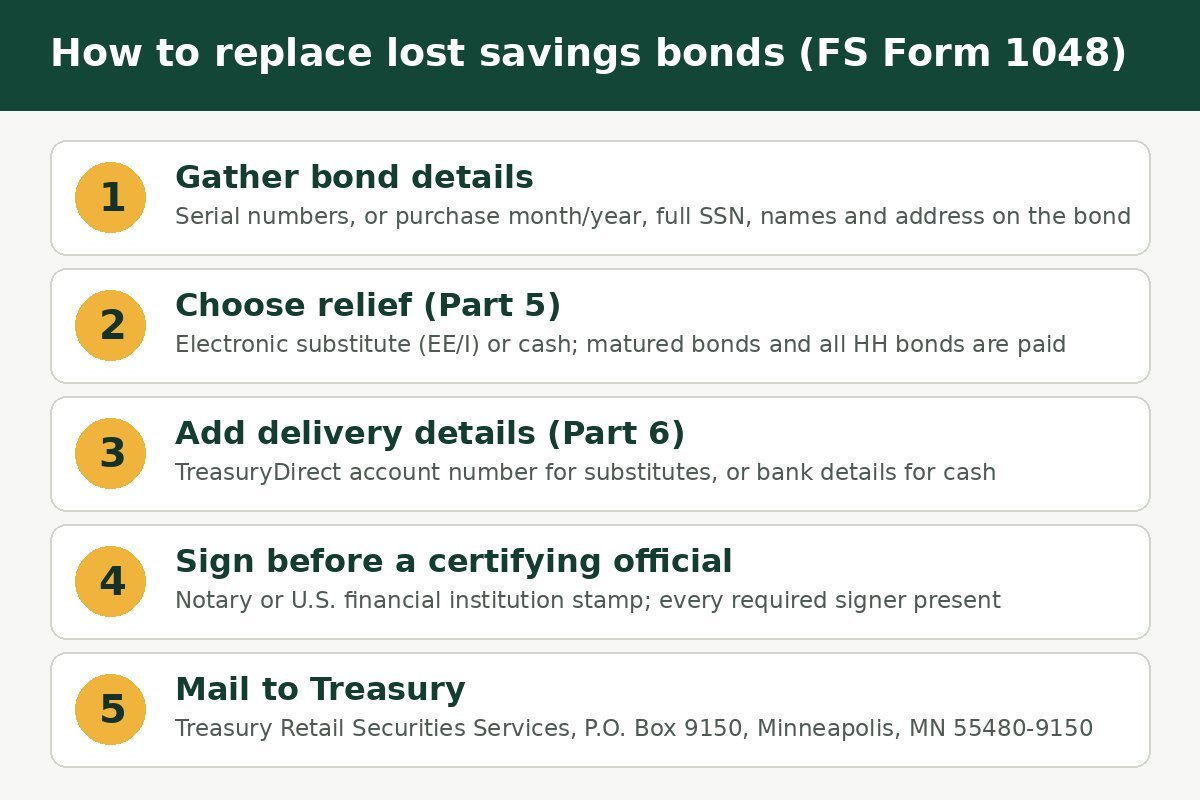
How to Replace Lost Savings Bonds, Step by Step
- Download the current form. Use FS Form 1048 from TreasuryDirect. Print in ink or type.
- Describe the bonds (Part 1) using serial numbers, or the month/year, SSN, names and address if you don’t have them.
- Explain the loss (Part 2) and attach any police report or remaining pieces.
- Show your authority (Part 3) if you aren’t named on the bonds, for example as a parent, guardian, executor or administrator.
- Complete the minor section (Part 4) if a child is named on the bonds.
- Choose relief (Part 5): electronic substitute bonds or payment by direct deposit.
- Add delivery details (Part 6): your TreasuryDirect account (6A) or bank details (6B).
- Sign in front of a certifying official (Part 7). Everyone who has to sign must appear in person, prove their identity, and sign in the official’s presence. Don’t sign beforehand.
- Mail it to Treasury Retail Securities Services, P.O. Box 9150, Minneapolis, MN 55480-9150. Documents you send, including death certificates, are not returned, so keep copies.
Who can certify your signature
The form’s certification instructions accept a notary’s seal or stamp, or the official seal or stamp of a U.S. financial institution (including credit unions). That covers Signature Guaranteed, Endorsement Guaranteed, corporate, or paying agent stamps, as well as Treasury-recognized signature guarantee or Medallion programs. If a Medallion stamp is used, an original signature is required.
Special Situations
The bond owner has died
Include a certified copy of the official death certificate. If you were appointed as a legal representative because the owner died with no surviving co-owner or beneficiary named on the bond, attach a court certificate or certified letters of appointment under court seal, dated within one year of submission. If no representative has been appointed, the form says to tell the Bureau of the Fiscal Service and it will send further instructions.
Bonds lost in a declared disaster
If you live in an officially declared disaster area, TreasuryDirect’s disaster page says you can get cash even for bonds less than a year old. Write “DISASTER” at the top of the form’s first page and on the front of the envelope. The form says disaster claimants need to complete only Parts 1, 5, 6B and 7.
You find the bond after it’s replaced
Once the Treasury replaces or cashes a bond, the original belongs to the U.S. government. If it turns up later, mail it back to the Minneapolis address above. By signing the form, you also agree to repay the Treasury if the original bond is ever cashed after you’ve received relief.
What If You Don’t Know Whether the Bonds Exist?
The Treasury Hunt search tool closed on September 30, 2025, according to TreasuryDirect. Under SECURE Act 2.0, searches for matured, unredeemed Treasury securities now go through state unclaimed property programs, which can access the Treasury’s database. Start at unclaimed.org and contact the state where the original purchaser lived when the bond was bought.
Tax Points to Keep in Mind
Simply replacing a bond in the same owner’s name doesn’t change who owes the tax on its interest. The form warns that if a living owner or principal co-owner is removed from the registration during a reissue, that person must report the previously unreported interest for that year. EE and I bond interest is subject to federal income tax but exempt from state and local income tax, as the I bonds page explains.
Common Mistakes That Delay a Claim
- Signing the form before you’re in front of the notary or certifying officer.
- Leaving out a co-owner’s signature. Everyone named on the bonds, or an authorized representative, must sign.
- Asking for an electronic substitute without a TreasuryDirect account number.
If you still have some paper bonds that aren’t lost, consider moving them online so this doesn’t happen again. See how to convert paper savings bonds to electronic.
FAQ
Is there a fee to replace lost savings bonds?
FS Form 1048 and TreasuryDirect’s instructions don’t list a Treasury fee. A notary or bank may charge for its own certification service, so ask first.
Can I get a paper replacement bond?
No. Substitute EE and I bonds are issued only in electronic form in TreasuryDirect. HH bonds can’t be reissued at all and are paid out instead.
Can I replace a bond that has matured?
Not as a substitute. If a bond has reached final maturity, or is within one full calendar month of it, the Treasury pays it instead.
Where do I call with questions?
FS Publication 0107 lists Treasury Retail Securities Services at 844-284-2676 (toll free).
Disclaimer: This article is general information, not financial, legal, or tax advice. Treasury rules and forms can change, so check the current FS Form 1048 and TreasuryDirect guidance, or speak to a qualified professional, before acting.