
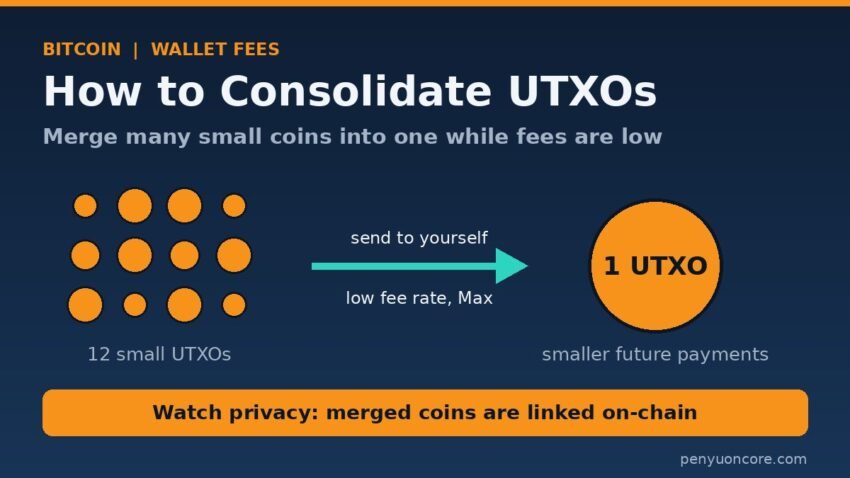
To consolidate UTXOs, you send several small coins from your Bitcoin wallet back to a fresh address in the same wallet, in one transaction, at a low fee rate. That turns many inputs into one, so your future payments are smaller and cheaper. Do it only when fees are low, and don’t merge coins you want to keep separate for privacy.
This guide explains what a UTXO is, when consolidating is worth it, how to do it in Sparrow and Electrum, what fee rate to pick, and the basic US and UK tax points. The facts come from Bitcoin Core’s source code and release notes, wallet documentation, Bitcoin Optech, the IRS and HMRC, checked on 23 November 2026.
What a UTXO is and why many small ones cost you money
Your wallet balance isn’t one number on the blockchain. It’s a set of separate coins called unspent transaction outputs (UTXOs). Sparrow’s documentation explains that when you send bitcoin, the wallet uses one or more UTXOs as inputs, spends each of them in full, and sends any leftover back to you as a new change output. If you’ve seen an unfamiliar output in your own transaction, that’s what our guide to the Bitcoin change address covers.
Fees are charged by transaction size (in virtual bytes, or vB), not by the amount you send. Every input adds size. Bitcoin Core’s policy code notes that spending a typical native SegWit (P2WPKH, bc1q) output needs an input of at least 67 bytes. Fireblocks’ developer docs put it at about 68 vB per input. So if you bought bitcoin in many small amounts, such as weekly purchases withdrawn to your own wallet, a later payment may need 20 or 30 inputs. You then pay for all of them at whatever the fee rate is that day.
When to consolidate UTXOs (and when not to)
Consolidating means paying one fee now, when block space is cheap, instead of paying for those same inputs later, when it might be expensive. In a Bitcoin Optech field report, Xapo’s Anthony Towns gave an example: spending a dozen 2-of-3 multisig inputs at 100 sat/vB would cost about 360,000 sats. Consolidating them first at 2 sat/vB and spending the single output later at 100 sat/vB would cost about 41,000 sats in total. If fees stayed low, the extra cost of consolidating was small (7,900 vs 7,200 sats in his example).
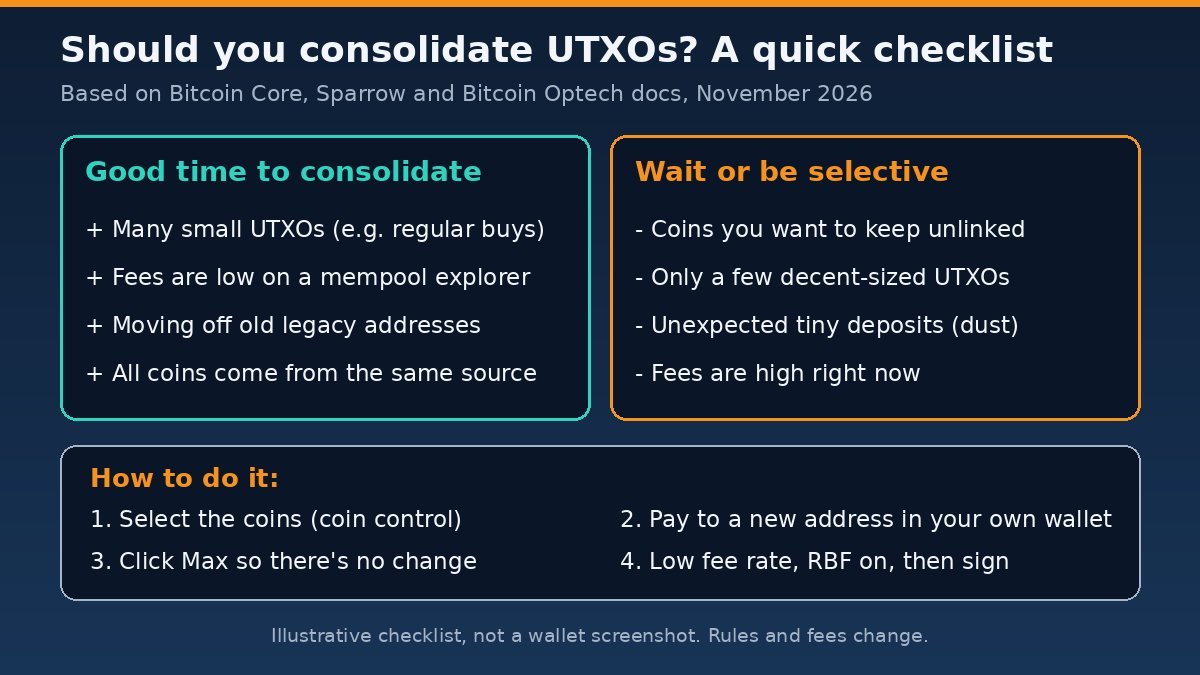
Consolidation usually makes sense if:
- You have many small UTXOs, for example from regular purchases or small payments.
- Current fee rates are low compared with what you’d expect to pay later.
- You want to move coins from an old address type (legacy or nested SegWit) to native SegWit or Taproot. The Optech report mentions this as a side benefit.
Skip it, or be selective, if:
- Privacy matters for some coins. Sparrow’s docs note that observers generally assume all inputs in a transaction belong to the same owner. Consolidating permanently links coins that came from an exchange where you passed KYC with coins from other sources.
- You only have a few UTXOs of a decent size. There’s little to save.
- Some of the coins are unexpected tiny deposits. These may be “dust” sent to track you. Freeze them instead of spending them.
How much a consolidation costs
The table below is a rough estimate for a native SegWit wallet. It assumes about 68 vB per input plus about 41 vB for the transaction overhead and one output, so treat it as a guide only. Your wallet shows the exact fee before you sign.
| Inputs merged | Approx. size | Fee at 1 sat/vB | Fee at 5 sat/vB | Fee at 20 sat/vB |
|---|---|---|---|---|
| 10 | ~720 vB | ~720 sats | ~3,600 sats | ~14,400 sats |
| 20 | ~1,400 vB | ~1,400 sats | ~7,000 sats | ~28,000 sats |
| 50 | ~3,440 vB | ~3,440 sats | ~17,200 sats | ~68,800 sats |
The takeaway is simple. The same consolidation costs 20 times more at 20 sat/vB than at 1 sat/vB, so timing matters far more than anything else.
How to consolidate UTXOs step by step
Every method follows the same idea: select the coins, pay them all to one new address you own, use “Max” so there’s no change output, and pick a low fee rate.
In Sparrow Wallet
- Open your wallet and go to the UTXOs tab. Sparrow’s FAQ describes this as the coin control screen.
- Select the UTXOs you want to merge (Ctrl/Cmd+Click to pick several) and click Send Selected.
- In Pay to, enter a fresh receive address from the same wallet, and add a label such as “consolidation”.
- Click Max so the whole selected amount, minus the fee, goes to one output.
- Set a low fee rate, then create, sign and broadcast the transaction. Check that the output address really is yours before you sign, especially on a hardware wallet screen.
In Electrum
- Go to View > Show Coins to show the Coins tab, as described in BitBox’s Electrum coin control guide.
- Select the coins, right-click and choose Add to coin control. A “coin control active” message appears.
- On the Send tab, pay to a new unused address from your own wallet (from the Receive or Addresses tab), use Max, choose a low fee and send.
In a simple mobile wallet
If your wallet has no coin control, sending your full balance to one of your own receive addresses with “Send max” does the same job. You just can’t choose which coins are included, so it merges everything.
Choosing a fee rate for a consolidation
Nobody is waiting for this payment, so you can choose a very low fee and let it confirm when it confirms. Check a mempool explorer such as mempool.space first. When we checked its public API around midday WIB on 23 November 2026 (early morning in the UK), its recommended fee for every priority level was 1 sat/vB. Most of the queued transactions were paying between 0.1 and 0.2 sat/vB. This changes constantly, so check again on the day.
Some things to know about sub-1 sat/vB fees:
- Bitcoin Core 29.1 lowered the default minimum relay fee to 0.1 sat/vB (100 sat/kvB). The release notes warn that unless the lower default is widely adopted, cheaper transactions “are not guaranteed to propagate or confirm”.
- Bitcoin Core’s own wallet still defaults to a 1 sat/vB minimum (
-mintxfee) in v32.1, and other wallets set their own floors. - If the mempool fills up, low-fee transactions can be dropped. Our guides to the min relay fee not met error and a Bitcoin transaction dropped from the mempool explain what to do in each case.
Leave replace-by-fee (RBF) on if your wallet offers it, so you can raise the fee later if you need the coins sooner.
Dust: when a UTXO isn’t worth spending
Bitcoin Core treats an output as dust if spending it would cost more than it’s worth at the dust relay fee rate, which defaults to 3 sat/vB (3,000 sat/kvB). Its policy code gives the resulting thresholds as 294 sats for a native SegWit output and 546 sats for a legacy one. Merging coins near that size can cost almost their whole value in fees, and tiny unexpected deposits are a known tracking trick. In Sparrow or Electrum, freeze them so they’re never included by accident.
Is consolidating UTXOs a taxable event?
- US: The IRS virtual currency FAQ (Q38) says moving crypto between wallets, addresses or accounts that all belong to you is non-taxable. The IRS notes that these FAQs generally apply to transactions before 1 January 2025. See IRS digital assets for current guidance.
- UK: HMRC’s CRYPTO22100 says moving tokens between addresses you beneficially control isn’t a disposal. However, CRYPTO22280 says a fee paid in tokens should also be considered as a disposal in its own right.
In both countries, record the date, the transaction ID and the fee paid in sats. Ask a tax adviser how to treat the fee.
FAQ
Does consolidating UTXOs reduce my balance?
Only by the network fee. The coins stay in your wallet, now as one UTXO instead of many.
Does Bitcoin Core consolidate automatically?
Partly. Bitcoin Core has a -consolidatefeerate setting (default 10 sat/vB). When fees are below that rate, coin selection may use more inputs than strictly necessary to shrink your UTXO pool. That’s not the same as a deliberate consolidation, though.
How many UTXOs should I merge at once?
There’s no official number. Merging coins that already have the same source keeps the privacy cost down. Splitting a very large set into a few transactions also limits how much is stuck if fees rise before they confirm.
What if my consolidation is stuck?
Bump it with RBF, or spend its output with a higher fee using child pays for parent.
Disclaimer: This article is for general information only and isn’t financial, tax or legal advice. Wallet features and network fee policies change, so check your wallet’s current documentation and a live mempool explorer before you send. Always confirm the receiving address belongs to your own wallet.