
A bitcoin transaction dropped from mempool has not lost your money. A transaction that never confirmed never moved your coins, so the bitcoin stays with the sender’s wallet. You can rebroadcast it, replace it with a higher fee, or let your wallet treat it as cancelled and spend the coins again.
The rest of this guide covers why nodes drop transactions, how to find out what really happened to yours, and the safe way to fix it in common wallets without paying twice.
What “dropped from the mempool” actually means
The mempool is the waiting room for unconfirmed transactions. Bitcoin has no single, global mempool. As the mempool.space FAQ puts it, every node keeps its own, so different nodes can hold different transactions. If a block explorer says “transaction not found”, that only tells you that explorer’s nodes no longer have it. Other nodes might still have a copy. Bitcoin Core maintainer Ava Chow makes the same point on Bitcoin Stack Exchange: being evicted from one node’s mempool doesn’t mean every node has evicted it.
Being dropped also isn’t the same as failing. Your coins only move when a transaction spending them gets mined into a block. Until that happens, the inputs are still unspent on the blockchain.
Bitcoin transaction dropped from mempool: why it happens
Most nodes run Bitcoin Core, so its defaults decide what happens on most of the network. We checked these defaults in the help output of Bitcoin Core 32.1, the current release on bitcoincore.org in November 2026:
- The mempool is full.
-maxmempooldefaults to 300 MB. When a node’s mempool hits that limit, it evicts the lowest-feerate transactions and raises its minimum fee for new ones. mempool.space shows the current purging threshold on its front page. - The transaction is too old.
-mempoolexpirydefaults to 336 hours (14 days). After that, a node forgets an unconfirmed transaction even if there is room for it. - The fee was below what a node relays. Since Bitcoin Core 29.1, the default
-minrelaytxfeeis 100 sat/kvB (0.1 sat/vB). The release notes warn that lower-fee transactions “are not guaranteed to propagate or confirm” unless those lower defaults are widely adopted. Older nodes and some services still use 1 sat/vB. - It was replaced. The sender, or the exchange processing a withdrawal, swapped it for a higher-fee version (Replace-by-Fee). The old TXID disappears and a new TXID confirms.
- It conflicted with another spend. If a different transaction spending the same coins confirmed first, the original can never confirm.
Step 1: Work out what really happened
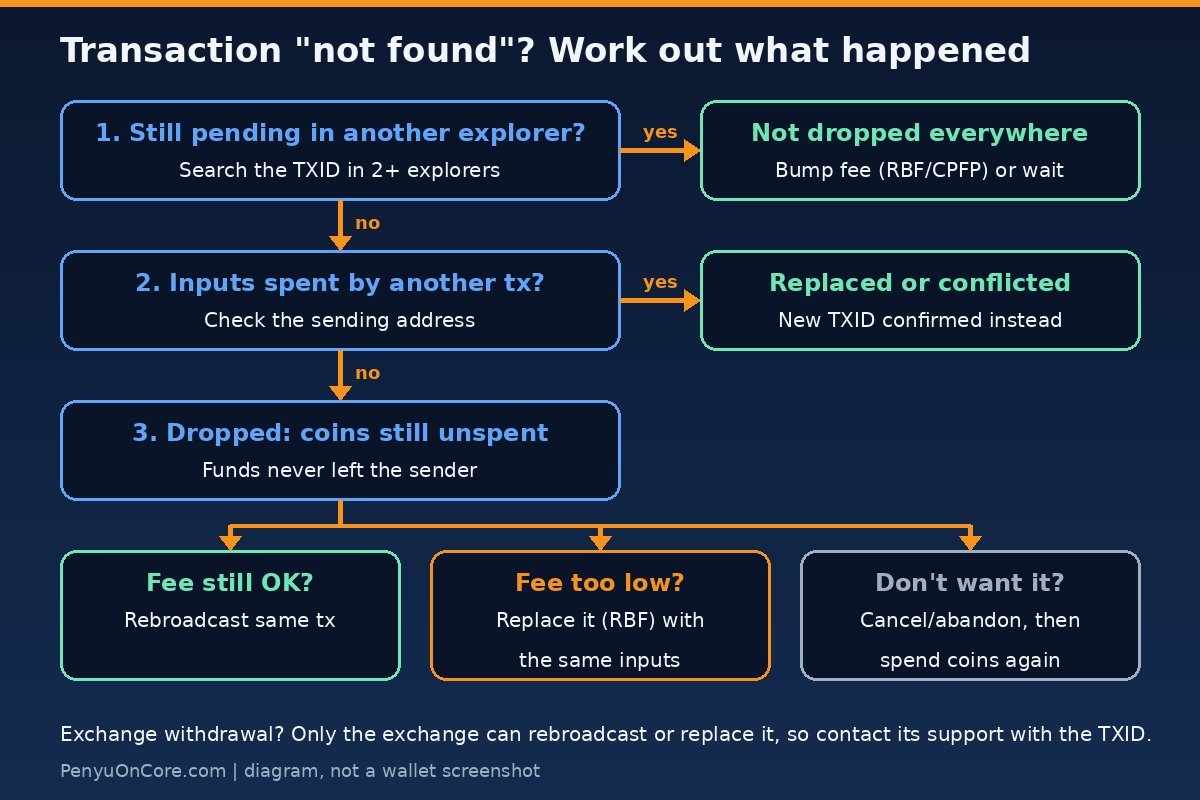
- Search the TXID in two or more explorers. If one still shows it as unconfirmed, it hasn’t been dropped everywhere.
- Search the sending address, not just the TXID. If you can see a different confirmed transaction that spends the same inputs and pays the same recipient, it was replaced, and the payment arrived under a new TXID.
- Check the inputs. If the sending address still has the coins unspent and nothing is pending, the transaction really was dropped. Go to Step 2.
- If you withdrew from an exchange, the exchange’s wallet signed the transaction, so only the exchange can rebroadcast or replace it. Contact support with the TXID. mempool.space says the same thing: it only provides data and “cannot help you with retrieving funds”.
Step 2: Choose the right fix
Rebroadcast it if the fee is still competitive
If the fee rate you paid is still above the current minimum, you can simply rebroadcast the same signed transaction. Many wallets do this for you. The Bitcoin Core wallet resubmits its unconfirmed transactions automatically at a random interval of between 12 and 36 hours (see GetDefaultNextResend in wallet.cpp), and every time the wallet loads. If you have the raw transaction hex, you can paste it into an explorer’s “broadcast transaction” page. That hex only contains a signed transaction, not your keys, but use a site you trust anyway.
Bump the fee with RBF if it was too cheap
If the fee was too low for the current network, rebroadcasting the same transaction will just get it dropped again. Replace it with a higher-fee version that spends the same inputs:
- Electrum: according to the Electrum FAQ, Electrum creates replaceable transactions by default (lightning channel opens and closes are the exception). Right-click the transaction in History, choose Increase Fee, then sign and broadcast. The same menu also has a cancel (double-spend) option that sends the coins back to your own wallet.
- Bitcoin Core wallet: right-click the transaction and choose Increase transaction fee, or use the
bumpfeeRPC. - Other wallets: look for “Speed up”, “Bump fee” or “Cancel”. Under the hood these are all replacements.
You no longer have to rely on the old “RBF signal” flag. Bitcoin Core 28.0 turned on full replace-by-fee by default (mempoolfullrbf=1), and 29.0 removed the option entirely, making full RBF standard behavior. Whether your wallet’s interface offers a bump button is a separate question that depends on the wallet.
Use CPFP if you are the recipient
The recipient can’t use RBF but can use Child-Pays-for-Parent: spend the incoming unconfirmed output with a high fee so miners take both transactions together. Electrum offers this from the same right-click menu. CPFP only works while the parent is still in mempools, though. If it has been purged from most nodes, it has to be rebroadcast first.
Let it expire and spend the coins again
If you no longer want the payment to go through, you can wait for it to drop and then mark it as cancelled. In Bitcoin Core, the abandontransaction RPC (or Abandon transaction in the GUI) frees the inputs to be spent again. The docs say it only works on transactions that aren’t in a block and aren’t currently in your node’s mempool.
What we saw when we tested this on regtest
To check how this behaves, we ran Bitcoin Core 32.1 in regtest mode, a private local test network with no real money involved. We sent a transaction, then restarted the node without its saved mempool and with wallet broadcasting turned off, so the transaction was no longer in the mempool:
gettransactionstill listed it with 0 confirmations and"trusted": false. The wallet still remembered it, even though the mempool had forgotten it.getbalancesreported the spent coins under anonmempoolfield. The RPC help describes this as “coins that are spent by transactions not in the mempool”.abandontransactionsucceeded, and thenonmempoolamount went back to zero.- When we restarted with broadcasting turned back on and a different unconfirmed transaction was still in the wallet, the wallet put that transaction straight back into the node’s mempool on startup.
bumpfeealso worked on a transaction we had created withreplaceable=false, which fits with full RBF being the default.
The takeaway is that an abandoned or dropped transaction isn’t dead until its inputs are spent somewhere else. Anyone who kept a copy, including the recipient, can rebroadcast it, and it could still confirm days later.
How to avoid paying twice
The expensive mistake is sending a brand-new payment from different coins while the old one could still confirm. Then both can confirm. To stay safe:
- Use your wallet’s replace, bump fee or cancel feature. These spend the same inputs, so only one version can ever confirm.
- If you send again by hand, use coin control to pick the same inputs the dropped transaction used.
- Don’t call a payment final until it has confirmations. Be wary of anyone offering to “recover” a stuck transaction for a fee or asking for your seed phrase. Our crypto security guide explains why no legitimate service ever needs it.
Dropped transactions are part of self-custody. If you’d rather not manage fees and mempools yourself, see our comparison of a bitcoin ETF vs buying bitcoin directly. If your stuck transaction is an exchange withdrawal, our overview of exchange risks explains what is and isn’t in your control.
FAQ
Can I lose bitcoin if a transaction is dropped from the mempool?
No. An unconfirmed transaction never moved the coins, so they stay spendable by the sender until some transaction spending them confirms.
How long before a stuck bitcoin transaction is dropped?
Nodes running Bitcoin Core’s default settings drop it after 336 hours (14 days), or sooner if their 300 MB mempool fills up and the fee is too low. Nodes with custom settings can keep it longer or drop it sooner.
Why does one explorer show my transaction and another says “not found”?
Each explorer runs its own nodes with their own mempool limits. A low-fee transaction can still be in one mempool after another has evicted it.
My TXID changed but the payment arrived. Is that normal?
Yes. If the sender or exchange replaced the transaction with RBF, the confirmed version has a new TXID and the old one is shown as replaced or not found.
Disclaimer: This article is for general educational purposes only and is not financial, tax or legal advice. Check your own wallet’s documentation before acting, and never share your seed phrase or private keys with anyone.