
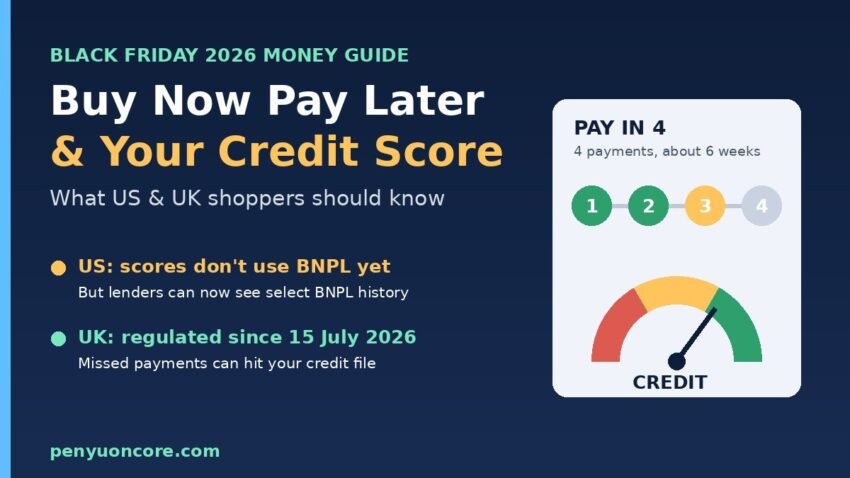
The buy now pay later credit score question comes up every Black Friday, and in 2026 the honest answer has changed slightly. Splitting a holiday purchase into four payments usually still won’t move your FICO or VantageScore number in the US, but more of that activity now shows up on credit reports, and in the UK it is now regulated credit that can appear on your credit file.
Short answer: in the US, the main credit scores do not currently use BNPL data, although some providers report your plans to credit bureaus and lenders can now see select BNPL history when you apply for credit. In the UK, BNPL lenders must check affordability and can report missed payments to credit reference agencies, which can make future borrowing harder. Everywhere, a missed payment that ends up with a debt collector can damage your credit.
Does buy now pay later affect your credit score in the US?
For most “Pay in 4” plans, not directly, at least not yet. The Consumer Financial Protection Bureau (CFPB) says most four-payment BNPL products don’t report to the major credit reporting companies and generally don’t use hard credit inquiries. It adds a key warning: if you don’t repay and the loan is turned over to a debt collector, that can be reported and hurt your scores.
Scoring is a separate question from reporting. myFICO says its understanding is that none of the three major bureaus currently feed BNPL account information into a FICO Score calculation, so for as long as that is true, BNPL accounts won’t affect your FICO Score. Experian says the same about “existing traditional credit scores at this time,” while noting that may change as new scoring models are developed.
What changed in October 2026
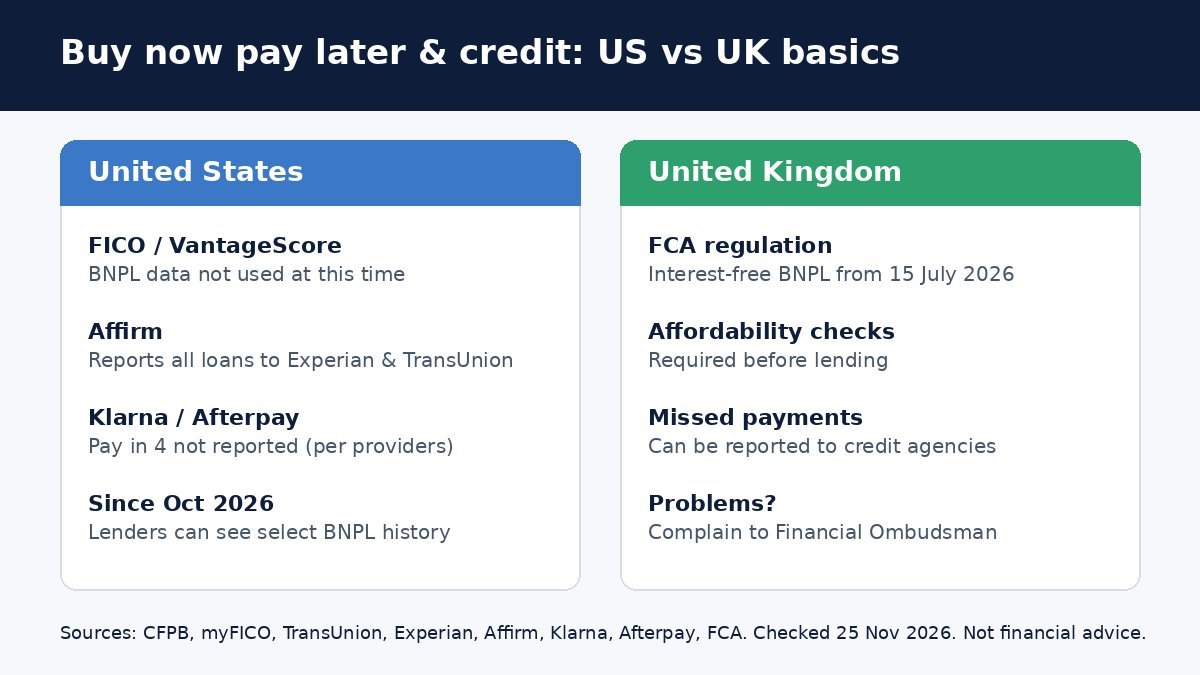
The part many shoppers miss is that a score and a credit decision are not the same thing. TransUnion’s BNPL page, updated 19 October 2026, says that starting October 2026, select BNPL loans on your TransUnion report may begin to affect some credit decisions, while BNPL data still does not affect credit scores provided by TransUnion. Affirm’s update dated 23 October 2026 says the bureaus have begun giving lenders summaries of BNPL repayment history, including Affirm data, and that these summaries do not currently affect FICO or VantageScore scores.
In practice, your score may not move, but a lender reviewing a mortgage, car loan or card application could still see how many BNPL plans you have and whether you paid them on time. How much weight it gives that information is up to the lender.
A newer scoring model also exists. On 23 June 2025 FICO announced FICO Score 10 BNPL and FICO Score 10 T BNPL, which are designed to include BNPL data and to be offered alongside existing FICO versions. Each lender decides which score it uses, so a model existing does not mean your lender relies on it.
Which BNPL providers report to credit bureaus?
Policies differ by provider and by product, which is why answers online often conflict. Here is what the larger US providers say on their own pages, checked 25 November 2026:
| Provider (US) | Pay in 4 reported? | What the provider says |
|---|---|---|
| Affirm | Yes | Reports all BNPL loans to Experian and TransUnion; says this data does not currently affect FICO or VantageScore scores |
| Klarna | No | Shares only Monthly Pay over time loans with TransUnion and Experian; not Pay in 4, Pay in 30, Pay in full or Klarna Card activity |
| Afterpay | No | Does not currently report to US credit bureaus; may run a soft check at sign-up and a credit check for Pay Monthly |
Sources: Affirm, Klarna US, Afterpay US. Policies change, so check your provider’s help page before relying on this.
When a BNPL loan is reported to Experian, Experian says it appears on your report like other loans but is clearly marked as BNPL, with the payment converted to a monthly amount (a six-week plan shows as a two-month term). TransUnion says BNPL loans reported to it do not count toward your credit utilization, because utilization is based on revolving accounts such as credit cards.
Buy now pay later credit score rules in the UK
The UK moved further this year. The Financial Conduct Authority (FCA) started regulating interest-free BNPL, legally called Deferred Payment Credit, on 15 July 2026. It covers interest-free credit repayable in 12 or fewer instalments over 12 months or less, where the lender is a different business from the shop. Under the new rules, lenders must check you can afford to repay, tell you upfront about late fees and repayments, contact you if you miss a payment, and offer support if you are struggling. You can also complain to the Financial Ombudsman Service. Agreements taken out before 15 July 2026 stay unregulated.
On credit files, Citizens Advice says a provider might do a hard credit check, which is recorded on your credit history, must tell you if it is going to report you to a credit reference agency, and that missed payments might lower your credit score. Provider policies differ:
- Klarna UK says it runs a soft credit check for Pay in 3, Pay in 30 days and Financing, which does not affect your score, and reports Pay in 3 and Pay in 30 days payment data to TransUnion, Experian and Equifax. It says late and unpaid balances are visible to other lenders, that paying on time can build a positive history, and that mortgage lenders may include your monthly BNPL commitments in affordability checks.
- Clearpay says paying on time won’t affect your credit score, but missed payments may be reported to credit reference agencies. It uses a soft check that it says has no impact on your score.
The FCA’s February 2026 announcement put the number of UK BNPL users at around 11 million, and its Financial Lives Survey found 20% of UK adults used BNPL in the 12 months to May 2024.
How BNPL can still hurt you this holiday season
Even where your score is not directly affected, a few things can still cause damage:
- Collections. CFPB, Experian and TransUnion all warn that an unpaid BNPL debt sent to collections can be reported and hurt your score.
- Lender visibility. Since October 2026, select BNPL history on US reports can be considered in some credit decisions, according to TransUnion. Lots of overlapping plans could look like extra debt to a lender.
- Late fees and overdrafts. TransUnion points out that missed payments can trigger BNPL late fees and, if your linked account runs dry, bank overdraft fees.
- The January pile-up. Experian describes pay-in-4 as four payments over about six weeks, so a plan started on Black Friday (27 November) or Cyber Monday (30 November) can still be collecting payments in January, when holiday credit card bills arrive too.
How to use BNPL without hurting your credit
- Know your provider’s policy before you click “Pay in 4” or “Pay in 3.” Use the table above and the provider’s own help page.
- List every plan with the amount, due dates and the card or account it draws from, then add up what is due over the next six weeks.
- Keep a buffer in the linked account so an automatic payment never bounces. A small emergency fund helps here.
- Act early if you can’t pay. Contact the lender before the due date. UK lenders now have to offer support, and Citizens Advice says that could include reducing or pausing payments for a limited time.
- Compare protections. UK regulated BNPL now gets Section 75 Consumer Credit Act refund rights, according to the FCA. In the US, buyer protection depends on the provider and payment method; our guide to Venmo purchase protection shows how much these policies can vary.
- Check your credit reports to see which plans are listed and whether they are accurate.
If you are saving ahead for big purchases next year instead, parking that money somewhere that earns interest may beat paying in instalments. See our comparison of SGOV vs high-yield savings.
FAQ
Does paying BNPL on time build credit?
In the US, usually not today, because the main FICO and VantageScore scores don’t use BNPL data. In the UK, Klarna says paying on time helps build a positive history on your file, while Clearpay says on-time payments won’t affect your score.
Does applying for Pay in 4 cause a hard inquiry?
The CFPB says BNPL lenders generally don’t run hard inquiries. Afterpay, for example, says it may run a soft check at sign-up that won’t affect your score, but does a credit check for its Pay Monthly option; longer, larger loans are more likely to involve a hard inquiry. In the UK, Citizens Advice says some providers might do a hard check.
Can BNPL affect a mortgage application?
It can. Klarna UK says mortgage lenders may include monthly BNPL commitments in affordability checks, and in the US lenders can now see select BNPL history on TransUnion reports.
Are BNPL plans taken out before 15 July 2026 covered by the UK rules?
No. The FCA says agreements entered into before that date remain unregulated.
This article is for general information only and is not financial or credit advice. BNPL and credit reporting policies change often; check your provider’s current terms and your own credit reports before deciding.