
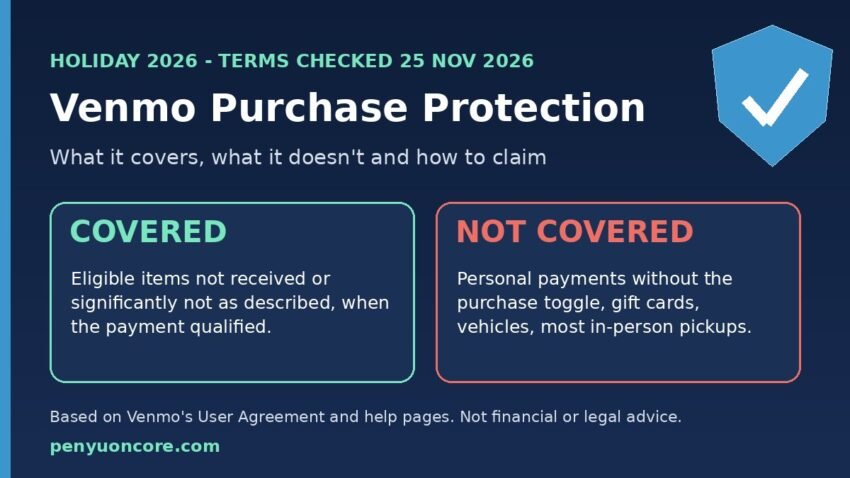
Venmo purchase protection can refund you when something you bought never arrives or turns up significantly different from the listing, but only if the payment qualified when you sent it. For a payment to a personal profile, that means switching on the “Turn on for purchases” toggle before you tap Pay. Friends-and-family style payments, gift cards, vehicles and items you pick up in person are generally not covered.
That matters this week, as Black Friday and holiday gift buying push more people to pay strangers on Facebook Marketplace, in ticket groups and through small online shops. Below is what Venmo’s own terms say, checked on 25 November 2026 against the Venmo User Agreement (effective 24 August 2026).
What Venmo purchase protection actually covers
Venmo calls it the Venmo Purchase Protection Program. According to the user agreement, it can entitle an eligible buyer to “a refund of the full purchase price of the item plus the original shipping costs paid, if any.” It applies to two kinds of problems:
- Item Not Received: you paid, but the item never arrived.
- Significantly Not as Described: you received a completely different item, a counterfeit of something advertised as authentic, a used item sold as new, an item missing major parts that weren’t disclosed, fewer items than you paid for, or something damaged in shipping or unusable in a way the seller didn’t mention.
Venmo’s Purchase Protection page gives everyday examples: you ordered a book and got a DVD, a photographer took a deposit and didn’t show up, or you bought three items and only two arrived. Venmo says it applies “with no fees to the buyer.”
Which payments qualify
Under the user agreement, “Qualifying Payments” are limited to:
- Venmo Debit Card (and Teen Debit Card) purchases
- Purchases from authorized merchants, such as paying with Venmo at an online or in-app checkout
- Pay and Request payments sent to a business profile
- Pay and Request payments to a personal profile that you identify as for goods and services
Venmo also says QR code checkouts can be covered. Its eligibility page lists “payments that you make without swiping ‘on’ the ‘Turn on for purchases’ toggle” as ineligible. So the decision is made when you send the money: the toggle has to be on before you pay.
What Venmo purchase protection does not cover
Tagging a payment as a purchase does not guarantee cover. Venmo’s eligibility page says plainly that “designating a transaction as a ‘Purchase’ or for ‘Good and Services’ does not mean that Purchase Protection automatically applies.” Here are the main exclusions, taken from Venmo’s eligibility page and user agreement:
| Situation | Covered? | Why |
|---|---|---|
| Personal payment without the purchase toggle | No | Listed as an ineligible payment category |
| Splitting a bill or paying someone back | No | Reimbursements aren’t “Purchases” |
| Item you collect in person | Generally no | Excluded except in-person Venmo QR code transactions |
| Gift cards and prepaid cards | No | Ineligible item |
| Cars, boats, real estate, rent | No | Ineligible items |
| Crypto, NFTs, stocks or other investments | No | Ineligible items |
| Donations and crowdfunding | No | Ineligible payment |
| Item matched the listing but you changed your mind | No | Not “Significantly Not as Described” |
| Shipped item that never arrived (toggle on) | Potentially | Item Not Received claim, unless the seller proves delivery |
A few more limits are worth knowing. The user agreement says payments to Teen Accounts aren’t covered, and Tap to Pay transactions are excluded. If the seller shows proof of delivery, Venmo “may find in favor of the seller” even if you say nothing arrived. You may also have to send the item back, and the program does not refund return shipping. Finally, you can’t collect twice: you’re not eligible if you have already recovered the money elsewhere, for example through a dispute with your bank or card issuer.
Holiday buying: where people lose cover
Most problems come from a few habits that are common around Black Friday and Christmas:
- “Send it as friends and family to avoid the fee.” When a buyer tags a payment as goods and services, the seller pays a 2.99% fee on a personal profile, according to Venmo’s fee schedule. A seller who asks you to skip the toggle is asking you to give up your protection to save them that fee. For an unknown seller, treat that as a red flag.
- Local pickup. If you meet a Marketplace seller and pay by personal transfer, in-person collection is excluded. Check the item before you pay.
- Gift cards. They’re excluded outright, which is one reason scammers like them.
- “Too good to be true” shops. The FTC recommends paying with methods that protect you, such as credit cards. The US Secret Service’s 2026 holiday advisory warns about fake shopping sites and tells you to go to retailers directly rather than clicking ad or email links.
Event tickets come up a lot in December. Venmo’s eligibility page says “certain intangible items like event tickets and hotel reservations” are often eligible when you buy them online. Even so, the payment still has to qualify, and the claim still has to fit one of the two problem types.
How to file a Venmo purchase protection claim
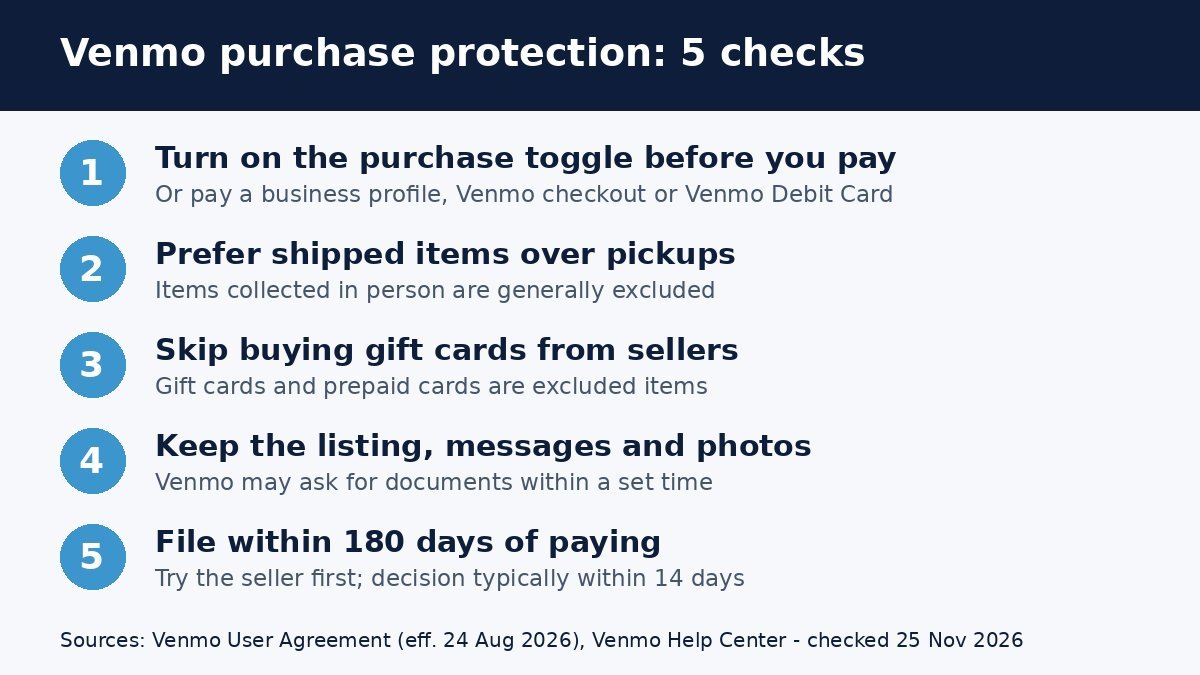
Venmo requires you to try to sort it out with the seller first. If that fails, open a dispute within 180 days of the date you sent the payment. That limit applies to both Item Not Received and Significantly Not as Described claims, according to Venmo’s dispute filing timeframes. Venmo’s Opening a Dispute guide sets out the in-app steps:
- Go to the Me tab and select the transaction.
- Tap Need Help? and choose the statement that best describes your situation.
- Add any related transactions with Add more, then tap Next.
- Add as much detail as you can, then tap Submit Issue. Reset your password if prompted.
Venmo says Venmo Debit Card transactions and online purchases can’t be disputed in the app. For those, go to Me > Settings > Get Help > Chat With Us and ask for an agent. Venmo Credit Card purchases are disputed with Synchrony Bank.
Evidence and timing
Keep screenshots of the listing and your messages with the seller, any tracking number, and photos of what actually arrived. Venmo’s user agreement says you must answer its requests for documentation within the time it gives you. According to Venmo’s dispute follow-up page, a decision is “typically” made within 14 days, but some cases take 30 days or longer. You can check progress under Me > Settings > Get Help > Disputes.
Posts in r/venmo point to two traps. One buyer cancelled a dispute after the seller promised to ship and was then told it couldn’t be reopened. Another had evidence uploads fail and had to chase support. These are individual accounts, not Venmo policy, but they’re a good reason to keep a dispute open until the item actually arrives and to confirm your documents went through. The user agreement says Venmo’s first decision is final, though you may be able to appeal if you have new or compelling information.
If your payment isn’t covered
If you sent a personal payment without the toggle, Venmo will usually treat it like handing over cash. You can still report the seller to Venmo, report the scam at ReportFraud.ftc.gov, and ask the bank or card issuer that funded the payment whether it can help. If someone sends you money “by mistake” and asks you to return it, read our guide to the accidental payment scam. The same pattern shows up on Venmo, and the Secret Service advises contacting the app’s official support rather than sending money back yourself.
Venmo purchase protection for sellers
If you sell gifts or crafts this season, the same program can protect you against Item Not Received claims, unauthorized-payment claims and some chargebacks, but only if you meet its requirements. The user agreement asks you to ship to the address on the transaction details page and keep proof of shipment or delivery. Unless the buyer agrees otherwise in writing, you also need to ship within 7 days of payment. A parcel redirected to a different address loses eligibility. Venmo accounts are provided by PayPal, Inc., and if you also sell on PayPal, our guide to why PayPal holds funds covers the seller side of that platform. Regular sales income can also bring tax reporting; our 1099-K threshold explainer shows how the reporting threshold works.
FAQ
Does Venmo purchase protection cost the buyer anything?
No. Venmo says it is free for buyers. The seller pays the fee, which is 2.99% on payments tagged as goods and services to a personal profile.
Can I add purchase protection after I’ve paid?
Venmo’s eligibility page lists payments made without the “Turn on for purchases” toggle as ineligible, so plan on switching it on before you send. If you’ve already paid without it, contact Venmo support and the seller straight away.
How long do I have to file a claim?
You have 180 days from the date you sent the payment for Item Not Received and Significantly Not as Described disputes.
Are Facebook Marketplace purchases covered?
They can be if the item is shipped to you and you used the purchase toggle. Items you collect in person are generally excluded, and so are vehicles.
This article is general information, not financial or legal advice. Venmo’s terms can change, so check the current User Agreement and the transaction details screen in your app before relying on cover.