
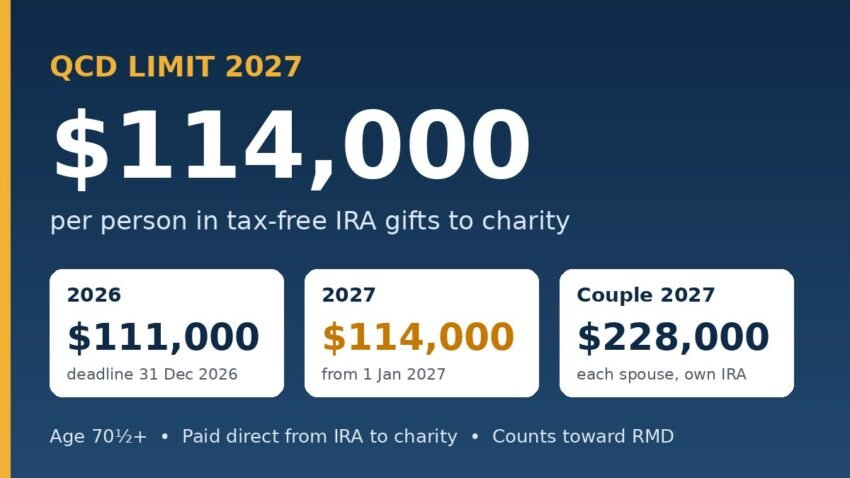
The QCD limit 2027 is $114,000 per person: IRA owners aged 70½ or older can send up to that amount directly from an IRA to eligible charities during calendar year 2027 without it counting as taxable income. That is up from $111,000 for 2026, and a married couple can each give up to $114,000 from their own IRAs. Gifts you make before 31 December 2026 still fall under the $111,000 limit.
The new figure came out on 12 November 2026 in IRS Notice 2026-66, the same notice that set the 2027 401(k) and IRA contribution limits. With Thanksgiving here and Giving Tuesday next week, a lot of retirees are asking the same two questions: how much can I give from my IRA next year, and what do I have to do before this year ends? This guide answers both. Sources are IRS publications and custodian help pages, checked 26 November 2026.
QCD limit 2027 vs 2026 at a glance
A qualified charitable distribution (QCD) limit is indexed to inflation every year under SECURE 2.0. Notice 2026-66 says the excludable amount under section 408(d)(8)(A) “is increased from $111,000 to $114,000”, and the one-time limit for a QCD to a split-interest entity rises from $55,000 to $57,000. The 2026 figures came from Notice 2025-67, which raised them from $108,000 and $54,000.
| QCDs made in | Annual QCD limit (per person) | One-time split-interest QCD | Married couple, both eligible |
|---|---|---|---|
| 2025 | $108,000 | $54,000 | $216,000 |
| 2026 | $111,000 | $55,000 | $222,000 |
| 2027 | $114,000 | $57,000 | $228,000 |
The limit is per individual, not per household. IRS Publication 590-B explains that if you file a joint return, your spouse can also make a QCD and exclude up to the same limit. Each spouse has to give from an IRA in their own name, though. You cannot use your spouse’s allowance from your account.

What a QCD is and who can make one
The IRS’s IRA distribution FAQs define a QCD as “an otherwise taxable distribution from an IRA (other than an ongoing SEP or SIMPLE IRA) owned by an individual who is age 70½ or over that is paid directly from the IRA to a qualified charity.” In practice, that means:
- Age 70½ at the time of the gift. This age did not move when the RMD age went up. You can make QCDs between 70½ and your RMD age even if you have no required withdrawal yet. Vanguard confirms this.
- An IRA, not a workplace plan. Traditional and rollover IRAs qualify. So do inherited IRAs if you, the beneficiary, are 70½ or older, and SEP or SIMPLE IRAs that are no longer receiving contributions. Schwab notes that QCDs are not permitted from 401(k)s. You would have to roll the money into an IRA first.
- Paid directly to the charity. Your IRA custodian must pay the charity. Fidelity’s QCD page is blunt: taking the money yourself and then donating it “does not qualify as a QCD.”
- An eligible charity. It must be a 501(c)(3) organisation that can receive tax-deductible gifts. Fidelity lists private foundations, donor-advised funds and supporting organisations as recipients that may not qualify. A gift where you receive goods or services in return (a gala dinner, for example) also fails.
- The right paperwork. Pub. 590-B says you need the same written acknowledgment from the charity that you would need to claim a deduction.
Why a QCD can beat a normal donation
A QCD is excluded from your income, not deducted from it. That gives you several benefits:
It counts toward your RMD
The IRS FAQs say a QCD “can satisfy all or part the amount of your required minimum distribution.” RMDs start at 73, or 75 depending on your birth year. If yours is $20,000 and you send $8,000 to charity as a QCD, you only need to withdraw another $12,000. Missing part of an RMD is expensive, so read our guide to the missed RMD penalty if you’re behind for 2026.
You don’t need to itemize
Fidelity notes that “itemization is not required to make a QCD.” The new 2026 deduction for non-itemizers only covers cash gifts up to $1,000 or $2,000. A QCD lets you give far more and still take the full standard deduction.
A lower AGI can help elsewhere
Because the money never enters your adjusted gross income (AGI), Schwab points out that it “may reduce Medicare premiums and the taxable portion of Social Security benefits.” The Social Security Administration sets those surcharges from your modified AGI on the most recent tax return the IRS provides (for 2026 premiums, generally the 2024 return), so a QCD made in 2027 would usually show up in your 2029 premiums. See our breakdown of Medicare Part B premiums for 2027.
The trade-off: you can’t double-dip. Pub. 590-B states, “You can’t claim a charitable contribution deduction for any QCD not included in your income.”
The 2026 QCD deadline: what to do before 31 December
The 2027 limit only matters from 1 January. For this year, the rules are still $111,000 and a hard calendar-year deadline. Fidelity says the deadline “is December 31 of the tax year for which you want it to count” with no extensions. It also tells you to allow time for processing and for the charity to receive the cheque.
- Check your custodian’s cutoff now. Some custodians use paper forms or mail cheques. Schwab’s own guidance is: “don’t wait until the last minute and risk missing the year-end deadline.”
- Do the QCD before you take the rest of your RMD. Schwab warns that if you have already taken your RMD and donated the cash, “you cannot retroactively classify it as a QCD.” If you use an automatic RMD service, Vanguard advises factoring in the QCD so you don’t withdraw more than you need.
- Confirm the charity is eligible. Use the IRS Tax Exempt Organization Search, and don’t send money to a donor-advised fund expecting QCD treatment.
- Get the acknowledgment letter and keep it with your tax records.
If you are also planning other year-end moves, such as a Roth conversion before 31 December, model the two together. A conversion raises your AGI while a QCD keeps it lower.
How a QCD shows up on your tax return
Your custodian reports the QCD on Form 1099-R. Under the 2026 Form 1099-R instructions, the IRS added a new box 7a code “Y” for QCDs, but its use is optional for tax year 2026. That means your form may simply show a normal distribution, so tell your tax preparer how much you gave.
On Form 1040, Pub. 590-B’s example reports the full distribution on line 4a and the taxable amount (zero if all of it was a QCD) on line 4b, with the QCD box checked on line 4c. The IRS FAQs add that you also need Form 8606 if you made the QCD from a traditional IRA with nondeductible basis and took other distributions that year, or if you made it from a Roth IRA.
Two traps to watch
- Deductible IRA contributions after 70½ reduce how much of your QCD you can exclude. Pub. 590-B has a QCD Adjustment Worksheet for this.
- Anything above the limit is taxable. Pub. 590-B says any QCD over the exclusion limit “is included in income as any other distribution.”
The one-time $57,000 split-interest QCD
Since SECURE 2.0, you can make a once-in-a-lifetime QCD to a charitable remainder annuity trust, a charitable remainder unitrust or a charitable gift annuity. Pub. 590-B says a gift annuity must start fixed payments of 5% or more within one year of funding, and you have to attach an election statement to your return. The cap is $55,000 in 2026 and $57,000 in 2027. Schwab notes that it counts toward your annual QCD limit for that year.
FAQ
What is the QCD limit for 2027?
$114,000 per eligible IRA owner for QCDs made in 2027, according to IRS Notice 2026-66. That’s $228,000 for a married couple if both spouses qualify and give from their own IRAs.
Can I use the 2027 limit for a gift I make in December 2026?
No. QCDs count in the calendar year your IRA pays them, so anything paid by 31 December 2026 falls under the $111,000 limit for 2026.
Can a QCD go to a donor-advised fund?
No. Donor-advised funds, private foundations and supporting organisations don’t qualify for QCD treatment.
Can my QCD be bigger than my RMD?
Yes, up to the annual limit. Fidelity notes that any excess does not carry forward to reduce future years’ RMDs.
Disclaimer: This article is general information, not tax or financial advice. Tax rules can change and state treatment varies. Check the IRS links above or speak to a qualified tax professional before making a qualified charitable distribution.