
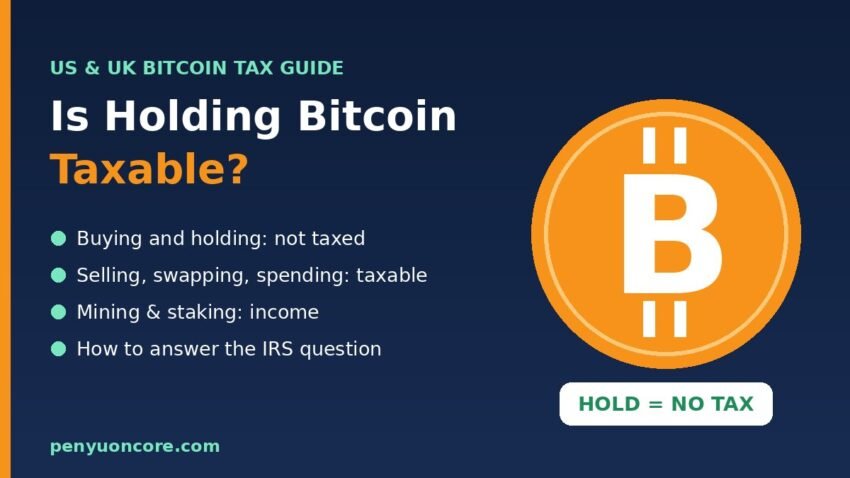
If you bought Bitcoin and have simply held it, you are probably wondering whether you owe anything at tax time, especially with the price swinging hard this month. Is holding Bitcoin taxable? No: in both the US and the UK, simply buying Bitcoin with dollars or pounds and holding it is not a taxable event. Tax usually applies when you sell, swap, spend or give it away, or when you receive Bitcoin as income, such as mining or staking rewards.
Below: what counts as a disposal, when you owe tax without selling, and how to answer the IRS digital asset question, based on IRS and HMRC guidance checked on 27 November 2026.
Is holding Bitcoin taxable? The short answer
The IRS treats digital assets such as Bitcoin as property, not currency. A gain or loss on Bitcoin you own as an investment is taxed when you sell or otherwise dispose of it, not while you hold it. A rising balance in your wallet is an unrealized gain, and there is no annual tax on it.
HMRC takes a similar approach. Its guidance on receiving cryptoassets says that if you bought the tokens yourself, “you do not need to pay tax on the tokens when you buy them, but you may need to pay tax when you sell them.” Capital Gains Tax is only worked out when you “dispose” of them.
This matters right now. CoinDesk reported on 25 November 2026 that Bitcoin had fallen 24% in November and was on track for an eighth straight weekly loss. If you are sitting on paper losses (or gains) and haven’t sold, nothing is taxed or deductible until you make a disposal.
What counts as “selling” for tax purposes
“I didn’t sell” doesn’t always mean “I had no taxable transactions”. Both tax authorities define a disposal more broadly than a sale for cash.
US: what the IRS treats as a disposal
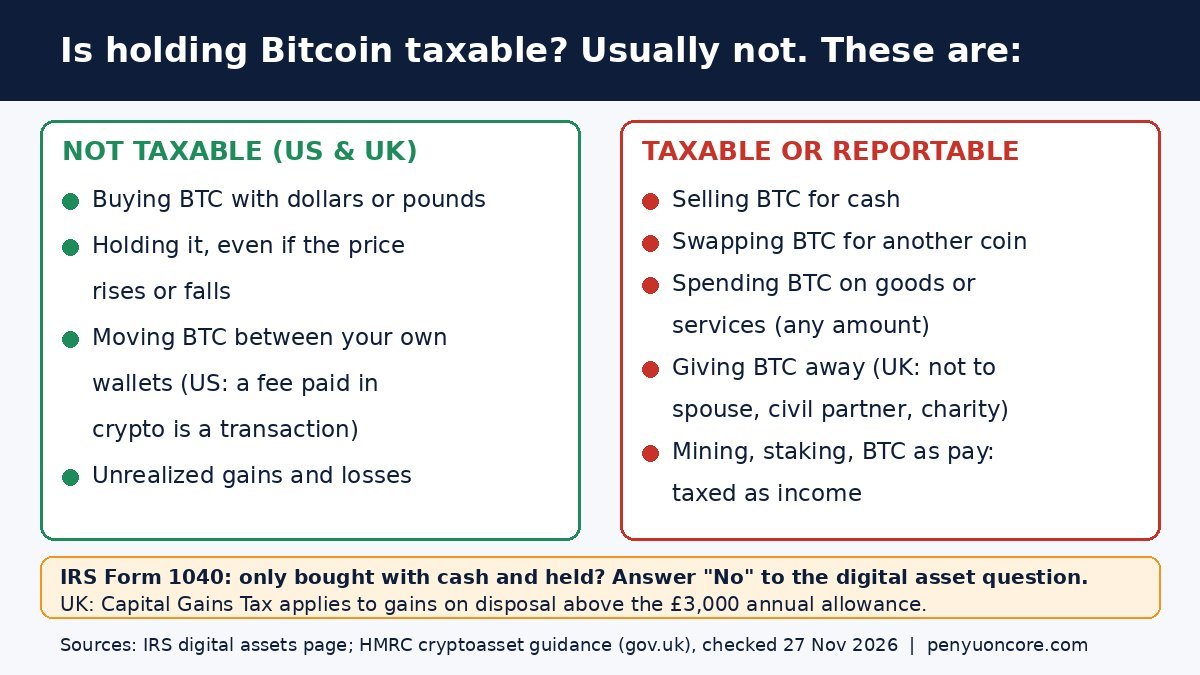
The IRS says you had a digital asset transaction if you sold, exchanged or transferred ownership of digital assets:
- for another digital asset (for example, swapping BTC for ETH or a stablecoin)
- for US dollars or other currency
- in exchange for property, goods or services, in any amount
- by paying a transfer fee with digital assets
So paying for a Black Friday purchase with Bitcoin, even a small one, is a disposal. The IRS’s virtual currency FAQs confirm that paying for a service with virtual currency you hold as a capital asset gives you a capital gain or loss.
UK: what HMRC treats as a disposal
HMRC’s guide Check if you need to pay tax when you sell cryptoassets lists four kinds of disposal:
- selling tokens
- exchanging them for a different type of cryptoasset
- using them to pay for goods or services
- giving them to another person (unless it’s a gift to your spouse, civil partner or charity)
Our guide is gifting Bitcoin taxable? covers the gift rules in more detail.
Holding vs other common actions: US and UK at a glance
| What you did | US (IRS) | UK (HMRC) |
|---|---|---|
| Bought BTC with cash and held it | Not taxable; answer “No” if that was your only activity | Not taxable when you buy |
| Moved BTC between your own wallets | Not taxable, but a fee paid in crypto counts as a transaction | Not a disposal if you keep beneficial ownership |
| Swapped BTC for another coin | Disposal: report gain or loss | Disposal: Capital Gains Tax rules apply |
| Spent BTC on goods or services | Disposal, in any amount | Disposal |
| Earned BTC from mining or staking | Income when received | Usually taxable income |
When you owe tax without selling: income
The other exception is Bitcoin you receive rather than buy. The IRS lists receiving digital assets as payment for property or services, as a reward or award, from mining, staking and similar activities, or from an airdrop following a hard fork. These are income. Wages paid in crypto go on Form 1040, independent contractor income on Schedule C, and mining or staking income on Schedule 1, according to the IRS digital assets page.
In the UK, HMRC says tokens you receive from employment, mining, staking or lending (including DeFi) count as income. If you’re not trading, rewards from mining, staking or lending are treated as other taxable income. They count towards the £1,000 trading and miscellaneous income allowance. HMRC says to contact it if your total miscellaneous income from all sources is between £1,000 and £2,500, and to register for Self Assessment if it’s over £2,500.
How to answer the IRS digital asset question
Every Form 1040 asks whether, at any time during the year, you received a digital asset (as a reward, award or payment) or sold, exchanged or otherwise disposed of one. According to the IRS, you can check “No” if you:
- only owned or held digital assets in a wallet or account, with no transactions during the year
- purchased, but did not sell, digital assets using US or other real currency, including through electronic platforms
- transferred digital assets between wallets or accounts you own or control, unless you paid a transaction fee with digital assets
If you had any of the income or disposal events above, check “Yes”. The IRS says you must report digital asset transactions whether or not they produce a taxable gain or loss.
What about Form 1099-DA?
Brokers such as custodial exchanges report sales on Form 1099-DA for transactions on or after 1 January 2025. Under the 2026 Form 1099-DA instructions, brokers must report gross proceeds for sales after 2025, and cost basis for “covered” assets: generally coins acquired after 2025 and kept in that same broker account. If you only bought and held, you shouldn’t have a sale to report. If a form shows proceeds without your cost, see our guide to a 1099-DA with missing cost basis.
Can you claim a loss on Bitcoin you still hold?
No. A drop in value while you still hold isn’t a deductible loss in either country. You realize the loss when you dispose of the coins.
US: If your capital losses exceed your gains, the IRS lets you deduct the lesser of $3,000 ($1,500 if married filing separately) or your net loss against other income, and carry the rest forward to later years. To count for 2026, a sale has to happen by year-end. See our tax loss harvesting deadline guide for the timing rules.
UK: You can report losses to HMRC to reduce your taxable gains. HMRC says you can claim a loss up to 4 years after the end of the tax year in which you disposed of the asset. Note that the UK has a 30-day rule: if you buy the same token back within 30 days of selling, the normal pooling rules don’t apply to that purchase, which can change the loss you can claim.
UK holders: allowance, reporting and new exchange data
The Capital Gains Tax tax-free allowance (Annual Exempt Amount) is £3,000. You pay tax only on total gains above it in a tax year (6 April to 5 April). But even if your gains are below the allowance, HMRC says that if you’re registered for Self Assessment you must report your gains if the total amount you sold assets for was more than £50,000 (from 2023 to 2024 onwards).
From 1 January 2026, under the Cryptoasset Reporting Framework (CARF), UK crypto service providers must collect user details and transaction data, including your National Insurance number or Unique Taxpayer Reference. HMRC says providers must submit their first report by 31 May 2027, covering 2026. Holding isn’t taxable, but HMRC will increasingly see disposals. If you’ve already had a letter, read our guide to the HMRC crypto letter.
Records to keep even if you never sell
Both the IRS and HMRC expect you to keep your own records. For each purchase, save:
- the date (and, for the IRS, the time) you acquired the Bitcoin
- the number of units and what you paid in dollars or pounds, including fees
- wallet addresses and transaction IDs for transfers between your own wallets
- exchange statements or CSV exports, plus related bank statements
HMRC also notes that exchange reports “are not tax calculations” and won’t track your pooled costs, so UK holders need their own pooling records.
FAQ
Do I have to report crypto if I didn’t sell?
In the US, if you only bought crypto with dollars and held it, the IRS says you can answer “No” to the digital asset question. You still need to report any income, swaps, spending or crypto-paid fees. In the UK, buying and holding isn’t reported as a gain.
Is moving Bitcoin from an exchange to my hardware wallet taxable?
No. The IRS says transfers between wallets or accounts you own are non-taxable, and HMRC says there’s no disposal if you keep beneficial ownership. In the US, a network fee paid in crypto counts as a digital asset transaction.
Do I pay tax on Bitcoin gains if I don’t cash out to my bank?
Swapping Bitcoin for another crypto or spending it is a disposal in both countries, even if no cash reaches your bank. Only holding, or moving coins between your own wallets, avoids a disposal.
This article is for general information only and isn’t tax, legal or financial advice. Tax rules depend on your circumstances and can change, so check current IRS or HMRC guidance or speak to a qualified tax professional before acting.