
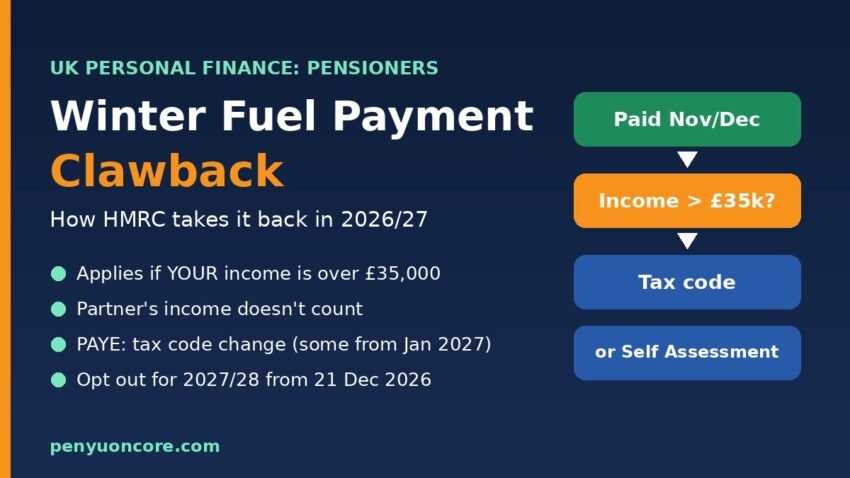
The winter fuel payment clawback is how HMRC takes back the 2026 to 2027 Winter Fuel Payment from pensioners whose own total income is over £35,000. You still get the money in November or December 2026. If you pay tax through PAYE, HMRC then usually recovers it by changing your tax code, and some people will see that change from January 2027. If you file a Self Assessment return, it’s added to your tax bill instead.
There’s no taper. If your income is even slightly over the line, the full payment is taken back. Your partner’s income doesn’t count. Below, using GOV.UK, HMRC and UK Parliament sources checked on 27 November 2026, we cover who it applies to, how much extra tax you might see each month, and what you can still do about it.
How the winter fuel payment clawback works
Since winter 2025, everyone over State Pension age can get the Winter Fuel Payment again. The catch is a separate tax called the Winter Fuel Payments charge. HMRC’s policy paper on the charge says it is “equal to the full value” of the payment for pensioners with total income over £35,000. The payment itself isn’t made taxable, and it’s still paid to you in full.
GOV.UK’s Winter Fuel Payment page says people born on or before 27 June 1960 could get between £100 and £300 for winter 2026 to 2027. Most eligible people will be paid in November or December 2026. In Scotland, the equivalent is the Pension Age Winter Heating Payment, and the same HMRC charge applies there too.
How much you’ll get before any clawback
According to GOV.UK’s how much you’ll get page, the amount depends on your age and your circumstances during the qualifying week of 21 to 27 September 2026. If you live alone, or nobody you live with is eligible:
- £200 if you were born between 28 September 1946 and 27 June 1960
- £300 if you were born before 28 September 1946
If you live with someone else who’s eligible and neither of you gets Pension Credit, Universal Credit or income-related ESA, you’ll usually get between £100 and £200 each, depending on which of you was born before 28 September 1946. People in care homes get £100 or £150. The DWP Christmas Bonus is a separate payment and isn’t affected by this charge.
Who has to pay it back?
You’ll face the clawback if your own total income for the tax year is over £35,000. This is “total income” as defined in Section 23 of the Income Tax Act 2007. Scotland’s Pension Age Winter Heating Payment factsheet explains it in plain terms: your expected income for the tax year before deductions. That includes:
- State Pension and private or workplace pensions
- Employment or self-employment income
- Taxable state benefits
- Savings interest and investment income held outside an ISA
It’s worked out per person, not per household. The House of Commons Library briefing says that if only one partner in a couple has income over £35,000, only that partner’s payment is recovered. The other partner keeps theirs.
Savings interest is easy to forget. With higher rates in recent years, interest from non-ISA savings can be what pushes someone over the line. Our guide to tax on savings interest in 2027 explains how that interest is taxed.
Who is exempt regardless of income
HMRC’s policy paper says you won’t pay the charge, whatever your income, if during the qualifying week you got Pension Credit, Universal Credit, income support, income-based Jobseeker’s Allowance or income-related Employment and Support Allowance.
How HMRC takes the Winter Fuel Payment back
How the money is recovered depends on how you pay tax. GOV.UK’s “If your income is over £35,000” page explains each route.
| How you pay tax | How the payment is recovered | What you need to do |
|---|---|---|
| PAYE only (pension or wages) | Tax code change, so more tax is taken from your pension or pay | Nothing. HMRC contacts you by email or post |
| Self Assessment (online) | Added to your tax bill as the “Winter Fuel Payment charge” | Check it’s on your return. HMRC usually pre-fills it |
| Making Tax Digital for Income Tax | HMRC writes after you submit, telling you how much and how to pay | Wait for HMRC’s letter before paying |
| Estate of someone who died | Usually repaid when the estate is settled | Include it when dealing with the person’s taxes |
Why some people will pay about £30 to £33 more tax a month from January 2027
HMRC is moving to collect each winter’s payment during the same tax year it’s paid. To make that switch, some people will have two payments recovered at once for a while. GOV.UK gives this example: if HMRC is already collecting your 2025 payment, your tax code will change in January 2027 to start collecting your 2026 payment as well. If both payments were £200, you’ll pay roughly £30 to £33 more tax each month. HMRC’s policy paper also estimates deductions of about £33 a month during the 2027 to 2028 tax year for a typical £200 payment, while both the 2026 and 2027 payments are being recovered.
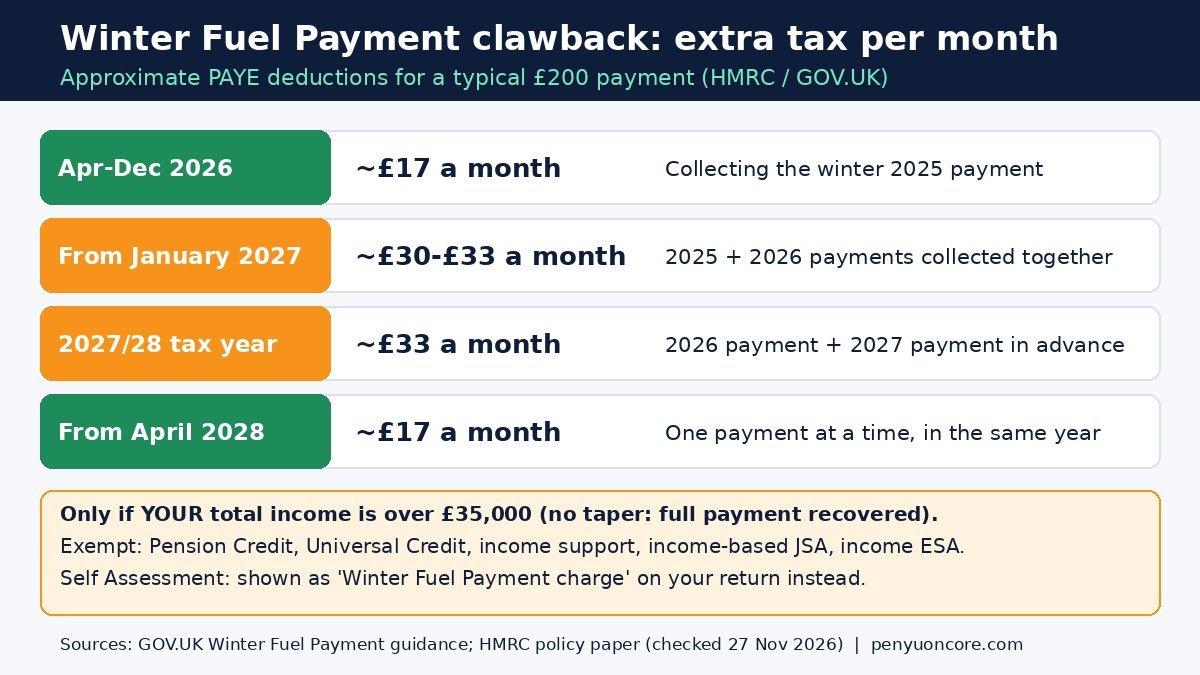
The Association of Taxation Technicians reported on 9 September 2026 that this January start is earlier than HMRC first planned. Before, collection was due to start in April 2027. The ATT adds that HMRC says nobody will repay more than they actually received. From April 2028, most people should only have one payment collected at a time. For a £200 payment, that’s around £17 extra tax a month.
If you don’t opt out, GOV.UK says your tax code will change again in April 2027. That’s when HMRC carries on collecting the 2026 payment and starts collecting the 2027 payment in advance. If HMRC can’t collect the full amount during the year, it will send you a tax calculation letter.
Tax codes are a common target for scammers, especially in winter. GOV.UK warns that messages asking for bank details or passwords could be a scam. Only make payments through HMRC’s official online services. If a message about your tax code asks you to click a link or pay straight away, check it by logging in to your HMRC account directly instead.
Can you avoid the winter fuel payment clawback?
For this winter, not really, unless your income ends up at £35,000 or less. GOV.UK’s opt-out page says you can no longer opt out for 2026 to 2027. In a written answer on 5 November 2026, DWP minister Baroness Sherlock confirmed the 2026/27 deadline was 20 September 2026.
For future winters, there are a few things worth knowing:
- Opting out for 2027 to 2028 opens on 21 December 2026. If you expect your income to stay over £35,000, opting out means you won’t get the payment, so there’s nothing to claw back and no double-collection period. The House of Commons Library notes that once you opt out, you stay opted out in future years unless you opt back in.
- You can opt back in. If your income falls, contact the Winter Fuel Payment Centre. To get a payment for winter 2026 to 2027, you need to contact them before 31 March 2027.
- Check your figure. GOV.UK has a tool to check whether your total income is over the threshold. You’ll need your expected income for the tax year before deductions.
- Check your new tax code. If HMRC changes your code, compare the amount being collected with the payment you actually got. GOV.UK says mistakes are fixed through the usual year-end tax reconciliation.
If you’re on a lower income and might qualify for Pension Credit, it’s worth checking. Pension Credit doesn’t just protect your Winter Fuel Payment. It can also unlock other help, such as the Cold Weather Payment. From April 2027, the State Pension increase will also raise many pensioners’ total income. That makes it worth rechecking how close you are to £35,000 each year.
FAQ
Is the Winter Fuel Payment taxable?
No. The payment isn’t added to your taxable income. A separate charge equal to the full payment applies only if your total income is over £35,000.
What if my income is £35,500? Do I keep part of it?
No. There’s no taper. If your total income is over £35,000, HMRC recovers the full amount you received.
Does my husband’s or wife’s income count?
No. Each person is assessed on their own income. Only the partner with income over £35,000 has their payment recovered.
Do I need to contact HMRC?
Usually not. If you’re PAYE only, HMRC changes your tax code automatically. If you file Self Assessment online, check that the “Winter Fuel Payment charge” appears on your return.
Can I just send the money back?
For winter 2026 to 2027, HMRC recovers the money through your tax code or tax return. Wait for HMRC to tell you how much you owe. To stop future payments, opt out for 2027 to 2028 from 21 December 2026.
This article is general information, not financial or tax advice. Rules and figures are from GOV.UK, HMRC and UK Parliament sources checked on 27 November 2026 and may change. Check GOV.UK or speak to a qualified adviser about your own situation.