
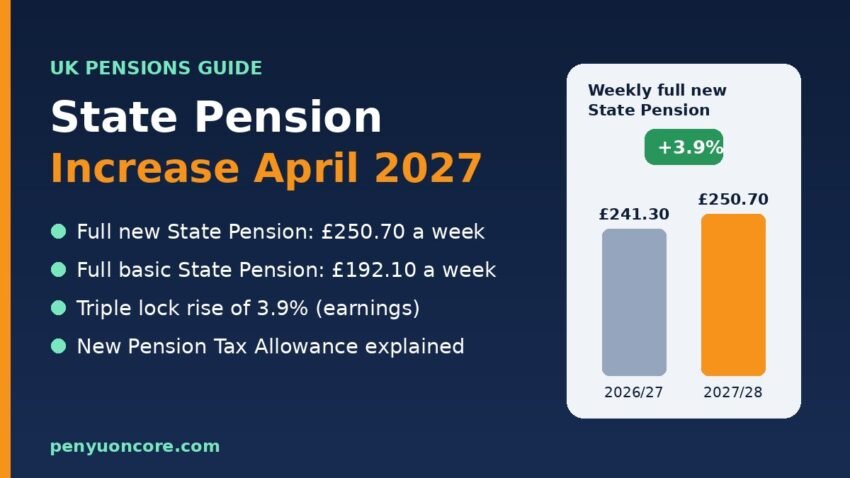
The State Pension increase April 2027 is 3.9%. The full new State Pension rises from £241.30 to £250.70 a week, and the full basic (old) State Pension rises from £184.90 to £192.10 a week. The government confirmed the new rates in its proposed benefit and pension rates for 2027 to 2028, published by the Department for Work and Pensions (DWP) on 11 November 2026. You don’t need to apply. The increase is added to your payments automatically.
For the first time, the full new State Pension will be worth more than the frozen £12,570 Personal Allowance. So the 2026 Budget also created a new Pension Tax Allowance to stop the lowest-income pensioners from being taxed just because of the uprating. All figures below come from GOV.UK and UK Parliament sources, checked on 27 November 2026.
State Pension increase April 2027: the new weekly rates
On 28 October 2026, the Work and Pensions Secretary’s written statement to Parliament confirmed that the basic and new State Pensions will go up by 3.9%. That matches growth in average weekly earnings in May to July 2026. The statement says the new rates “will mainly come into effect from 12 April 2027”. Here are the main pensioner rates from the DWP rates document:
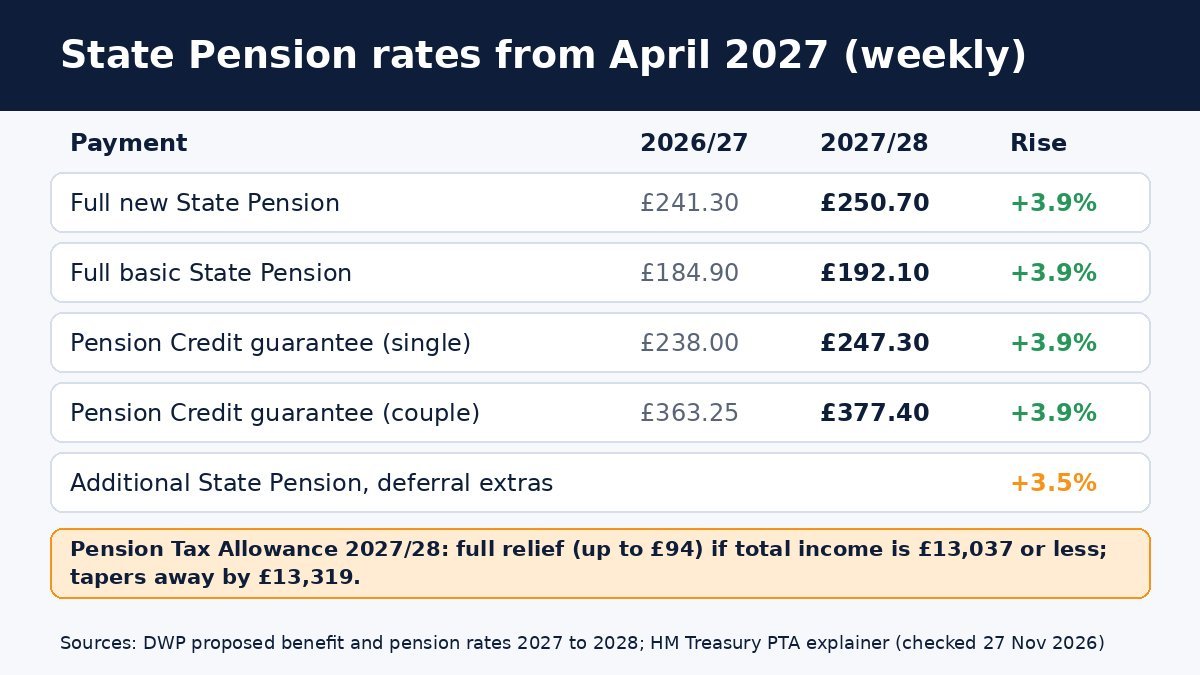
| Payment (weekly) | 2026 to 2027 | 2027 to 2028 | Increase |
|---|---|---|---|
| Full new State Pension | £241.30 | £250.70 | 3.9% |
| Full basic State Pension (Category A or B) | £184.90 | £192.10 | 3.9% |
| Basic State Pension, Category B (lower) and C or D | £110.75 | £115.05 | 3.9% |
| Pension Credit Standard Minimum Guarantee, single | £238.00 | £247.30 | 3.9% |
| Pension Credit Standard Minimum Guarantee, couple | £363.25 | £377.40 | 3.9% |
| Attendance Allowance, higher rate | £114.60 | £118.60 | 3.5% |
| Attendance Allowance, lower rate | £76.70 | £79.40 | 3.5% |
Over a year, the government says the full new State Pension goes up by “around £490” and the full basic State Pension by “around £375”. At £250.70 a week, the full new State Pension is worth £13,036.40 for the 2027 to 2028 tax year. The full basic State Pension, at £192.10 a week, works out at about £9,989 a year.
Why the rise is 3.9% this time
Under the triple lock, the basic and new State Pensions rise each April by the highest of three figures: CPI inflation in the year to September, average earnings growth over May to July, or 2.5%. MoneyHelper explains that earnings growth of 3.9% beat both inflation and the 2.5% floor this year. The DWP statement puts CPI inflation in the year to September 2026 at 3.5%.
Who gets 3.9% and who gets 3.5%
Not every part of your State Pension follows the triple lock. Your total rise depends on what makes up your payment.
- Full or partial new State Pension: the transitional rate below the full rate rises by 3.8956%, according to the DWP rates table. So a partial new State Pension rises roughly in line with the full rate.
- Protected Payment (the extra some people get above the full new State Pension because of pre-2016 contributions): rises by 3.5%, which is CPI.
- Additional State Pension (SERPS or S2P on the old State Pension): rises by 3.5%.
- Extra State Pension from deferring: the increments rise by 3.5%.
- Pension Credit Standard Minimum Guarantee: rises by 3.9%. The Savings Credit maximum rises by 3.5%.
- Disability and carer benefits such as Attendance Allowance, and other benefits covered by the review, rise by 3.5% (CPI). Carer’s Allowance goes from £86.45 to £89.50 a week. The DWP says the Carer’s Allowance rate and disability benefits such as PIP apply only to England and Wales, because these are devolved in Scotland.
When will you get the higher payment?
The new rates mainly start from 12 April 2027, according to the DWP statement. GOV.UK says the new State Pension is usually paid every 4 weeks. Your payment day depends on the last two digits of your National Insurance number: 00 to 19 is Monday, 20 to 39 Tuesday, 40 to 59 Wednesday, 60 to 79 Thursday, and 80 to 99 Friday. So the first payment at the new rate will land on different dates for different people, depending on where your four-week cycle falls.
If you live abroad, check whether you get the increase at all. GOV.UK says your State Pension only goes up each year if you live in the EEA, Gibraltar, Switzerland, or a country with a social security agreement with the UK. Canada and New Zealand are excluded even though they have such agreements. Elsewhere, your pension stays “frozen” at the rate you first received.
Will you pay tax on your State Pension from April 2027?
The State Pension is taxable income, but tax is not taken off before it is paid. The Personal Allowance stays frozen at £12,570 for 2027 to 2028, according to the Budget’s rates and allowances annex. That means a full new State Pension of £13,036.40 would be £466.40 above the allowance. Without the new rule, someone whose only income is the full new State Pension would owe £93.28 of income tax.
How the new Pension Tax Allowance works
HM Treasury’s Pension Tax Allowance explainer (28 October 2026) sets out the rules for 2027 to 2028:
- You must be over State Pension age, or reach it during the tax year.
- Total income of £12,570 or less: no income tax is due anyway.
- Total income between £12,570 and £13,037: you get the full Pension Tax Allowance, which is worth up to £94. That removes the tax bill created by the State Pension rise.
- Total income between £13,037 and £13,319: you get a partial allowance. It reduces by £1 for every £3 of income above £13,037.
- Total income of £13,319 or more: no Pension Tax Allowance.
“Total income” means income from all sources, including the State Pension, private or workplace pensions, earnings, self-employment, rent, and savings or dividend income. ISA income does not count. HMRC applies the allowance automatically, so you don’t need to claim it. The allowance can’t be transferred to a partner, and it will never create a refund. It applies for the 2027 to 2028, 2028 to 2029 and 2029 to 2030 tax years. The government estimates that in 2027 to 2028 around 290,000 pensioners will pay no tax because of it, and around 500,000 will get some reduction.
If your income is above £13,319, for example because you have a modest workplace pension, nothing changes for you. Tax is still collected through PAYE on your other pension, through Self Assessment, or through a Simple Assessment letter from HMRC. If you earn interest outside an ISA, note that the Budget also raises tax rates on savings income from April 2027. Our guide to the cash ISA limit for 2027 explains why that makes ISA wrappers more useful.
The triple lock changes from April 2030
The full triple lock stays in place for this Parliament, which covers the April 2027, 2028 and 2029 rises. From April 2030, the government plans an “adjusted” triple lock. In a written answer on 28 October 2026, the DWP said the basic and new State Pensions will then rise by “the highest of 2.5 per cent, Consumer Price Index inflation, or the increase needed to return or maintain the State Pension at the protected earnings level”. In practice, earnings growth stops being an automatic minimum. Instead, the pension must at least keep the value it reaches relative to average earnings in April 2029. The change still needs legislation and was discussed in the House of Lords on 23 November 2026.
What to do now
- Check your forecast if you haven’t reached State Pension age. The Check your State Pension forecast service shows what you could get and whether you can fill gaps. You need 10 qualifying years to get any new State Pension, and usually 35 for the full rate.
- Check Pension Credit. The Standard Minimum Guarantee tops weekly income up to £247.30 for a single person from April 2027. Pension Credit can also unlock other help, such as the Cold Weather Payment and the DWP Christmas Bonus.
- Add up your total income for 2027 to 2028. If it falls close to £13,037 to £13,319, the Pension Tax Allowance could reduce or remove your tax bill.
- Watch out for scams. You never need to pay a fee or “apply” to receive the April increase.
FAQ
How much is the State Pension increase in April 2027?
It’s 3.9% for the basic and new State Pensions. The full new State Pension goes from £241.30 to £250.70 a week, and the full basic State Pension from £184.90 to £192.10 a week.
Do I need to apply for the increase?
No. If you already get your State Pension, the new rate is applied automatically.
Is the State Pension now tax-free?
No. The State Pension remains taxable. From April 2027, the Pension Tax Allowance only removes or reduces tax for people over State Pension age with total income below £13,319.
Why is my increase less than 3.9%?
Parts of your pension such as Additional State Pension, Protected Payments and deferral increments rise by 3.5% (CPI), not 3.9%. If you live in a country where UK State Pension is frozen, you won’t get the rise at all.
This article is general information, not financial or tax advice. Rates are the DWP’s proposed 2027 to 2028 rates and the Pension Tax Allowance is subject to the Finance Bill becoming law. Check GOV.UK or speak to a regulated adviser about your own situation.