
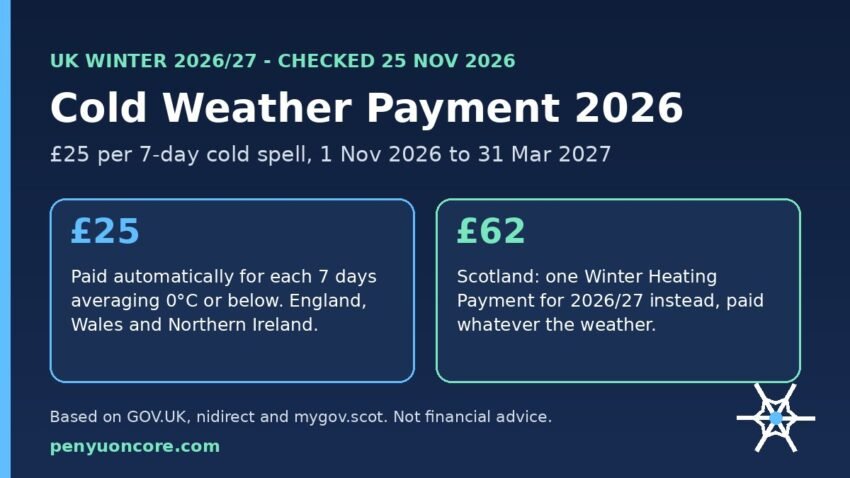
The Cold Weather Payment 2026 scheme pays £25 for each 7-day spell of very cold weather between 1 November 2026 and 31 March 2027 to people on certain benefits in England, Wales and Northern Ireland. You don’t apply: if you qualify and your local weather station records or forecasts an average of 0°C or below for 7 days in a row, the money is paid automatically into your benefit account. Scotland doesn’t have Cold Weather Payments and pays a fixed Winter Heating Payment instead.
With colder weather arriving and the season already under way, here’s how eligibility, the postcode checker and payment timing work this winter. Everything below was checked against GOV.UK, nidirect and mygov.scot on 25 November 2026.
Cold Weather Payment 2026: the key facts
| Detail | 2026/27 scheme |
|---|---|
| Amount | £25 for each qualifying 7-day period of very cold weather |
| Season | 1 November 2026 to 31 March 2027 |
| Trigger | Average temperature recorded or forecast at 0°C or below over 7 consecutive days |
| Where it applies | England, Wales and Northern Ireland (not Scotland) |
| How to claim | No claim needed: paid automatically if you’re eligible |
| When it arrives | Usually within 14 working days of each cold spell |
| Effect on other benefits | None: it doesn’t reduce your other benefits |
Source: GOV.UK Cold Weather Payment guide and the nidirect Cold Weather Payment page.
Who is eligible for a Cold Weather Payment?
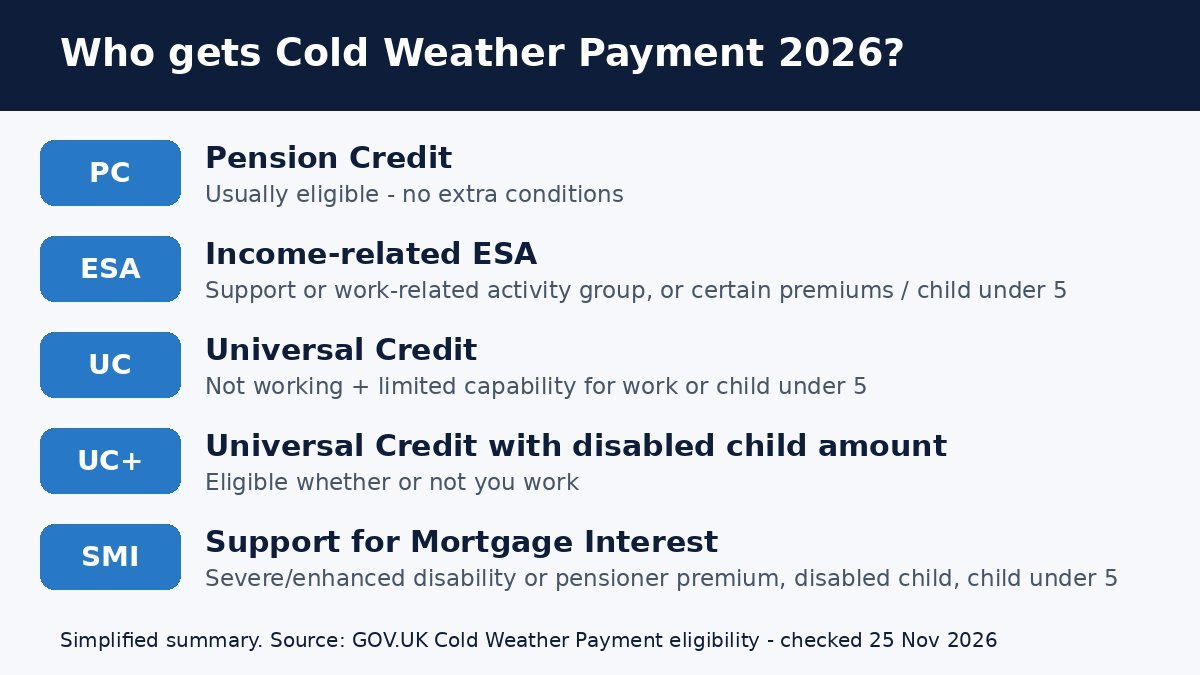
Two things both have to be true: you must be getting a qualifying benefit, and your area must have a qualifying cold spell. According to GOV.UK’s eligibility page, the qualifying benefits are Pension Credit, income-related Employment and Support Allowance (ESA), Universal Credit and Support for Mortgage Interest (SMI). Most of them come with extra conditions.
Pension Credit
You’ll usually get Cold Weather Payments if you get Pension Credit. There are no extra conditions.
Income-related ESA
You’ll usually qualify if you’re in the work-related activity group or the support group. If you’re in neither, you might still qualify if you have a severe or enhanced disability premium, a pensioner premium, a disabled child, or a child under 5 living with you.
Universal Credit
This is where most confusion comes from. You’ll usually qualify only if you aren’t employed or “gainfully self-employed” (and neither is your partner, if you have one), and one of these applies:
- you or your partner have a health condition or disability and limited capability for work (with or without work-related activity), or
- you have a child under 5 living with you.
There’s one exception to the work rule: if your Universal Credit includes a disabled child amount, you’re eligible whether you or your partner work or not. GOV.UK says you’re likely to be treated as gainfully self-employed if self-employment is your main job, you work regularly and you expect to make a profit. If you earn a little on the side, our explainer on the trading allowance increase covers how small side income is taxed. That’s a separate question from benefit rules, though.
Support for Mortgage Interest
You’ll usually qualify if you get SMI and are treated as getting a qualifying benefit, with a severe or enhanced disability premium, a pensioner premium, a disabled child, or a child under 5 living with you.
Had a baby? You may need to tell DWP
If you get Universal Credit or income-related ESA and you’ve had a baby, or a child under 5 has come to live with you, you need to report the change. Use your Universal Credit online account (or the helpline), or tell Jobcentre Plus if you’re on ESA. GOV.UK warns that you won’t automatically get Cold Weather Payments if you don’t.
How to use the Cold Weather Payment postcode checker
Payments are triggered by weather station, not by individual home, so the quickest check is the official postcode tool for where you live:
- England and Wales: the DWP Cold Weather Payments checker shows any payments triggered in your area since 1 November and the weather station used for your postcode.
- Northern Ireland: use the nidirect Cold Weather Payment checker.
- Scotland: there’s no checker, because the scheme doesn’t apply. See the Winter Heating Payment section below.
Two points are worth knowing. First, a triggered payment in your postcode isn’t a personal decision on your claim: you still need to meet the benefit rules above. Second, a few frosty nights aren’t enough. The average temperature has to be at or below zero across 7 consecutive days. Selectra reported on 23 November that its own check of 35 postcode districts in England and Wales showed no payments triggered yet, despite cold-health alerts in northern England. Check your own postcode rather than relying on headlines.
DWP publishes weekly estimates of payments triggered. The first release of the 2026/27 season, covering 1 to 27 November 2026, is due at 9:30am on 2 December 2026, with further releases scheduled for 9, 16 and 23 December.
When and how you’ll be paid
According to GOV.UK, you should get each payment within 14 working days after the cold spell in your area. It goes into the same bank or building society account as your benefit payments. If your area has three separate qualifying spells this winter, you’d get three separate £25 payments.
If you think you’ve missed one:
- check your postcode result and your eligibility separately,
- allow the full 14 working days,
- then contact the Pension Service or Jobcentre Plus. On Universal Credit, add a note to your online journal, or call the helpline number shown on your Universal Credit letters.
Also tell the Pension Service or Jobcentre Plus (or add a journal note on Universal Credit) if you go into hospital, as this could affect your payment.
Watch out for scams
Because the payment is automatic, nobody needs your bank details to “release” it. nidirect states plainly that you won’t be sent a text or email asking for your bank details. Treat any message like that as a scam and report it.
Scotland: Winter Heating Payment instead
If you live in Scotland, you can’t get Cold Weather Payments. Social Security Scotland pays a single Winter Heating Payment instead. The key differences:
| Feature | Cold Weather Payment | Winter Heating Payment (Scotland) |
|---|---|---|
| Amount | £25 per qualifying 7-day cold spell | £62.00 once a year for winter 2026/27 |
| Depends on weather? | Yes | No, paid however cold it gets |
| When paid | Within 14 working days of each spell | From December and through winter |
| Who runs it | UK benefit system (Pension Service, Jobcentre Plus, Universal Credit) | Social Security Scotland |
| How to get it | Automatic | Automatic, based on a qualifying week |
The £62.00 rate for 2026/27 (up from £59.75) is set in the Scottish Government’s 2026-27 up-rating report and the 2026 up-rating regulations. Eligibility depends on getting a qualifying benefit (such as Pension Credit, or Universal Credit with certain elements) at some point during the qualifying week of 2 to 8 November 2026. The payment shows as “WHP” on bank statements. If you think you’ve missed it, you can send Social Security Scotland a request.
Cold Weather Payment vs Winter Fuel Payment
These are different schemes, and GOV.UK says so explicitly. Cold Weather Payments are linked to low-income benefits and actual cold spells. The Winter Fuel Payment is a separate annual payment of £100 to £300 for winter 2026 to 2027 for people born on or before 27 June 1960, with its own rules. You can be eligible for one, both or neither. In Scotland, Winter Fuel Payment has been replaced by Pension Age Winter Heating Payment.
£25 won’t cover a winter of heating bills, but it helps. A small cash buffer makes surprise costs easier to absorb. Our guide on how much emergency fund you need walks through sizing one, and it’s also worth checking for unclaimed Premium Bonds prizes you may have forgotten about.
FAQ
How much is the Cold Weather Payment in 2026?
£25 for each 7-day period of very cold weather in your area between 1 November 2026 and 31 March 2027. Each separate qualifying spell triggers its own £25 payment.
Do I need to apply for a Cold Weather Payment?
No. If you’re eligible, it’s paid automatically. You may need to report a new baby or a child under 5 joining your household if you get Universal Credit or income-related ESA.
Can I get a Cold Weather Payment if I work and get Universal Credit?
Usually not, unless your Universal Credit includes a disabled child amount. In that case, working doesn’t affect eligibility.
Do pensioners get the Cold Weather Payment automatically?
Only if they get Pension Credit (or another qualifying benefit). The State Pension on its own doesn’t qualify.
Does the Cold Weather Payment affect my other benefits?
No. GOV.UK says the payments don’t affect your other benefits.
This article is general information, not financial or benefits advice. Benefit rules depend on your circumstances and can change. Check GOV.UK, nidirect or mygov.scot, or contact the relevant office, if you’re unsure about your entitlement. Sources checked 25 November 2026.