
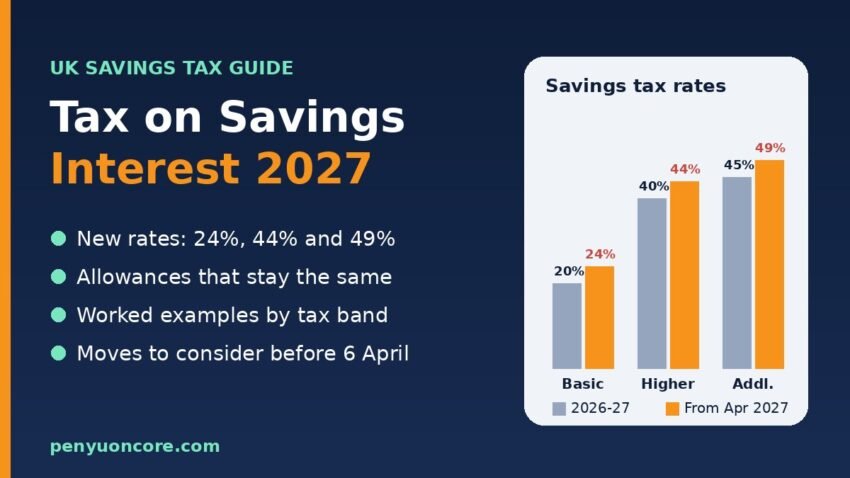
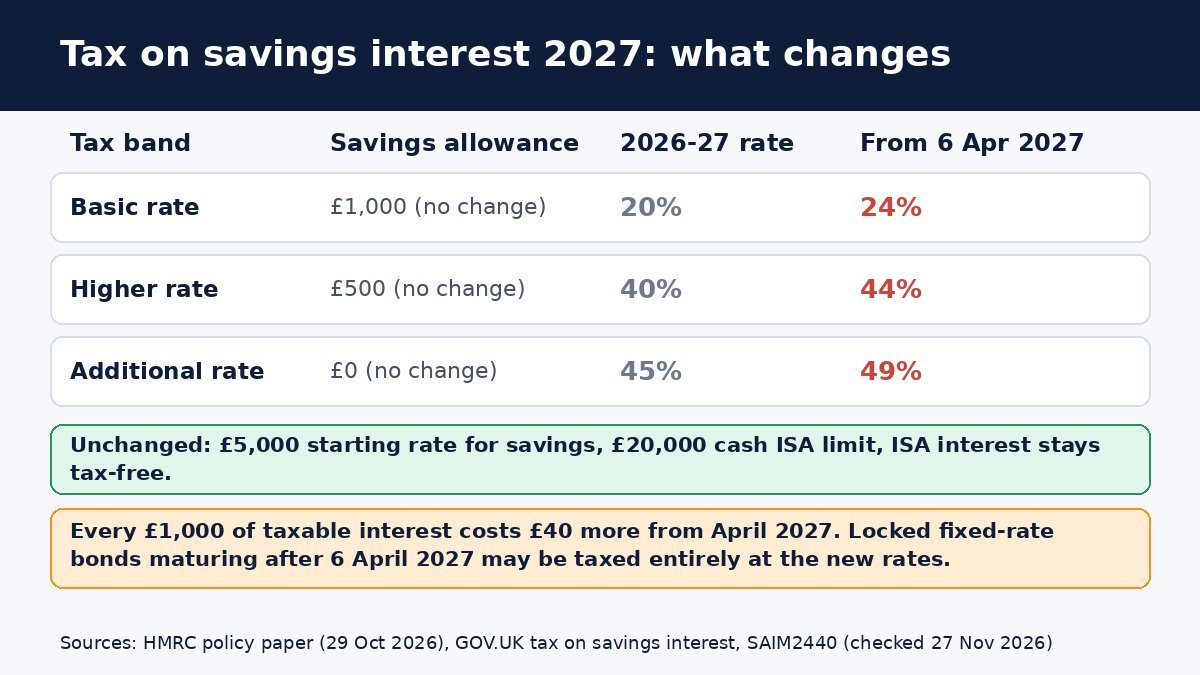
The tax on savings interest 2027 changes are bigger than many savers realise. From 6 April 2027, interest above your tax-free allowances will be taxed at 24% for basic-rate taxpayers, 44% for higher-rate taxpayers and 49% for additional-rate taxpayers, up from 20%, 40% and 45% today. The Personal Savings Allowance (£1,000, £500 or £0) and the £5,000 starting rate for savings stay the same, and interest inside an ISA stays tax-free.
The jump is 4 percentage points because two Budgets stacked on top of each other. The Autumn Budget on 26 November 2025 had already set 22%, 42% and 47% for 2027-28. Then Budget 2026 on 28 October 2026 added “a further two percentage points across all bands”. This guide uses GOV.UK and HMRC sources, all checked on 27 November 2026, to explain who pays, how much more, and what you can sensibly do before April.
Tax on savings interest 2027: the new rates
HMRC’s policy paper published on 29 October 2026 sets out the new savings rates. They take effect for the 2027 to 2028 tax year and later years, and they will be legislated in Finance Bill 2026-27.
| Your Income Tax band | Personal Savings Allowance | Rate on taxable interest 2026-27 | Rate from 6 April 2027 |
|---|---|---|---|
| Basic rate | £1,000 | 20% | 24% |
| Higher rate | £500 | 40% | 44% |
| Additional rate | £0 | 45% | 49% |
Sources: HMRC’s savings and property income rates paper, the GOV.UK guide to tax on savings interest and the 2026-27 Income Tax rates.
Some details are worth knowing:
- It applies across the UK. HMRC says the new savings rates “apply across the UK”, including Scotland. Scotland sets its own rates for earned income, but savings rates are reserved to Westminster.
- The allowances are not changing. The October 2026 tax-free savings newsletter confirms that the starting rate for savings and the Personal Savings Allowance stay the same.
- The savings trust rate also rises to 49%, which matters for trustees and personal representatives.
Who actually pays more?
Most people won’t pay a penny more. Your interest has to exceed your tax-free allowances before any tax is due, and GOV.UK explains that these are:
- Personal Allowance (£12,570): any part not used by your wages or pension can cover interest.
- Starting rate for savings (up to £5,000): available if your other taxable income is under £17,570. It shrinks by £1 for every £1 of other income above your Personal Allowance.
- Personal Savings Allowance: £1,000 for basic-rate taxpayers, £500 for higher-rate taxpayers and nothing for additional-rate taxpayers. To work out your band, you add your interest to your other income.
HMRC estimates that around 12% of taxpayers will see an average rise of £113 a year in 2027-28 from the savings change. By 2031-32, it expects about 6 million people to be affected. HMRC also says people aged 55 and over make up 63% of those affected, compared with 39% of UK adults, so retirees with large cash balances are hit hardest. HMRC gives a useful benchmark too: a basic-rate taxpayer making full use of the starting rate and the Personal Savings Allowance would need more than £150,000 saved outside an ISA, earning 4%, before paying any tax on interest.
Worked examples: how much more you could pay
These examples are only illustrations. They assume interest of 4% a year, that the interest doesn’t push you into a different band, and that allowances and bands for 2027-28 are the same as for 2026-27.
| Saver | Interest (outside ISA) | Taxable after allowance | Tax at 2026-27 rates | Tax at 2027-28 rates |
|---|---|---|---|---|
| Basic rate, £20,000 saved | £800 | £0 (under £1,000) | £0 | £0 |
| Basic rate (£30,000 salary), £60,000 saved | £2,400 | £1,400 | £280 | £336 (+£56) |
| Higher rate (£70,000 salary), £60,000 saved | £2,400 | £1,900 | £760 | £836 (+£76) |
| Additional rate, £250,000 saved | £10,000 | £10,000 | £4,500 | £4,900 (+£400) |
The pattern is simple: every £1,000 of taxable interest costs £40 more from April 2027, whatever your band.
When does the new rate apply to your interest?
What matters is when the interest arises, not when it was earned. HMRC’s Savings and Investment Manual (SAIM2440) says interest arises “when it is received or made available to the recipient”, which includes being credited to an account you are free to draw on.
Why fixed-rate bonds need a second look
For easy-access accounts, interest credited up to 5 April 2027 is taxed at the current rates. Fixed-rate bonds work differently. HMRC’s example says that if a bond’s terms let you draw the interest, even with a penalty, the interest is taxable each year as it’s credited. If you can’t access it until maturity, all the interest arises at maturity. So a two-year bond that rolls up interest and matures after 6 April 2027 could have its whole interest taxed at the new 24%, 44% or 49% rates. It could also use up a whole year’s Personal Savings Allowance in one go. Before you lock in a new bond this winter, check whether interest is paid annually or only at maturity.
Sensible moves before 6 April 2027
1. Use your ISA allowance, twice if you can
Interest inside an ISA is tax-free and stays that way. Budget 2026 also scrapped the planned £12,000 cut and kept the cash ISA limit at £20,000 from April 2027. If you have spare cash, you can use your 2026-27 allowance before 5 April 2027 and a fresh £20,000 from 6 April. Couples get an allowance each. If you’re saving for a first home, our guide to the new First Time Buyer ISA explains how it will work alongside the Lifetime ISA.
2. Consider Premium Bonds for part of your cash
NS&I says Premium Bonds prizes are free from UK Income Tax and Capital Gains Tax, and you can hold up to £50,000. Premium Bonds don’t pay guaranteed interest, though. Returns depend on the prize draw, so your actual return can be lower than a savings account’s. Our guide on reinvesting Premium Bonds prizes covers how the prizes work.
3. Check whose name the savings are in
Allowances belong to each person. GOV.UK says HMRC splits interest on joint accounts equally between the holders, so a couple where one partner pays basic rate and the other pays higher rate should think about how their cash is held. Moving money between spouses is a genuine gift, so get advice first if your situation is complex.
4. Keep an emergency fund, but don’t over-hoard cash
Easy-access cash still matters. Our guide to how much emergency fund you need can help you decide how much to keep in cash. Large balances held outside an ISA above that level will be taxed more heavily from April.
Check your HMRC letter before 30 November
This one is urgent. If you’re employed or get a pension and owe tax on 2025-26 savings interest, GOV.UK says HMRC usually sends a tax calculation between June and the end of November, and normally collects the tax through your tax code. If you have tax to pay and haven’t had a letter by the end of November, you must contact HMRC. Also check the estimated interest in your tax code in your Personal Tax Account, and ask HMRC to correct it if it’s wrong. If your interest is over £10,000, you must report it on a Self Assessment tax return.
FAQ
Is the Personal Savings Allowance going up in 2027?
No. HMRC confirms it stays at £1,000 for basic-rate taxpayers, £500 for higher-rate taxpayers and £0 for additional-rate taxpayers. The starting rate for savings stays at up to £5,000.
Do I need to do anything when the rates change?
Not necessarily. HMRC says most people who owe tax on savings have it collected automatically through PAYE, and there are no new reporting requirements. If you file Self Assessment, you will report interest in the same way as now.
Is ISA interest affected by the 2027 rise?
No. Interest and returns inside ISAs remain tax-free.
Does the rise affect dividends?
Not in April 2027. Dividend rates went up separately from April 2026 under the Autumn Budget 2025. The April 2027 change covers savings income and property income.
This article is general information, not financial or tax advice. Tax rules depend on your circumstances and may change before the Finance Bill becomes law. Check GOV.UK or speak to a qualified adviser before making decisions.