
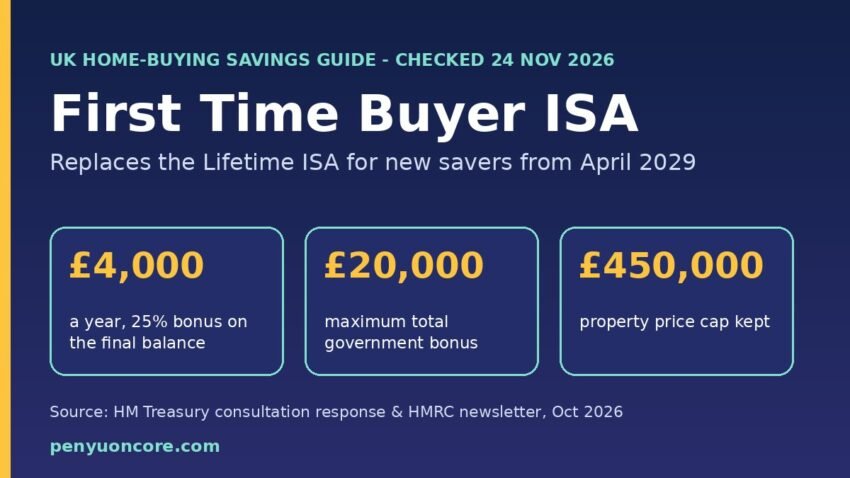
The First Time Buyer ISA is a new UK savings account confirmed at Budget 2026 that will replace the Lifetime ISA for new savers from April 2029. You’ll be able to pay in up to £4,000 a year and get a 25% government bonus when you buy your first home, with no withdrawal charge and no upper age limit.
Short answer: You can’t open one yet. Existing Lifetime ISAs carry on under their current rules, you can’t transfer a Lifetime ISA into the new account, but you’ll be able to use both towards the same purchase. The £450,000 property price cap stays.
This guide is for UK savers. It’s based on HM Treasury’s consultation response and HMRC and GOV.UK guidance, all checked on 24 November 2026. The account isn’t law yet, so some details may still change.
What is the First Time Buyer ISA?
The government first said at Autumn Budget 2025 that it would consult on “a new, simpler first-time buyer ISA”. The consultation ran from 23 June to 18 August 2026 and drew 194 responses. On Budget day, 28 October 2026, HM Treasury published its government response confirming the final design.
HMRC’s tax-free savings newsletter for October 2026 sums it up. The product “will be offered in place of the Lifetime ISA and provide a government bonus when a person uses it to buy a house, removing the need for a withdrawal charge.” The key points are:
- Launch: April 2029. The tax year starts on 6 April 2029.
- Contributions: up to £4,000 per tax year, counted within your overall £20,000 ISA allowance.
- Bonus: 25%, worked out on the final account balance and capped at £20,000 in total.
- When the bonus is paid: when you withdraw the money for an eligible first-home purchase. The design table says it’s paid at exchange, and you then have 90 days to complete.
- Age: you must be 18 or over to open one, and there’s no upper age limit.
- Accounts: you can hold only one First Time Buyer ISA at a time. Cash and stocks and shares versions are planned.
- Qualifying rules: you must have held the account for 1 year to get the bonus, buy with a mortgage and stay within the £450,000 price cap.
First Time Buyer ISA vs Lifetime ISA: key differences
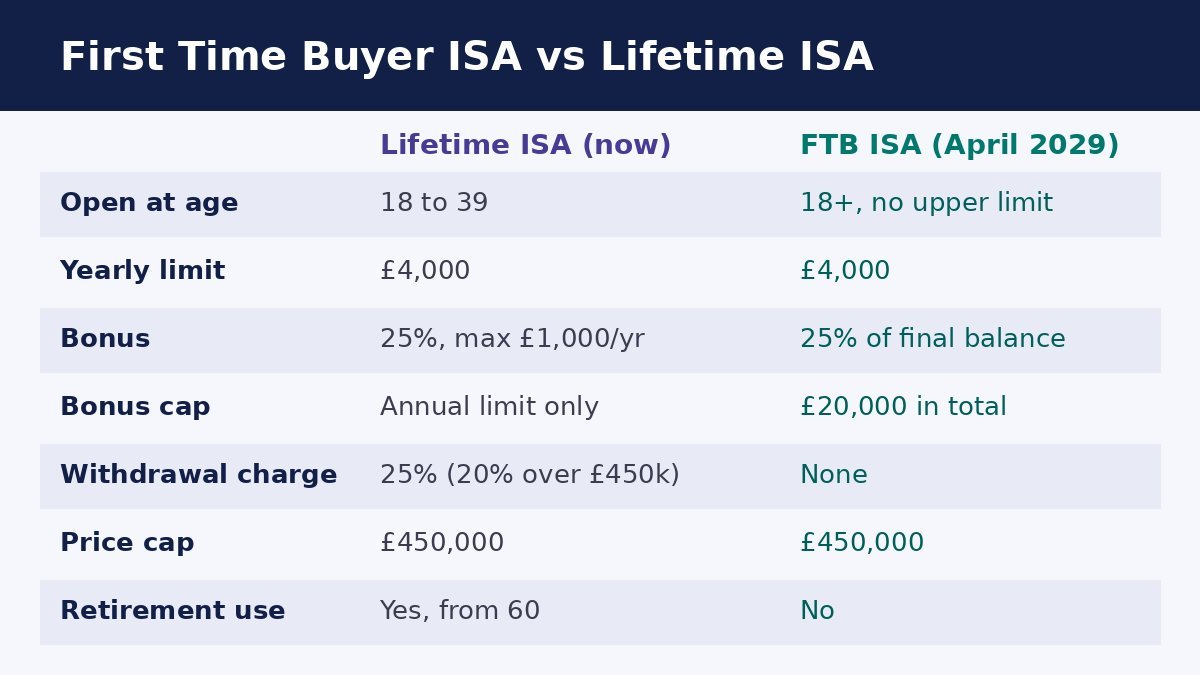
The new account copies the Lifetime ISA’s £4,000 limit and 25% bonus, but changes how the bonus works and drops the age limits. Here’s how the two compare, based on the design features summary (PDF) and GOV.UK’s Lifetime ISA guide.
| Feature | Lifetime ISA (now) | First Time Buyer ISA (from April 2029) |
|---|---|---|
| Who can open | Age 18 to 39 | Age 18 or over, no upper limit |
| Annual limit | £4,000, paid in until age 50 | £4,000, no lifetime maximum on subscriptions |
| Government bonus | 25% of savings, up to £1,000 a year | 25% of final balance, capped at £20,000 in total |
| Bonus paid | Added to the account as you save | At exchange on a qualifying first home |
| Withdrawal charge | 25% for unauthorised withdrawals; 20% for first homes over £450,000 | None |
| Property price cap | £450,000 | £450,000 |
| Use for retirement | Yes, penalty-free from age 60 | No, first-home purchase only |
The biggest change is the bonus. In a Lifetime ISA, the bonus is added as you save and can be clawed back by the 25% withdrawal charge. In the First Time Buyer ISA, the bonus is only worked out at the end, on your final balance. The government says this means “any investment or interest growth within the account is recognised when the bonus is calculated.” If you never buy a home, you simply don’t get a bonus. There’s no penalty on your own money.
What the £20,000 bonus cap means in practice
Since the bonus is 25% of the final balance, the £20,000 cap is reached when the account holds £80,000. Take someone who pays in £4,000 a year for five years with no growth. They’d have £20,000, which would earn a £5,000 bonus. That’s the same as five years of the Lifetime ISA’s £1,000 maximum annual bonus. Most savers won’t get near the cap, but it matters for people who save for a long time, which is now possible because there’s no age limit.
What happens to your existing Lifetime ISA?
The government response says the new account “will be offered in place of the Lifetime ISA, with existing LISA accounts opened until that point able to continue under existing terms.” In practice:
- Keep paying in. An open Lifetime ISA keeps its £4,000 limit and 25% bonus, as described on GOV.UK.
- No transfer across. “To avoid duplicate government bonuses, individuals will not be able to transfer from a LISA to a FTB ISA.” Moving a Lifetime ISA to another type of ISA before age 60 still costs 25%. You can still switch to another Lifetime ISA provider, which is covered in our guide to transferring a Lifetime ISA to another provider.
- Use both on one home. The response says savers “will be able to use both products towards the same house purchase.”
- Retirement use stays. A Lifetime ISA can still be withdrawn penalty-free from age 60. That option won’t exist in the new account. Our guide to what happens to a Lifetime ISA at 50 explains the later-life rules.
One detail to watch: the design table says subscriptions are “allowed into one account per tax year, including a LISA or FTB ISA.” How this works for someone who holds both won’t be clear until the final legislation and HMRC guidance are published, so don’t base a savings plan on paying into both in the same year until then.
The Lifetime ISA charge cut that already applies
One change has already happened. Since 29 October 2026, if you use a Lifetime ISA to buy a first home costing more than £450,000, the withdrawal charge is 20% rather than 25%. HMRC says this “does not apply retrospectively.” The government says the 20% charge recovers the bonus “while allowing savers to retain their own contributions.” The £450,000 cap itself hasn’t changed. Other unauthorised withdrawals are still charged 25%.
Help to Buy ISA holders: the transfer window
You can no longer open a Help to Buy ISA. According to GOV.UK, existing holders can pay in up to £200 a month until November 2029 and claim the bonus until November 2030. Under the new plan, Help to Buy ISA holders can transfer their full balance into a First Time Buyer ISA, outside the £4,000 annual limit, between 6 April 2029 and 1 December 2030. The £450,000 cap will also apply to former Help to Buy savers who move across. The Help to Buy ISA has its own price limit of £250,000, or £450,000 in London.
Is the First Time Buyer ISA worth waiting for?
That depends on your timeline and age, so it’s worth weighing up a few points rather than looking for one right answer:
- Buying before April 2030? The new account opens in April 2029 and needs to be held for a year before the bonus can be used. For a purchase in the next few years, it may simply come too late.
- Aged 39 or close to it? A Lifetime ISA must be opened before your 40th birthday. The new account will have no upper age limit, which helps people who missed that cut-off.
- Not sure you’ll buy? A Lifetime ISA’s 25% charge can take back more than the bonus. The First Time Buyer ISA has no withdrawal charge, but you only get the bonus if you buy, and it can’t be used for retirement.
- Buying in a high-price area? Both accounts keep the £450,000 cap. Many respondents asked for it to be raised or indexed, but the government kept it.
Whatever you decide, the £20,000 overall ISA allowance still covers all your ISAs, and the cash ISA limit stays at £20,000 from April 2027. See our explainer on the cash ISA limit for 2027.
FAQ
When does the First Time Buyer ISA start?
The government says the account will be introduced from April 2029, and the Help to Buy transfer window opens on 6 April 2029. The Budget 2026 overview of tax legislation says primary and secondary legislation will be introduced before the launch.
Is the Lifetime ISA being scrapped?
Not for existing savers. New savers will be offered the First Time Buyer ISA instead once it launches, but Lifetime ISAs opened before then can continue under the existing rules.
Is there an age limit on the First Time Buyer ISA?
You must be 18 or over to open one, and there’s no upper age limit, unlike the Lifetime ISA’s under-40 rule.
Can I move my Lifetime ISA into a First Time Buyer ISA?
No. Transfers from a Lifetime ISA won’t be allowed. You can use both accounts towards the same first-home purchase.
Disclaimer: This article is general information, not financial or tax advice. The First Time Buyer ISA rules haven’t been made law yet and may change. Check GOV.UK and your provider, or speak to a regulated adviser, before making decisions about your savings.