
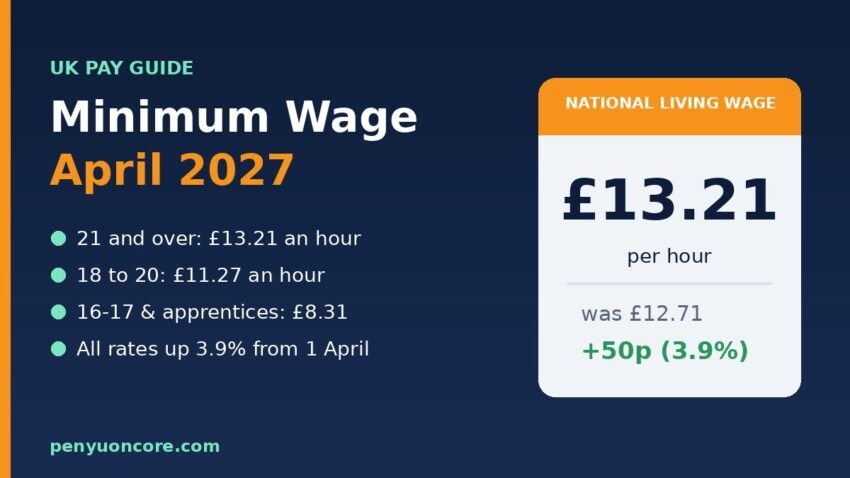
The minimum wage April 2027 rise is confirmed: from 1 April 2027 the National Living Wage for workers aged 21 and over goes up from £12.71 to £13.21 an hour, the rate for 18 to 20-year-olds rises to £11.27, and the under-18 and apprentice rates both rise to £8.31. Every rate goes up by 3.9%. The Government accepted the Low Pay Commission’s recommendations in full, and they were announced at the Autumn Budget on 28 October 2026.
Below you’ll find the new rates by age, what they work out to per week and per year, why your payslip might not show the rise until mid-April, and what to do if your employer pays you less than you’re owed.
Minimum wage April 2027: the new UK rates by age
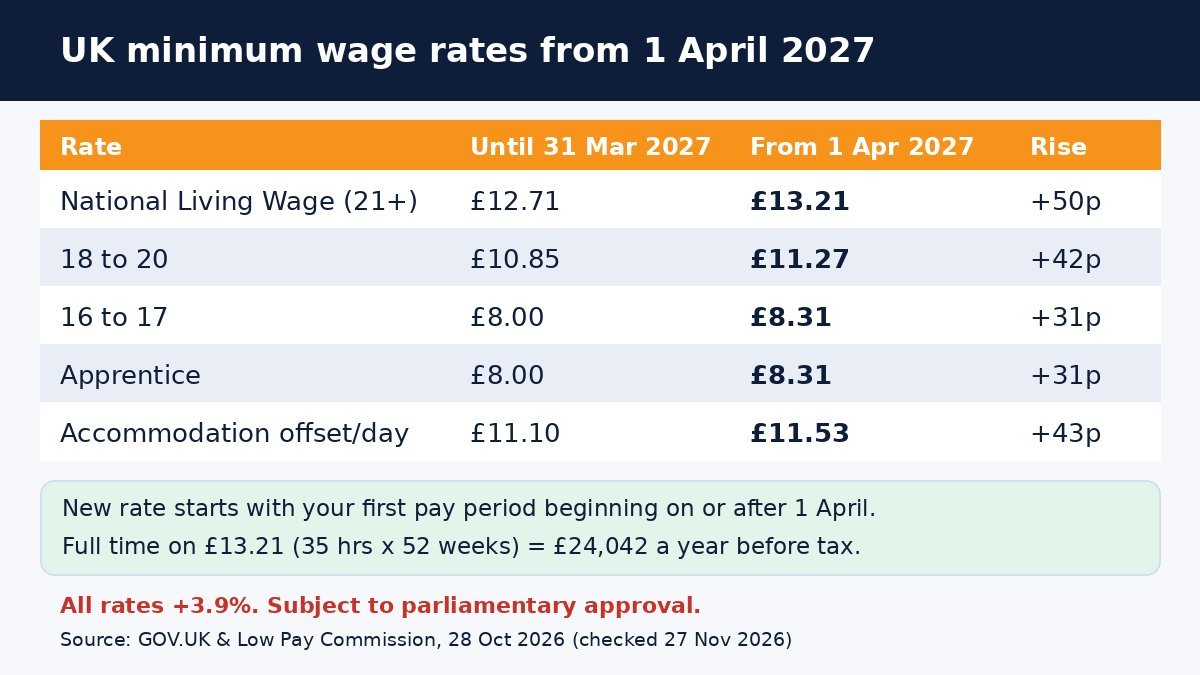
These are the legal minimum hourly rates that apply across the UK from 1 April 2027, as listed on GOV.UK’s National Minimum Wage and National Living Wage rates page:
| Rate | April 2026 to March 2027 | From 1 April 2027 | Increase |
|---|---|---|---|
| National Living Wage (21 and over) | £12.71 | £13.21 | +50p (3.9%) |
| 18 to 20 rate | £10.85 | £11.27 | +42p (3.9%) |
| 16 to 17 rate | £8.00 | £8.31 | +31p (3.9%) |
| Apprentice rate | £8.00 | £8.31 | +31p (3.9%) |
| Accommodation offset (per day) | £11.10 | £11.53 | +43p (3.9%) |
In a letter to the Business and Trade Committee, the minister said the increases will take effect from 1 April 2027 “subject to parliamentary approval”. In practice that means the government still has to lay the regulations before Parliament.
Why younger workers didn’t get a bigger rise this time
In recent years the 18 to 20 rate has risen faster than the adult rate, because the government wants to eventually lower the National Living Wage age to 18. This year the Low Pay Commission recommended pausing that alignment because demand for young workers has slowed, so every age band gets the same 3.9%. The BBC pointed out that this means no progress this year on narrowing the gap between older and younger workers’ minimum pay.
Who gets the apprentice rate
According to GOV.UK, you’re on the apprentice rate if you’re under 19, or if you’re 19 or over and in the first year of your apprenticeship. Once you’re 19 or over and have finished that first year, you’re entitled to the normal minimum wage for your age. A 21-year-old in the second year of an apprenticeship would therefore get at least £13.21 from April 2027.
What the new rates mean for weekly and annual pay
The government says the rise adds £910 to the gross annual earnings of a full-time worker on the National Living Wage. That figure matches a 35-hour week over 52 weeks (50p × 35 × 52). Using the same method, here’s roughly what each minimum rate works out to before tax and National Insurance:
| Rate from April 2027 | 35 hours a week | Per year (35 hrs) | Per year (37.5 hrs) |
|---|---|---|---|
| £13.21 (21+) | £462.35 | £24,042.20 | £25,759.50 |
| £11.27 (18 to 20) | £394.45 | £20,511.40 | £21,976.50 |
| £8.31 (16 to 17 / apprentice) | £290.85 | £15,124.20 | £16,204.50 |
These are our own simple calculations: hourly rate × hours × 52 weeks. They don’t include holiday pay arrangements, overtime, unpaid breaks or deductions. Your take-home pay will be lower once Income Tax and National Insurance come off. The BBC also noted that income tax thresholds remain frozen, so more of a pay rise can end up taxed than you might expect.
If the extra money gives you some breathing room, it may be worth building up a cash buffer first. Our guide to how much emergency fund you need walks through a sensible target.
When will my pay actually go up?
This is where a lot of people get confused. The new rate doesn’t necessarily apply from 1 April itself. It applies from the start of your first pay reference period beginning on or after 1 April 2027.
A pay reference period is the stretch of time your pay covers: a week, two weeks or a month (never longer than a calendar month). GOV.UK’s guidance on calculating the minimum wage gives this example: if your pay period runs from the 16th of one month to the 15th of the next, you can legally be paid the old rate from 16 March to 15 April. The new rate starts on 16 April.
- Monthly pay covering 1 to 30 April: the new rate applies to the whole of April.
- Weekly pay with a week that starts before 1 April: that whole week can be paid at the old rate. The new rate starts with the first week that begins on or after 1 April.
- Payday doesn’t matter: what counts is the period the pay covers, not the date the money lands.
Employers can choose to pay the new rate earlier. The same rule applies to birthdays: if you turn 18 or 21, the higher rate starts from the first pay reference period that begins on or after your birthday.
Who is and isn’t entitled to the minimum wage
Almost all workers are covered, however small the employer. GOV.UK lists part-time and casual workers, agency workers, people paid per item made, trainees and workers on probation as entitled to the minimum wage. A contract that pays less than the minimum isn’t legally binding.
Groups who are not entitled include self-employed people running their own business, company directors, volunteers, members of the armed forces, and family members of the employer who live in the employer’s home. If you earn from freelance work or a side hustle, the minimum wage won’t apply to that income. The tax rules for small side income are also changing in April 2027, as covered in our article on the trading allowance increase to £3,000.
Things that can push you below the minimum
Your employer can’t count tips, service charges, or extra pay for unsocial-hours shifts toward the minimum wage. Unrefunded costs for things you need for the job, like uniform, tools or safety equipment, are deducted when checking whether you’ve been paid enough. GOV.UK gives the example of a worker on £13 an hour who pays £15 a week to rent a uniform. That deduction takes his effective rate below the legal minimum, so his employer owes him arrears.
The real Living Wage is a different thing
Don’t mix up the legal National Living Wage with the voluntary “real Living Wage”. The real Living Wage is set by the Living Wage Foundation, and on 15 October 2026 it rose to £14.10 an hour across the UK and £15.45 in London. Only accredited Living Wage Employers have to pay it, and they have until 1 May 2027 to bring it in. No employer is legally required to pay it.
What to do if you’re paid less than the minimum wage
- Check your pay. Use the official minimum wage calculator for workers. Remember that the new rate starts with the first pay period beginning on or after 1 April.
- Talk to your employer. If that doesn’t sort it out, you can ask in writing to see your pay records. Employers must keep them for at least six years.
- Get free advice. The Acas helpline is 0300 123 1100, Monday to Friday, 8am to 6pm (details on GOV.UK).
- Complain to HMRC. HMRC enforces the minimum wage. It can order your employer to pay arrears plus a fine, name employers who underpay, and take them to court. You can also go to an employment tribunal yourself.
Pensioners also get a 3.9% uplift next April. See our breakdown of the State Pension increase for April 2027.
FAQ
What is the minimum wage from April 2027?
£13.21 an hour for workers aged 21 and over (the National Living Wage), £11.27 for 18 to 20-year-olds, and £8.31 for 16 to 17-year-olds and apprentices.
What date does the minimum wage go up in 2027?
The new rates take effect on Thursday 1 April 2027. Your own pay rises from the start of your first pay reference period that begins on or after that date, so for some people it will be a little later in April.
Is the minimum wage the same in Scotland, Wales and Northern Ireland?
Yes. The National Minimum Wage and National Living Wage are UK-wide rates. Scotland has its own income tax bands, though, so take-home pay can differ.
Can my employer pay me less if I’m on a zero-hours or part-time contract?
No. Part-time, casual and agency workers are all entitled to the correct minimum wage for every hour they work.
Disclaimer: This article is general information, not financial, tax or legal advice. Rates were checked against GOV.UK and Low Pay Commission sources on 27 November 2026 and still require parliamentary approval. For your own situation, contact Acas or a qualified adviser.