

If you turn 73 in 2026, your first RMD deadline is not the usual December 31. The IRS lets you push your very first required minimum distribution (RMD) to April 1, 2027 – but that choice can stack two taxable withdrawals into one year. Here’s how the rule works, who it applies to, and how to decide before the year ends.
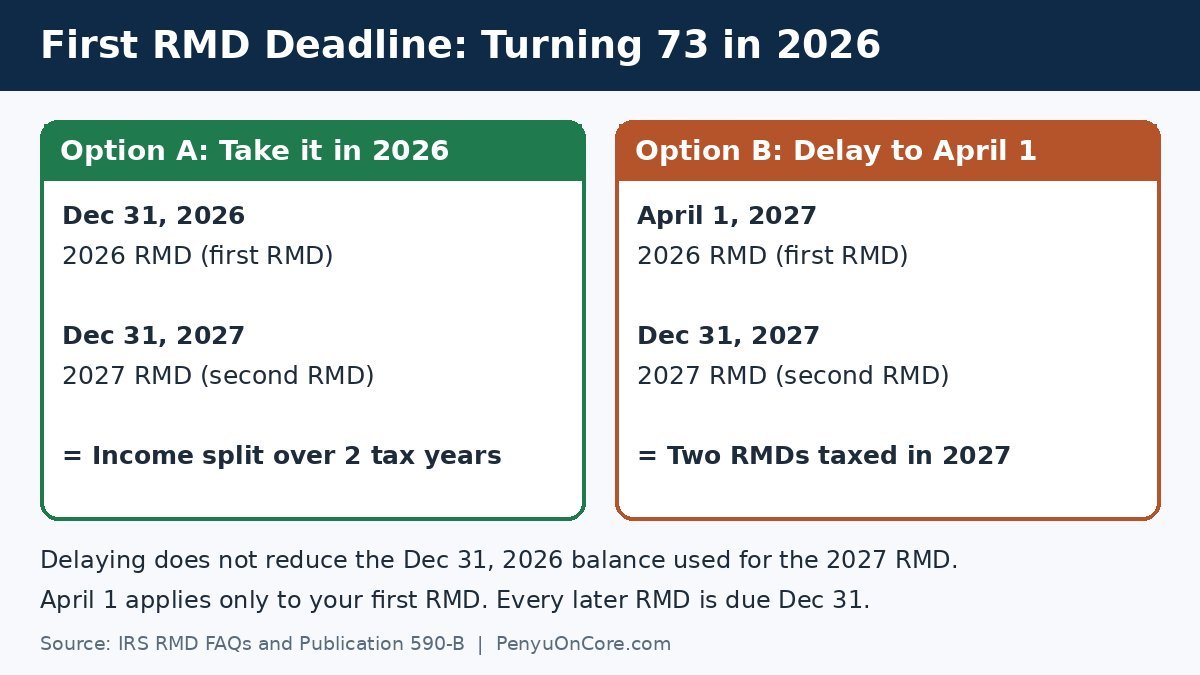
Quick answer: Your first RMD is for the year you turn 73, but you can delay taking it until April 1 of the following year. If you were born in 1953, your 2026 RMD is due by April 1, 2027, and your 2027 RMD is still due by December 31, 2027. Taking the first one by December 31, 2026 spreads the income across two tax years; delaying usually only makes sense if your 2026 income is unusually high.
What is the first RMD deadline?
RMDs are the minimum amounts you must withdraw each year from traditional IRAs, SEP IRAs, SIMPLE IRAs and workplace plans such as 401(k)s, 403(b)s and 457(b)s. According to the IRS RMD FAQs, you must take your first RMD for the year in which you reach age 73, but “you can delay taking the first RMD until April 1 of the following year.”
That April 1 date is called your required beginning date. It is a one-time grace period. For every year after that, the deadline is December 31.
| Your situation | RMD for | Deadline |
|---|---|---|
| Turned 73 in 2026 (born 1953) | 2026 (first RMD) | April 1, 2027 (or by Dec 31, 2026 if you choose) |
| Turned 73 in 2026 (born 1953) | 2027 (second RMD) | December 31, 2027 |
| Turned 73 in 2025 or earlier | 2026 | December 31, 2026 |
| Still working, 401(k) allows delay, not a 5% owner | That employer plan only | April 1 after the year you retire |
RMD age is set by the SECURE 2.0 Act. Under current rules it is 73, and it rises to 75 for people born in 1960 or later, as U.S. News explains. If you missed an RMD in a previous year, see our guide to the missed RMD penalty and how to fix it.
The catch: two RMDs in the same tax year
Waiting until April gives you a few more months, but it does not move your second deadline. The IRS RMD guidance says that for the year after you turn 73 you will generally have two required distribution dates, and that taking the first withdrawal by December 31 of the year you turn 73 “would allow the distributions to be included in your income in separate tax years.”
There is a second, less obvious effect. IRS Publication 590-B says a distribution for last year made after December 31 reduces this year’s account balance, “but not for last year.” In plain English: if you delay your 2026 RMD into 2027, your 2027 RMD is still calculated on the full December 31, 2026 balance, which was never reduced by that first withdrawal.
A worked example (hypothetical numbers)
Say you turn 73 in 2026 and your traditional IRA was worth $500,000 on December 31, 2025. The Uniform Lifetime Table in Publication 590-B gives a divisor of 26.5 at age 73 and 25.5 at age 74.
- 2026 RMD: $500,000 ÷ 26.5 = about $18,868.
- If you delay to 2027: suppose the IRA is worth $510,000 on December 31, 2026. Your 2027 RMD is $510,000 ÷ 25.5 = $20,000. Total taxable IRA income in 2027: about $38,868.
- If you take it in 2026: the December 31, 2026 balance would be roughly $491,132 (ignoring growth on the withdrawn cash), so your 2027 RMD is about $19,260. Income is split: about $18,868 in 2026 and $19,260 in 2027.
These figures are illustrations, not projections. Your actual numbers depend on your balance and investment returns.
Why bunching income can cost more than the RMD itself
RMDs from pre-tax accounts are taxed as ordinary income. Adding a second RMD to the same year can have knock-on effects:
- A higher tax bracket. The extra withdrawal is stacked on top of your other income. Compare your expected income against the 2027 tax brackets.
- More of your Social Security taxed. The share of benefits that is taxable depends on your other income, as explained in IRS Topic 423.
- Higher Medicare premiums later. The Social Security Administration sets income-related Part B and drug premiums using your most recent tax return – for 2026 premiums, generally your 2024 return. So a 2027 income spike could raise premiums about two years later. Our Medicare Part B premium 2027 guide covers the current brackets.
When delaying your first RMD can make sense
Delaying is not automatically wrong. It may be worth modelling if:
- 2026 is your last working year and your salary, bonus or other income will drop sharply in 2027.
- You had a one-off income event in 2026, such as a large capital gain.
- Your RMD is small enough that two of them in 2027 would not change your bracket or Medicare tier.
A practical approach: compare your expected 2026 and 2027 taxable income side by side, then decide which year should carry the extra withdrawal.
Rules that trip people up
The still-working exception covers only your current employer plan
If your employer’s plan allows it and you don’t own 5% or more of the business, you can delay RMDs from that plan until April 1 after the year you retire. Traditional IRAs, SEP IRAs and SIMPLE IRAs get no such exception – they start at 73 even if you are still working. Plan documents can also require earlier distributions, according to the IRS.
IRAs can be combined, 401(k)s cannot
You must calculate an RMD for each IRA, but you can take the total from one or more IRAs. The same applies across 403(b) contracts. RMDs from 401(k) and 457(b) plans must be taken separately from each plan, per the IRS FAQs.
Roth accounts are exempt while you’re alive
Roth IRAs and designated Roth accounts in 401(k) and 403(b) plans don’t require withdrawals during the owner’s lifetime.
RMDs can’t be rolled over, and extra doesn’t carry forward
RMD amounts can’t go into another tax-deferred account, and withdrawing more than required one year doesn’t reduce a future year’s RMD. However, Publication 590-B notes that anything you withdraw in the year you turn 73 counts toward the first RMD due by April 1.
A QCD can satisfy your RMD
If you give to charity, a qualified charitable distribution made directly from your IRA counts toward your RMD. See our QCD limit 2027 explainer for the annual cap.
First RMD deadline checklist for December 2026
- Confirm your RMD year: born in 1953 means 2026 is your first RMD year.
- Get each account’s December 31, 2025 balance and your custodian’s RMD figure – but check it yourself, because the IRS says the account owner is ultimately responsible.
- Estimate 2026 and 2027 income, including Social Security and any work income.
- Decide which year the first RMD should land in.
- If you’re taking it in 2026, submit the request early. December 31, 2026 is a Thursday, and providers can need processing time over the holidays.
- Choose federal (and state) tax withholding on the distribution so you aren’t short at filing time.
FAQ
Can I delay my first RMD if I turn 73 in 2026?
Yes. Your 2026 RMD can be taken as late as April 1, 2027. Your 2027 RMD is still due by December 31, 2027.
Is April 1 the deadline every year?
No. April 1 applies only to your first RMD. Every later RMD is due by December 31.
What happens if I miss the first RMD deadline?
The shortfall may face a 25% excise tax, reduced to 10% if corrected within two years. You report it on Form 5329 and can ask the IRS for a waiver for reasonable error.
Does the April 1 option apply to inherited IRAs?
No. Beneficiaries follow separate rules, including the 10-year rule for many non-spouse heirs. See the IRS FAQs for details.
Disclaimer: This article is general information, not financial or tax advice. RMD rules can differ by plan and personal situation. Check your plan documents and consider speaking with a qualified tax professional before deciding.