
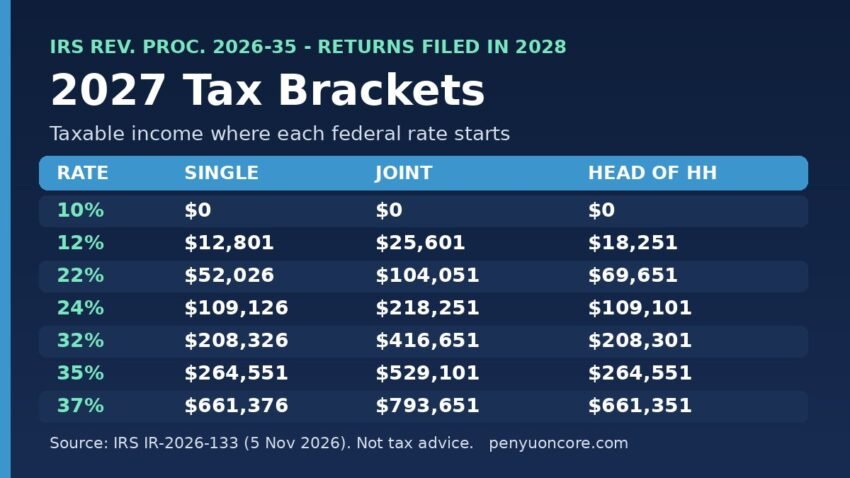
The 2027 tax brackets keep the same seven federal income tax rates, 10%, 12%, 22%, 24%, 32%, 35% and 37%, but every income threshold moves higher for inflation. For a single filer, the 10% rate covers taxable income up to $12,800 and the 37% top rate starts above $661,375. For married couples filing jointly, those points are $25,600 and $793,650. These brackets apply to income you earn in 2027 and report on the return you file in 2028.
The IRS announced the new figures on 5 November 2026 in news release IR-2026-133, with the full tables in Revenue Procedure 2026-35. Below you’ll find the full 2027 table for every filing status, a 2026 vs 2027 comparison, a worked example of marginal vs effective tax rates, and what the changes mean for your paycheck withholding.
2027 tax brackets by filing status
The thresholds below are for taxable income, which is what’s left after you subtract the standard deduction (or your itemized deductions) and any other deductions from your income. They come straight from Tables 1 to 4 of Rev. Proc. 2026-35, section 3.01.
| Rate | Single | Married filing jointly | Head of household | Married filing separately |
|---|---|---|---|---|
| 10% | $0 to $12,800 | $0 to $25,600 | $0 to $18,250 | $0 to $12,800 |
| 12% | $12,801 to $52,025 | $25,601 to $104,050 | $18,251 to $69,650 | $12,801 to $52,025 |
| 22% | $52,026 to $109,125 | $104,051 to $218,250 | $69,651 to $109,100 | $52,026 to $109,125 |
| 24% | $109,126 to $208,325 | $218,251 to $416,650 | $109,101 to $208,300 | $109,126 to $208,325 |
| 32% | $208,326 to $264,550 | $416,651 to $529,100 | $208,301 to $264,550 | $208,326 to $264,550 |
| 35% | $264,551 to $661,375 | $529,101 to $793,650 | $264,551 to $661,350 | $264,551 to $396,825 |
| 37% | Over $661,375 | Over $793,650 | Over $661,350 | Over $396,825 |
Two details are easy to miss. The married filing separately brackets match the single brackets all the way up to the 35% band, but the 37% rate starts much lower, above $396,825. And the head of household 37% threshold ($661,350) is $25 below the single threshold ($661,375), exactly as printed in the IRS tables.
2026 vs 2027 tax brackets: what changed
The 2026 figures come from Rev. Proc. 2025-32, which the IRS released with IR-2025-103. The table shows the top of each bracket, meaning the income level where the next rate begins.
| Rate | Single 2026 | Single 2027 | Joint 2026 | Joint 2027 |
|---|---|---|---|---|
| 10% | $12,400 | $12,800 | $24,800 | $25,600 |
| 12% | $50,400 | $52,025 | $100,800 | $104,050 |
| 22% | $105,700 | $109,125 | $211,400 | $218,250 |
| 24% | $201,775 | $208,325 | $403,550 | $416,650 |
| 32% | $256,225 | $264,550 | $512,450 | $529,100 |
| 35% | $640,600 | $661,375 | $768,700 | $793,650 |
Every bracket edge rose by roughly 3%. Heads of household see a similar shift, with the top of the 10% band going from $17,700 to $18,250 and the top of the 12% band from $67,450 to $69,650. The rates themselves haven’t changed. Because more of your income falls into the lower bands, someone whose pay doesn’t change will usually owe a little less federal income tax in 2027 than in 2026.
The standard deduction rises too
The same IRS release raised the 2027 standard deduction to $16,600 for single filers and married people filing separately, $33,200 for married couples filing jointly and $24,925 for heads of household. Our full guide to the standard deduction 2027 covers the extra amounts for people 65 and older and the separate senior deduction.
Marginal vs effective tax rate: a 2027 example
The IRS’s federal income tax rates and brackets page puts it simply: when your income moves into a higher bracket, “you don’t pay the higher rate on your entire income,” only on the part inside that bracket. Your marginal rate is the rate on your last dollar of taxable income. Your effective rate is your total tax divided by your income, and it’s always lower.
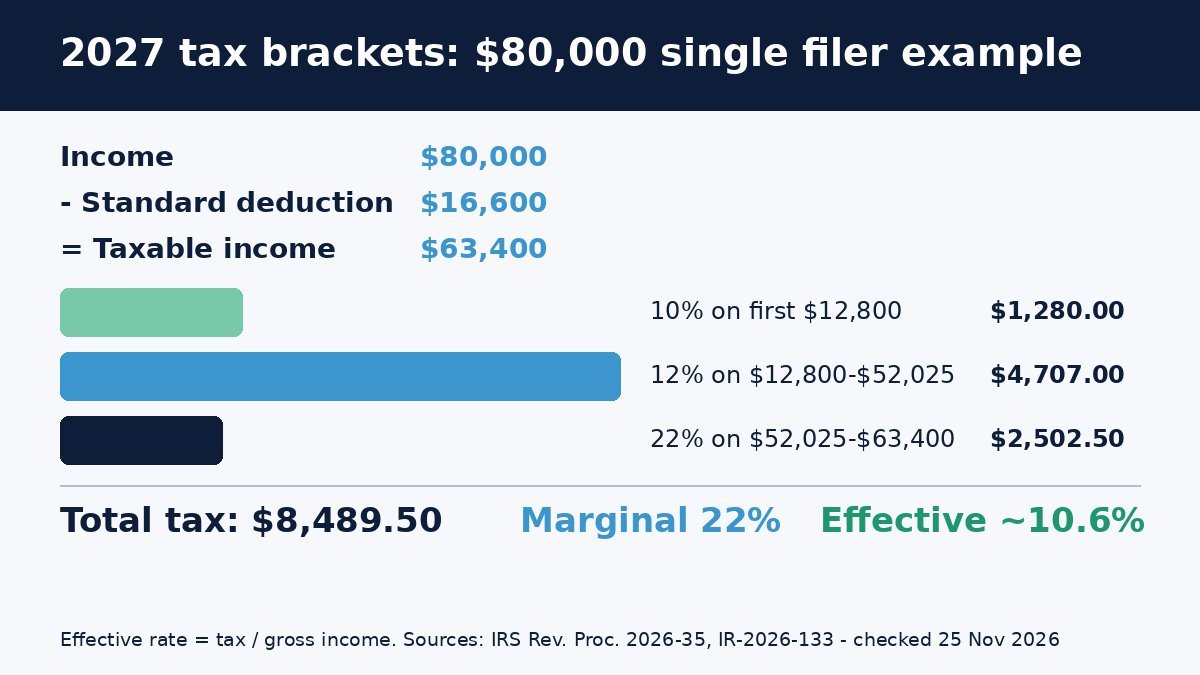
Here’s a single filer earning $80,000 in 2027 who takes the standard deduction and has no other deductions or credits:
- Taxable income: $80,000 − $16,600 = $63,400
- First $12,800 at 10% = $1,280
- $12,800 to $52,025 at 12% = $4,707
- $52,025 to $63,400 at 22% = $2,502.50
- Total federal income tax: $8,489.50
That person is in the 22% bracket, but their effective rate is about 13.4% of taxable income, or about 10.6% of their $80,000 gross income. The first two steps match the IRS formula in Table 3, which says tax at the start of the 22% band is “$5,987.00 plus 22% of the excess over $52,025.”
Using the 2026 brackets and the $16,100 standard deduction, the same $80,000 would produce $8,770 of tax. So inflation indexing alone saves this filer about $280. A married couple filing jointly with $150,000 of income would have $116,800 of taxable income in 2027 and owe $14,779, an effective rate of roughly 9.9% of gross income. Real returns can differ because of credits, other deductions and the IRS tax tables, which round income into small bands below $100,000.
When do the 2027 tax brackets apply?
The IRS says the tax year 2027 adjustments “generally apply to tax returns filed in 2028.” The return you file between January and April 2027 covers your 2026 income and uses the 2026 brackets. You won’t use the 2027 brackets on a return until early 2028.
Rev. Proc. 2026-35 also notes that if Congress changes the tax code for 2027 after the release date, taxpayers should check for additional guidance. Treat these numbers as current law, not a guarantee.
What it means for withholding and your W-4
You’ll feel the new brackets first in your paycheck. Employers use IRS Publication 15-T to work out how much federal income tax to withhold, and it’s updated for each year’s figures. You don’t need to file a new Form W-4 just because the brackets changed. Consider checking your withholding if your life changes in 2027, such as marriage, a new job, a second income or a big raise. The IRS Tax Withholding Estimator can help you decide whether to submit an updated Form W-4.
Ways to lower your 2027 taxable income
Because brackets apply to taxable income, pre-tax savings can pull dollars out of your top band. Our guide to the 401k contribution limit 2027 covers the new caps, and our Roth vs traditional IRA comparison explains when paying tax now or later makes more sense. Retirees can also read our explainer on the 2027 Social Security COLA.
FAQ
What are the 2027 tax brackets for married filing jointly?
10% up to $25,600; 12% to $104,050; 22% to $218,250; 24% to $416,650; 32% to $529,100; 35% to $793,650; and 37% above $793,650 of taxable income.
What are the 2027 tax brackets for single filers?
10% up to $12,800; 12% to $52,025; 22% to $109,125; 24% to $208,325; 32% to $264,550; 35% to $661,375; and 37% above that.
Did the tax rates change for 2027?
No. The seven rates, from 10% to 37%, are the same as in 2026. Only the income thresholds were raised for inflation.
Do I use the 2027 tax brackets when I file in 2027?
No. The return you file in 2027 is for tax year 2026. The 2027 brackets apply to returns filed in 2028.
This article is general information, not tax or financial advice. Figures are from IRS publications checked on 25 November 2026. Tax law can change, so confirm your own situation on IRS.gov or with a qualified tax professional.