
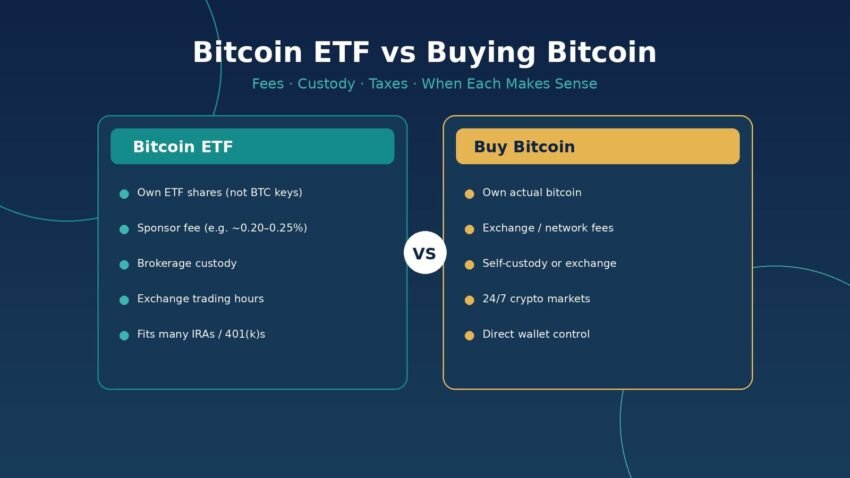
Short answer: A spot Bitcoin ETF (more precisely a spot bitcoin exchange-traded product, or ETP) gives you price exposure through brokerage shares. Buying Bitcoin means you own the asset on an exchange or in a wallet you control. ETFs are often simpler for IRAs/401(k)s and investors who do not want private keys; direct Bitcoin offers true ownership, 24/7 markets, and self-custody—with different fees, risks, and tax paperwork. Neither is always better.
This guide compares Bitcoin ETF vs buying Bitcoin on ownership, fees, custody, trading hours, retirement accounts, and U.S./U.K. tax framing. No price predictions.
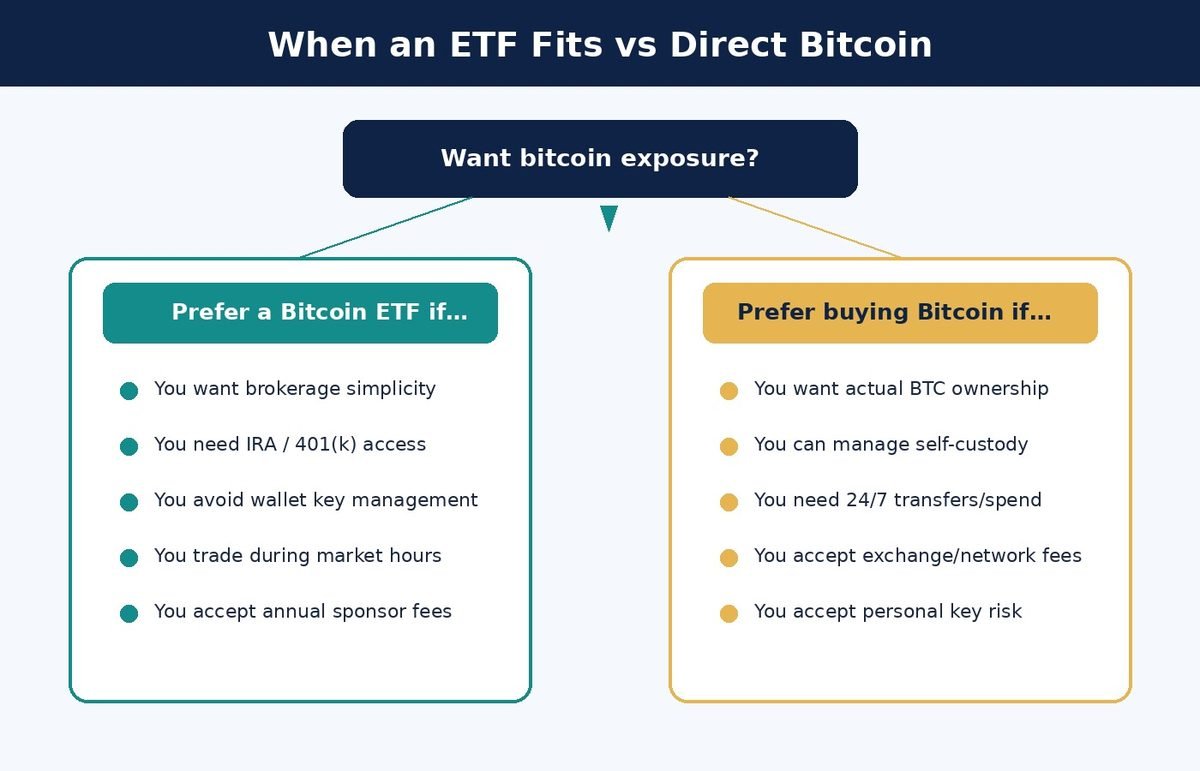
Decision map: brokerage simplicity and retirement access versus ownership and 24/7 control.
Quick Comparison Table
| Factor | Spot Bitcoin ETF / ETP | Buying Bitcoin directly |
|---|---|---|
| What you own | Shares of a commodity trust that holds bitcoin | Bitcoin (exchange or self-custody) |
| Ongoing product fee | Sponsor fee (verified examples ~0.20%–0.25%/yr) | No ETF sponsor fee; trade spreads + network fees if you move coins |
| Custody | Trust custodian; you hold brokerage shares | Exchange custody or your own keys |
| Trading hours | Securities exchange hours | Crypto markets 24/7 |
| Retirement accounts | Often easier in IRA/401(k) menus | Plan/custodian rules vary; often harder |
| Core operational risk | Sponsor, custodian, tracking, broker risks | Exchange failure or lost keys / phishing |
Structural framing: SEC Investor.gov spot bitcoin/ether ETP bulletin (Sept. 9, 2024).
What You Own: ETF Shares vs Actual Bitcoin
The SEC’s investor bulletin explains that spot bitcoin ETPs are exchange-traded commodity trusts that hold bitcoin. They aim to track bitcoin’s price and can provide exposure without you personally buying on a crypto platform or handling wallet keys—while the product itself still faces crypto-market and operational risks.
These products are not registered under the Investment Company Act of 1940, even when marketed as “Bitcoin ETFs.” They register under the Securities Act of 1933 and Exchange Act of 1934 and publish a prospectus, but they lack the 1940 Act custody and valuation framework that applies to many mutual funds and traditional ETFs.
Buying Bitcoin means owning the asset. On an exchange, the platform usually controls the keys. With self-custody, you control the private keys—and losing them can mean irreversible loss. For practical hardening steps, see our crypto security guide.
Fees: Sponsor Expense vs Trade and Network Costs
Verified sponsor fees (confirm the live prospectus)
Checked for this article:
- IBIT (iShares Bitcoin Trust): sponsor fee 0.25% — iShares product page.
- FBTC (Fidelity Wise Origin Bitcoin Fund): unified fee 0.25% of Bitcoin Holdings — Fidelity prospectus dated April 29, 2026.
- BITB (Bitwise Bitcoin ETF): unitary sponsor fee 0.20% — SEC 424B3.
- ARKB (ARK 21Shares Bitcoin ETF): expense/management fee 0.21% — factsheet as of Sept. 30, 2026.
Fees and waivers change. If a number is unclear, rely on the current prospectus—not a blog table.
The SEC bulletin notes that because these trusts generally do not generate income, the sponsor fee is typically paid in bitcoin, so the bitcoin represented by each share declines over time. Direct holders skip that trust fee but pay venue spreads and, for withdrawals, network fees that vary by congestion and platform.
Worked example (illustration only)
On $10,000 of exposure for one year, ignoring price moves, premiums/discounts, and taxes:
- 0.25% sponsor fee ≈ $25 annual drag.
- 0.20% sponsor fee ≈ $20 annual drag.
Direct Bitcoin costs are usually per trade or per transfer, not a fixed annual percentage of assets. Check your exchange fee schedule; do not assume a universal rate. Brokerage commissions may also apply to ETF trades.
Custody, Hours, and Liquidity
ETF path: You hold a securities position at a broker while the trust’s institutional custodian(s) hold bitcoin. You outsource key management but accept sponsor, custodian, brokerage, and securities-market risks. The SEC bulletin also flags fraud and manipulation risk in underlying crypto spot markets that are not SEC-registered national exchanges.
Direct path: Coins left on an exchange concentrate platform risk (hacks, insolvency, withdrawal pauses). Self-custody reduces that risk if done well, but introduces seed-phrase, phishing, and irreversible-transfer risk (security guide).
ETP shares trade during exchange hours and can trade at a premium or discount to NAV; the SEC notes possible deviation from spot bitcoin. Bitcoin markets run 24/7, so volatility can hit overnight. See also crypto liquidations.
Retirement Accounts
Listed Bitcoin ETPs are often far easier to hold inside an IRA or a 401(k) brokerage window than spot bitcoin in a personal wallet. Menus and prohibited-transaction rules differ by plan—confirm with your administrator. For contribution timing once you choose a vehicle, see DCA vs lump sum. Cash not yet allocated can sit in short-duration options discussed in SGOV vs high-yield savings.
Taxes: U.S. Basics and a U.K. Note
Not tax advice. Confirm with primary guidance and a qualified professional.
United States: The IRS treats digital assets as property. Selling them for dollars generally produces capital gain or loss. Holding one year or less is generally short-term; more than one year is generally long-term (IRS digital asset FAQs; IRS Digital assets).
Wash-sale nuance: Schedule D instructions apply wash sales to stock or securities sold at a loss when you repurchase substantially identical stock or securities within 30 days, and note they generally apply to digital assets that are also securities (2025 Schedule D instructions). Spot Bitcoin ETP shares are securities. Ordinary bitcoin has long been discussed as property—do not assume a harvest strategy is safe without advice; rules can change.
United Kingdom: HMRC says you may owe Capital Gains Tax on cryptoasset disposals (sell, exchange, spend, or most gifts), with pooling and same-day/30-day matching rules in some cases (GOV.UK guidance, updated 5 Oct 2026).
When Each Option Makes Sense
Prefer a spot Bitcoin ETF if you want brokerage simplicity; need IRA/401(k) access; prefer not to manage keys; mainly trade during market hours; and accept a clear annual sponsor fee.
Prefer buying Bitcoin if you want actual BTC you can transfer or self-custody; can secure keys (or knowingly accept exchange custody); need 24/7 markets; prefer avoiding ongoing ETP fees while budgeting trade/network costs; and accept wallet operational burden.
Some investors use both: an ETF sleeve in tax-advantaged accounts and a smaller self-custodied stack. Avoid leverage you do not understand (liquidations explainer).
FAQ
Is a Bitcoin ETF the same as owning Bitcoin?
No. You own trust shares, not the private keys to the trust’s bitcoin (SEC bulletin).
What fees should I expect in 2026?
Verified examples: 0.25% (IBIT, FBTC), 0.21% (ARKB), 0.20% (BITB). Always re-check the prospectus.
Can I hold a Bitcoin ETF in an IRA?
Often yes if your custodian lists the ticker. Spot bitcoin inside workplace plans is usually harder. Ask your plan.
Do wash-sale rules apply?
They target securities; ETF shares are securities. For ordinary bitcoin, get current tax advice (Schedule D; IRS FAQs).
Which is safer?
Different risks: ETFs outsource keys but add issuer/broker risk; self-custody can eliminate exchange custody risk—or permanently lose coins if keys are lost.
Bottom Line
Bitcoin ETF vs buying Bitcoin trades convenience and retirement logistics for direct ownership and operational control. Spot bitcoin ETPs are highly speculative commodity trusts with ongoing sponsor fees; direct bitcoin skips that fee but adds custody complexity. Choose the wrapper that matches your accounts, security skills, and tax situation.
Related reading: What Crypto Liquidations Mean · Crypto Security Guide · DCA vs Lump Sum
Disclaimer: Educational only—not financial, tax, investment, or legal advice. Spot bitcoin products are highly speculative. Fees, prospectuses, plan menus, and tax rules change. Verify with the SEC Investor.gov bulletin, current prospectuses, IRS digital asset pages, HMRC cryptoasset guidance, and a qualified professional.