
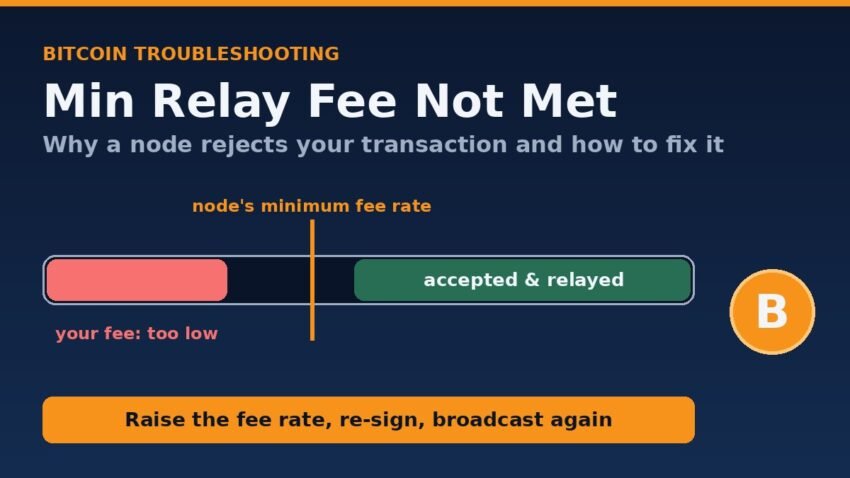
The min relay fee not met error means the Bitcoin node you broadcast to refused your transaction because its fee rate is below that node’s minimum relay fee rate. Your coins have not moved and nothing was lost. The fix is to rebuild the transaction (or let your wallet rebuild it) so it pays a higher fee rate, then broadcast it again.
This guide explains how to read the numbers in the error and how it differs from the similar “mempool min fee not met” message. It also covers how to fix it in Bitcoin Core and Electrum, and in raw transactions you build yourself. We reproduced both errors on a local regtest network with Bitcoin Core 32.1, using test coins only.
What “min relay fee not met” actually means
Every Bitcoin node keeps its own mempool and its own policy rules, which decide what it will accept and pass on to peers. One of those rules is a floor fee rate, set by the -minrelaytxfee option. A transaction paying less than that floor is treated as if it paid no fee. The node rejects it with error code -26 and the message min relay fee not met.
The important detail is that this is a policy rule, not a consensus rule. Your transaction may be perfectly valid. The node simply won’t relay it, so it never reaches miners through that node.
How to read the numbers in the error
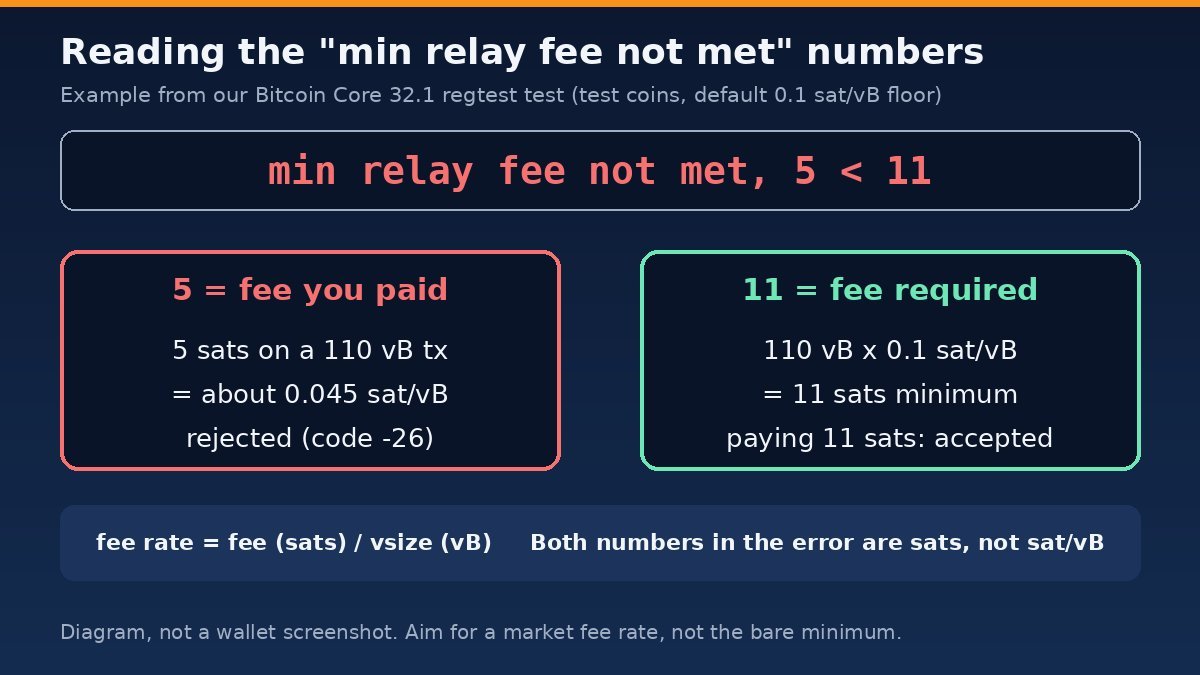
Recent Bitcoin Core versions add two numbers to the message. Both are in satoshis, not sat/vB. When we broadcast a 110 vB test transaction that paid a 5-sat fee, the node answered:
error code: -26
error message:
min relay fee not met, 5 < 11
The first number is the fee your transaction pays (5 sats). The second is the minimum fee the node wants for a transaction of that size (11 sats, which is 110 vB × 0.1 sat/vB). When we raised the fee to exactly 11 sats, testmempoolaccept returned "allowed": true.
Why the min relay fee not met error happens
Fee rate is fee divided by the transaction’s virtual size (vsize, in vbytes). The vsize comes from the transaction weight defined in BIP 141. The error shows up when that fee rate lands under the node’s floor. The usual causes are:
- A hand-built or raw transaction with too little fee. The fee is never written into a Bitcoin transaction. It is whatever is left over after inputs minus outputs. If you set the change output a little too high, the fee shrinks without warning. In a Bitcoin Stack Exchange case, a user believed they were paying 2 sat/vB. The transaction actually paid 140 sats for 141 vB, which is under 1 sat/vB.
- Confusing sat/vB, sat/byte and BTC/kvB. Bitcoin Core RPCs often use BTC/kvB. 1 sat/vB equals 0.00001 BTC/kvB, so one misplaced zero changes the fee rate tenfold.
- A very low fee rate sent to an older or stricter node. Since Bitcoin Core 29.1, the default
-minrelaytxfeeis 100 sat/kvB (0.1 sat/vB). Before that, it was 1 sat/vB. Nodes running older software, or nodes configured with a higher floor, will still reject anything under their own setting. When we restarted our regtest node with the old 1 sat/vB floor, a 110 vB transaction paying 50 sats was rejected withmin relay fee not met, 50 < 110. - A wallet or server with a different minimum. Light wallets broadcast through a server, and that server’s node decides. Electrum asks its server for the relay fee. If the fee rate you pick is below it, Electrum marks the transaction “below relay fee!” and won’t let you send it.
The Bitcoin Core 29.1 release notes add an important caveat. Unless the lower defaults are widely adopted across the network, transactions below 1 sat/vB “are not guaranteed to propagate or confirm.” Getting past one node is not the same as reaching a miner.
Min relay fee vs mempool min fee: which error do you have?
Two messages look alike but have different causes. Both are defined in Bitcoin Core’s validation code.
| Error | What it compares against | Does it change? | Typical fix |
|---|---|---|---|
min relay fee not met |
The node’s fixed -minrelaytxfee floor |
Only if the operator changes the setting | Pay at least the floor; in practice, use a normal market fee rate |
mempool min fee not met |
The node’s current mempool minimum, which rises when its mempool (300 MB by default) is full | Yes, it moves with network demand | Raise the fee rate above the current mempool minimum, or wait until demand falls |
You can see both values on your own node with bitcoin-cli getmempoolinfo. According to the RPC documentation, mempoolminfee is “the maximum of minrelaytxfee and minimum mempool fee”. It is the real bar a new transaction has to clear on that node.
How to fix min relay fee not met
Because the node never accepted the transaction, there is nothing stuck to “speed up”. You just need a new version that pays more.
1. Check the real fee rate first
Work out fee ÷ vsize. If you have the signed hex and access to a Bitcoin Core node, run testmempoolaccept. It checks the transaction against the node’s rules without broadcasting it. It returns the vsize and either "allowed": true or a reject-reason:
bitcoin-cli testmempoolaccept '["SIGNED_TX_HEX"]'2. Pick a sensible fee rate
Don’t aim for the bare minimum. Check a current fee estimate from your wallet, estimatesmartfee on your node, or a mempool explorer. Choose a rate that fits how quickly you need the payment to confirm. A transaction that barely clears one node’s floor can still sit unconfirmed for a long time, or be dropped later. Our guide to a bitcoin transaction dropped from mempool covers what happens then.
3. Rebuild and re-sign the transaction
- Raw transactions: lower the change output by the extra fee you need, then sign again. If you have no change output, you must lower the payment amount or add another input. Any edit invalidates the old signatures.
- Bitcoin Core wallet: set the fee rate explicitly, for example
sendtoaddresswithfee_ratein sat/vB. The wallet has its own minimum (-mintxfee, default 1 sat/vB). In our test, asking for 0.5 sat/vB failed with “Fee rate (0.500 sat/vB) is lower than the minimum fee rate setting (1.000 sat/vB).” The 29.1 release notes confirm that wallet fee rates were left unchanged. - Electrum: in the send dialog, raise the fee slider or enter a custom fee rate until the “below relay fee” warning disappears. If you deliberately want a very low rate, the warning text suggests using “a server with a lower relay fee”. Remember that most of the network still has to accept it as well.
4. Broadcast again and confirm it was accepted
Once the node accepts it, the transaction gets a TXID and appears in mempool explorers. If it then confirms slowly, you can raise the fee with replace-by-fee in most wallets. If you are the receiver, you can use child pays for parent.
Common mistakes to avoid
- Don’t panic-resend the same payment from a different wallet. The original was rejected, but make sure it truly never broadcast anywhere before you pay again from different coins.
- Don’t paste raw hex into random “free broadcast” sites. Use your own node or a well-known explorer, and never share seed phrases or private keys with anyone. See our crypto security guide.
- Don’t lower your node’s
-minrelaytxfeeto “fix” it. Your node may accept the transaction, but peers and miners with higher floors will ignore it.
FAQ
Is my bitcoin lost after a “min relay fee not met” error?
No. The node rejected the transaction, so it was never relayed and the coins never left your wallet. If a wallet still lists it locally as unconfirmed, abandoning that entry (for example with abandontransaction in Bitcoin Core) frees the coins to spend again.
What is the minimum relay fee in Bitcoin Core now?
The default has been 0.1 sat/vB (100 sat/kvB) since Bitcoin Core 29.1. Bitcoin Core 32.1, the current release when we checked, still uses that default. Individual node operators can set a higher or lower value.
Can I send a bitcoin transaction with a 0.1 sat/vB fee?
Nodes using the new defaults will relay it, but there is no guarantee it propagates far enough or that miners include it quickly. Bitcoin Core’s own wallet won’t create one unless you lower -mintxfee.
Why does the error show numbers like “5 < 11”?
They are absolute fees in satoshis. The first is what you paid; the second is what the node requires for your transaction’s size.
Disclaimer: This article is for educational purposes only and is not financial advice. Always double-check addresses, amounts and fees before broadcasting any Bitcoin transaction.