
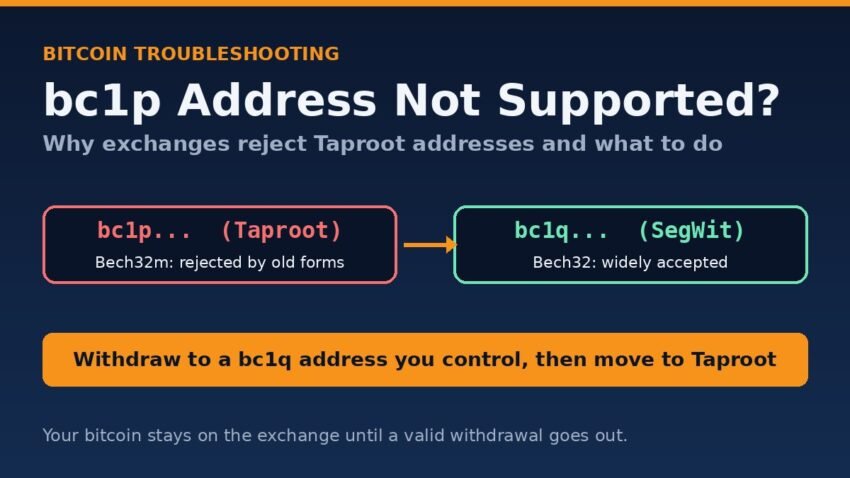
If an exchange shows bc1p address not supported (or just “invalid address”) when you paste a Taproot address into its Bitcoin withdrawal form, your address is almost certainly fine. The exchange’s software simply doesn’t accept the newer Bech32m address format yet. The fix: give it a native SegWit address starting with bc1q from a wallet you control, then move the coins to Taproot yourself later if you want to.
The rest of this guide covers why it happens, how to get a bc1q address in common wallets, and the mistakes to avoid so a small format problem doesn’t become a lost-funds problem.
Why you see “bc1p address not supported”
Addresses starting with bc1p are Pay-to-Taproot (P2TR) addresses. Taproot (BIP 341) activated on Bitcoin mainnet at block 709,632 in November 2021. Taproot outputs are “witness version 1” outputs, and BIP 350 says they must be written in a format called Bech32m. Older native SegWit addresses (bc1q, witness version 0) still use the original Bech32 format from BIP 173.
The two formats look nearly identical, but their checksums differ. BIP 350 says this break with older software was intentional: tests had found that some wallets supporting SegWit could burn funds if they sent to version 1 addresses. Because Bech32m addresses fail old Bech32 validation, outdated software rejects a bc1p address rather than sending coins somewhere unspendable.
So when a withdrawal form refuses your bc1p address, the address check did its job. Nothing has been sent and no bitcoin has left your exchange account.
Quick reference: Bitcoin address prefixes
| Starts with | Type | Encoding | Exchange support |
|---|---|---|---|
1 | Legacy (P2PKH) | Base58Check | Very widely accepted |
3 | P2SH (includes nested SegWit) | Base58Check | Very widely accepted |
bc1q | Native SegWit (P2WPKH / P2WSH) | Bech32 (BIP 173) | Widely accepted, default in most wallets |
bc1p | Taproot (P2TR) | Bech32m (BIP 350) | Accepted by many, but not all |
Length is another clue. A standard single-key bc1q address is 42 characters long. A bc1p address is 62 characters (you can count the examples in Trezor’s address-type guide).
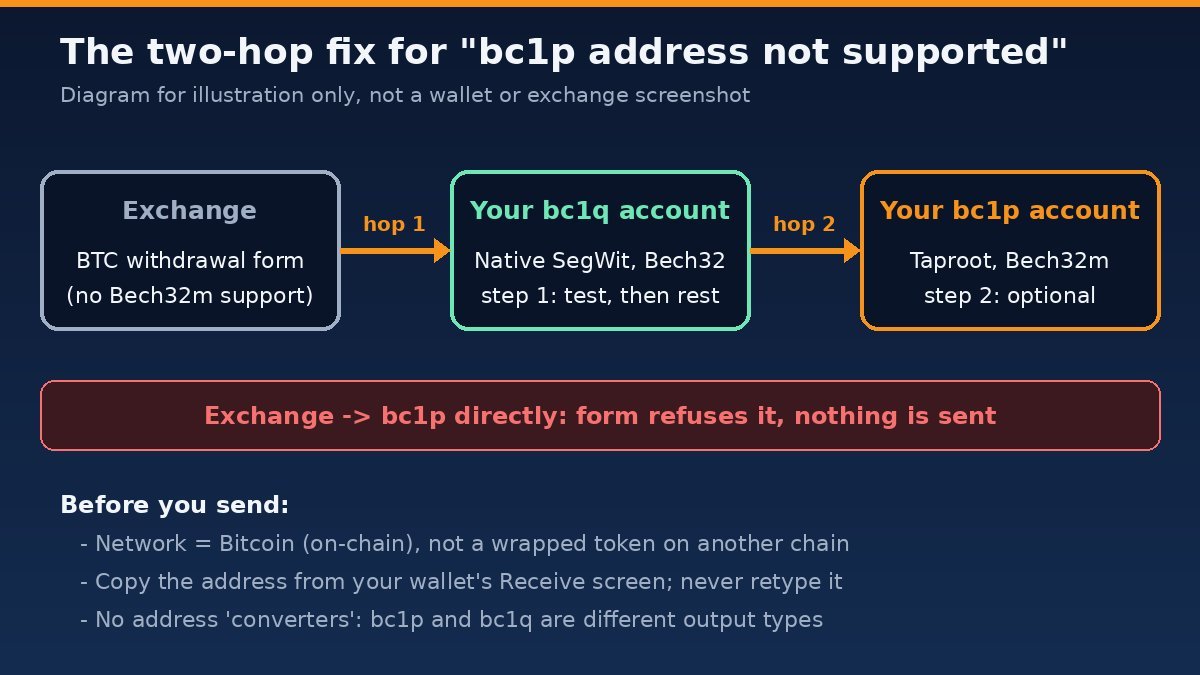
How to fix a bc1p address not supported error (step by step)
1. Confirm it really is an address-format problem
Before changing anything, check two things on the withdrawal screen:
- Network: make sure the network is plain Bitcoin (on-chain), not Lightning or a wrapped token on another chain. If the network is wrong, the form may reject any Bitcoin address.
- The address itself: copy it again straight from your wallet’s Receive screen. Don’t retype it, and never “fix” a character by guessing.
If you run your own node, Bitcoin Core’s validateaddress command reports isvalid and the witness_version. A Taproot address shows witness version 1. If it’s valid and the form still refuses it, the exchange doesn’t support Bech32m.
2. Get a bc1q (native SegWit) receive address
You can’t “convert” a bc1p address into a bc1q one. They’re different output types, so you need a new address from a native SegWit account or wallet. Most wallets support both formats with the same recovery phrase:
- Trezor Suite: SegWit (BIP84,
bc1q) is the default account type, and Taproot (BIP86) is a separate account type. Per Trezor’s account guide, you can’t convert an existing account to another type. Use or add a SegWit account with the + button next to Accounts. Suite only lets you add a new account of a type once the previous account of that type has transaction history. - Ledger Wallet (formerly Ledger Live): Native SegWit is the default. When adding a Bitcoin account, toggle Show all address types to choose Native SegWit, SegWit, Taproot or Legacy (Ledger support).
- Sparrow: the script type is set when you create a wallet, and Native Segwit (P2WPKH) is the default (Sparrow quick start). A Taproot wallet in Sparrow means you’d create or import a separate Native Segwit wallet to get
bc1qaddresses.
In every case, generate the address from the wallet’s own Receive screen, and check it on your hardware wallet’s display if you have one.
3. Do a small test withdrawal
Paste the bc1q address into the exchange, then withdraw a small amount above the exchange’s minimum first. Once it shows up in your wallet with at least one confirmation, send the rest. Exchanges often add extra checks for a new withdrawal address (email or 2FA confirmation, sometimes a hold), so allow time for that.
4. Optional: move the coins to Taproot yourself
If you specifically want your coins in a Taproot account, send them from your bc1q account to your bc1p account in a separate transaction. Ledger confirms that BTC can move between Taproot and Legacy, SegWit and Native SegWit accounts in either direction (Ledger Taproot guide). This costs one extra network fee, so pick a sensible fee rate. Our guide to the “min relay fee not met” error explains fee rates in sat/vB. For many users, though, staying on bc1q is perfectly fine.
Mistakes to avoid
- Switching networks until the form accepts the address. If a form only accepts your address after you pick a different network (for example, a wrapped BTC token), you’ve set up a wrong-network transfer, not fixed the problem.
- Using address “converter” websites. No tool can turn a Taproot address into a SegWit address that pays the same wallet. Only use addresses your own wallet generated.
- Getting around the exchange’s validation. If a platform rejects the address, don’t try to force it through some other way. The rejection is what protects your funds.
- Assuming a stuck transfer is lost. If your own follow-up transaction is slow to confirm, see how Child Pays for Parent (CPFP) speeds up a stuck transaction and what happens when a Bitcoin transaction drops from the mempool.
Does depositing from a Taproot wallet cause the same problem?
Usually not. The format check applies to the destination address you type in. When you deposit to an exchange, you send to the exchange’s deposit address, which is normally a format your wallet already supports. Wallet makers such as Ledger say BTC can move between address formats without trouble, though they note that in rare cases an exchange only accepts deposits from certain formats. If your exchange has a rule like that, send from an account in the format it asks for. The community-maintained Bech32 adoption page on the Bitcoin Wiki tracks which wallets and services can send to Bech32m. It isn’t always current, so your exchange’s own help center is the final word.
FAQ
Is my bc1p address broken or unsafe?
No. A Taproot address generated by a reputable wallet is a valid Bitcoin address. The error means the sending platform hasn’t implemented Bech32m, not that your address or wallet is faulty.
Will I lose my bitcoin if the exchange rejects the address?
A rejected address means the withdrawal never went out, so your BTC stays in your exchange balance. Fix the address and try again.
Do I need a new recovery phrase to get a bc1q address?
Normally no. Wallets like Trezor Suite and Ledger Wallet let you add a native SegWit account from the same backup. Trezor notes that every account comes from the same wallet backup. Still, keep a note of which account types you use, so you know what to look for if you ever restore into different wallet software.
Should I just use Legacy (1…) addresses instead?
Only as a last resort. Ledger notes that Legacy is the oldest and least efficient account type, useful mainly for exchanges that don’t support newer formats. A bc1q address works for most services and usually costs less to spend from later.
Disclaimer: This article is for general educational purposes only and is not financial, investment or tax advice. Always check address details and your exchange’s current withdrawal rules before sending funds.