
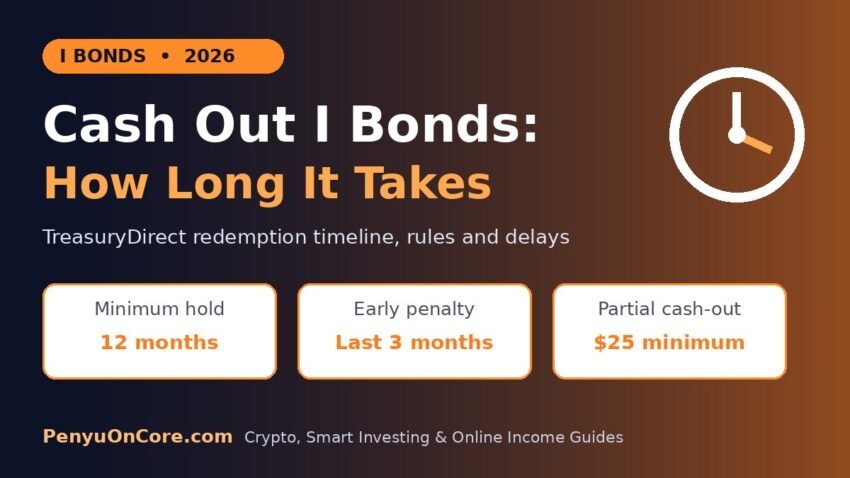
If you want to cash out I bonds held in TreasuryDirect, the redemption request itself takes a few minutes, and the money then travels to your bank by ACH direct deposit, which usually means a wait of a business day or two rather than weeks. The real time limits come earlier: you can’t redeem at all until the bond is 12 months old, and cashing out before five years costs you the last three months of interest.
Quick answer: Once your I bond is at least 12 months past its issue date, you can redeem it online any time. TreasuryDirect pays by ACH to your linked U.S. bank account, and ACH only settles on business days. TreasuryDirect’s own help pages say redemptions of its Zero-Percent C of I “should be credited within two business days of the redemption date.” It doesn’t publish a separate figure for savings bonds, so plan on roughly one to two business days, plus any weekend or federal holiday in between.
How long it takes to cash out I bonds, step by step
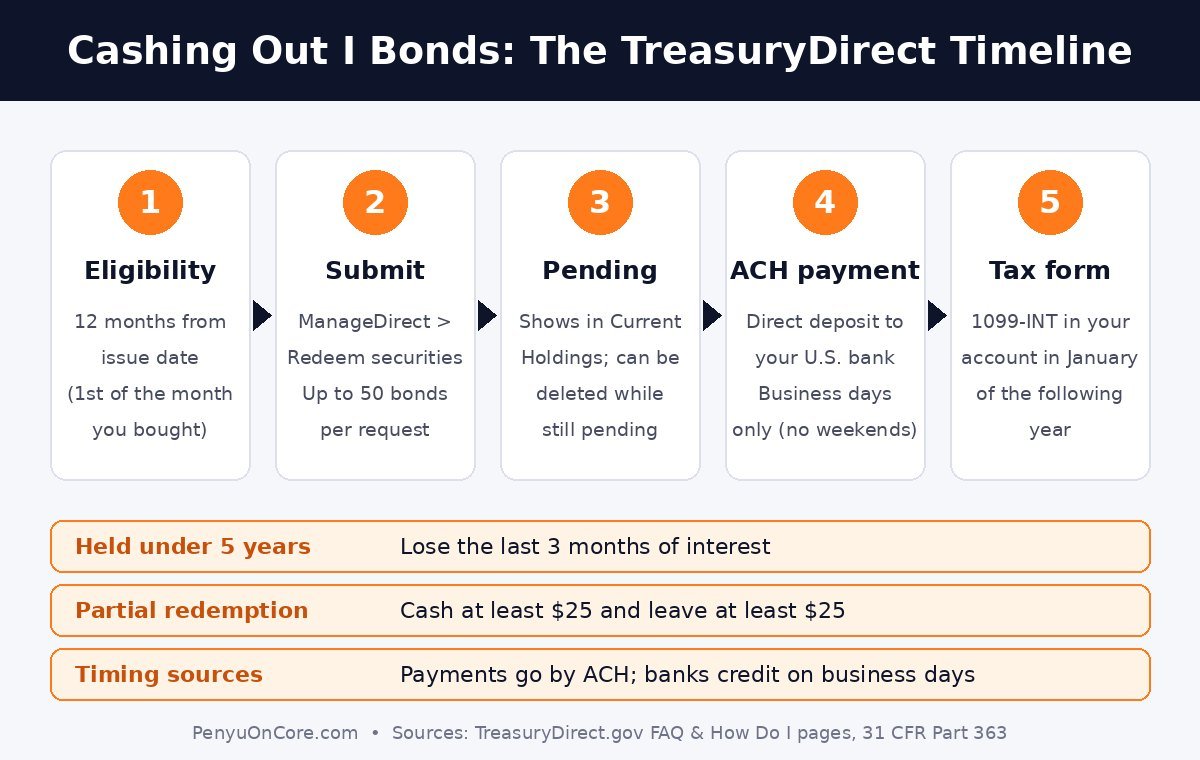
“How long” really has three parts: how long until you’re allowed to redeem, how long the request takes, and how long the deposit takes to reach you. Here is the full timeline based on TreasuryDirect’s official FAQ and “How Do I…?” guide.
| Stage | Typical timing | What controls it |
|---|---|---|
| Minimum holding period | 12 months from the issue date | Treasury rule; the issue date is the 1st of the month you bought |
| Submitting the redemption | A few minutes online | ManageDirect > Redeem securities |
| Pending status | Until it’s processed | Shows in Current Holdings and can still be deleted |
| ACH deposit to your bank | About 1–2 business days | ACH settlement days, weekends, federal holidays, your bank |
| Tax form (1099-INT) | January of the following year | Posted in your TreasuryDirect account |
1. The 12-month lock comes first
TreasuryDirect says EE and I bonds “must be held for 12 months from their issue date before they can be redeemed.” The issue date isn’t the day you clicked “buy”. It’s the first day of the month the bond was issued. TreasuryDirect’s example: a bond purchased on July 10 has an issue date of July 1. So that bond becomes redeemable on July 1 of the following year, not July 10.
There are narrow exceptions. The FAQ says Treasury may allow early redemption if an owner is facing financial hardship, and may waive the holding period for people living in areas hit by a natural disaster. Waivers are usually announced through a press release on TreasuryDirect’s main website.
2. The early-redemption penalty (under 5 years)
Cashing out is allowed after a year, but if the bond is less than five years old you lose the last three months of interest. TreasuryDirect’s I bonds page gives the example that a bond cashed after 18 months pays the first 15 months of interest. After five years, there’s no penalty. TreasuryDirect also says there are no fees for redeeming savings bonds.
This matters for timing because I bond interest is added monthly. If you’re close to a five-year mark, or close to a month boundary, waiting a few days can sometimes make a small difference. Check the value under Current Holdings before you submit.
How to submit the redemption in TreasuryDirect
According to TreasuryDirect’s “How Do I…?” guide, the process looks like this:
- Log in to your primary TreasuryDirect account.
- Open the ManageDirect tab.
- Under Manage My Securities, click Redeem securities.
- Choose the security type (Series I) and click Submit.
- Tick the bond(s) you want to cash. You can select up to 50 securities per redemption transaction.
- For a single bond, choose Redeem full amount or Redeem partial amount. If you select several bonds, each is redeemed in full to the same bank.
- Pick the destination, review, and click Submit. Save or print the confirmation page.
Partial redemptions have a floor: you must cash at least $25 and leave at least $25 in the bond. We cover the details in our guide to partial redemption of I bonds.
Changed your mind? Delete it while it’s pending
After you submit, the pending redemption appears in Current Holdings. TreasuryDirect’s FAQ says you can cancel it from the Pending Redemptions screen by clicking Delete and confirming. Once it has been processed, it’s done.
Where the money goes (and the C of I change)
Federal rules (31 CFR Part 363) say Treasury pays book-entry savings bonds “by the ACH method to the designated account at a United States depository financial institution.” The same rules define a business day as “any day that funds may be settled through ACH,” so a request made on a Friday evening, a weekend or a federal holiday won’t settle until the next business day. The Federal Reserve publishes its holiday schedule if you’re timing a payment around Thanksgiving or the year-end holidays.
Older guides often mention sending proceeds to your Zero-Percent Certificate of Indebtedness (C of I). That option is gone. TreasuryDirect’s C of I FAQ says that as of August 24, 2026, C of I is no longer available as a payment destination. If it was your destination, your primary bank account automatically took its place. TreasuryDirect also says it will try to automatically redeem remaining C of I balances to customers’ primary bank accounts on a rolling basis from late August through fall 2026, and will notify you when that happens. In practice, your I bond cash now goes to your bank.
Why your I bond redemption might take longer
If the deposit hasn’t shown up after a couple of business days, these are the usual suspects:
- Weekends and holidays. ACH doesn’t settle on non-business days, so count business days, not calendar days.
- Bank details changed mid-transaction. TreasuryDirect’s user guide says a change to your bank information won’t apply to a payment whose processing began before the change. The money goes to the old account. If you need to switch banks first, see how to change your TreasuryDirect bank account. Some edits require a signed FS Form 5512 that must be certified at a bank or credit union.
- Unverified bank account. New bank accounts are checked by a verification service. After three failed attempts, TreasuryDirect places a hold and emails you a link to the bank change form.
- Account access problems. If you can’t log in, you can’t redeem. Our guide to a locked TreasuryDirect account walks through the fixes.
- Your bank’s posting time. Some banks show ACH credits early in the morning, others later in the day.
Your redemption has a confirmation number. TreasuryDirect’s confirmation numbers for security redemptions begin with the letter R, which helps when you check your history or call support at (844) 284-2676.
Don’t forget the tax side
I bond interest is subject to federal income tax but exempt from state and local income tax. TreasuryDirect’s cashing page says the 1099-INT for your redemption will be available in your TreasuryDirect account in January of the year after you cash in the bond. For where to find and download the form, see our guide to the TreasuryDirect 1099.
FAQ
Can I cash out I bonds before 12 months?
Generally no. TreasuryDirect only makes exceptions for documented financial hardship or for owners in declared natural-disaster areas when a waiver is announced.
Is there a fee to cash out I bonds?
No. TreasuryDirect says it charges no fees for redeeming savings bonds. The only cost is the three-month interest penalty if the bond is under five years old.
Can I cancel an I bond redemption?
Yes, but only while it’s pending. Use Delete on the Pending Redemptions screen.
Can I cash out I bonds at a bank or broker?
Not electronic ones. Electronic I bonds are redeemed inside your TreasuryDirect account, and since January 1, 2025, new I bonds are sold only electronically.
How much can I take out at once?
Any amount of $25 or more, to the penny, as long as at least $25 stays in the bond. You can select up to 50 bonds in one redemption.
Disclaimer: This article is for general information only and is not financial, tax or legal advice. TreasuryDirect rules change, so confirm current details on TreasuryDirect.gov or with a qualified professional before acting.