Artificial intelligence and cryptocurrency are two of the most closely watched technologies in the digital economy. As AI adoption expands across industries, blockchain developers are exploring new ways to combine artificial intelligence with decentralized networks, digital payments, and token-based incentives.
This intersection has created a growing market for AI crypto tokens.
Some projects aim to provide decentralized computing power, support AI agent transactions, create marketplaces for machine intelligence, or reward contributors who supply valuable resources to AI networks. Others focus primarily on AI-related narratives to attract attention from cryptocurrency traders.
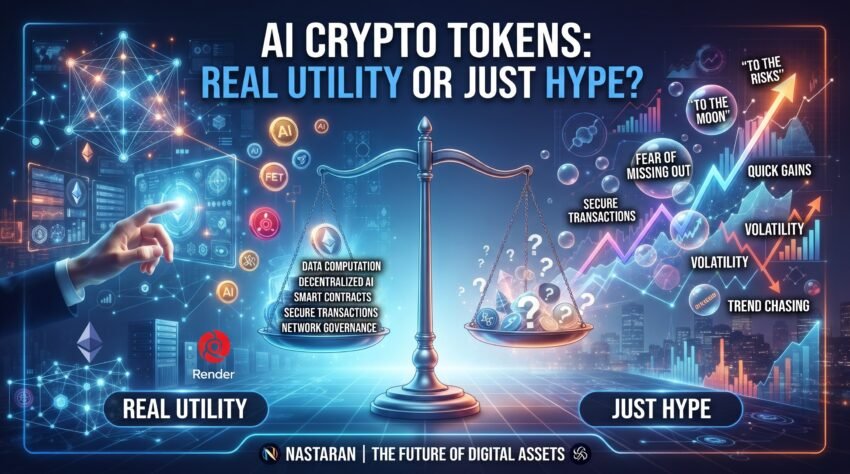
This raises an important question: Do AI crypto tokens offer real technological utility, or are they simply benefiting from the latest market hype?
The answer is not the same for every project.
Certain blockchain networks have developed infrastructure and services connected to specific AI-related activities. However, a project’s technological usefulness does not automatically mean its cryptocurrency will increase in value.
For investors, developers, and crypto enthusiasts, understanding this distinction is becoming increasingly important.
What Are AI Crypto Tokens?
AI crypto tokens are digital assets associated with blockchain projects that develop, support, or facilitate artificial intelligence applications.
Depending on the project, these tokens may be used to pay for computing resources, access decentralized services, reward network participants, coordinate AI agents, or participate in protocol governance.
Unlike traditional AI companies, which generally operate through centralized business structures, some AI crypto projects attempt to coordinate resources through blockchain networks and token-based economic systems.
According to CoinGecko’s guide to AI cryptocurrencies, AI-related crypto projects cover several areas, including autonomous agents, decentralized infrastructure, and AI service marketplaces.
However, not every token associated with artificial intelligence has a meaningful technological purpose.
A cryptocurrency can adopt AI-related branding without providing a working product or establishing a clear connection between its token and its underlying technology.
Therefore, understanding what a project actually does is more important than simply identifying it as an AI crypto token.
How Do AI Crypto Tokens Work?
The relationship between artificial intelligence and blockchain technology can take several forms.
1. Decentralized AI Computing
Developing and operating AI models can require substantial computing resources, including GPUs, storage, and specialized infrastructure.
Decentralized computing networks attempt to connect resource providers with individuals or organizations that need computing capacity.
In some models, cryptocurrency tokens help coordinate payments, incentives, or participation.
The potential benefit is a marketplace where computing resources can be supplied by multiple independent providers rather than relying entirely on a single infrastructure company.
However, decentralized computing must compete with established cloud providers on price, reliability, performance, and ease of use.
Its long-term success depends on whether it can deliver competitive services and attract consistent demand.
2. AI Agents and Autonomous Transactions
AI agents are software systems designed to perform tasks with varying degrees of autonomy.
Depending on their capabilities, they may analyze information, interact with applications, execute predefined workflows, or communicate with other agents.
Blockchain technology can provide payment infrastructure and programmable transactions for certain agent-based applications.
For example, an AI agent might need to pay for access to a data service, purchase computing resources, or interact with a decentralized application.
Crypto tokens can facilitate these transactions when the system is designed to use them.
Nevertheless, not every AI agent needs its own cryptocurrency. Traditional payment systems and conventional databases may be more practical for some applications.
The important question is whether blockchain and tokenization solve a genuine problem.
3. Decentralized AI Marketplaces
Another use case involves marketplaces where developers, businesses, or researchers can access AI services.
These services may include machine learning models, data processing, inference, or other specialized computing tasks.
A blockchain-based marketplace can use smart contracts to coordinate payments and establish transparent transaction records.
Tokens may be used to purchase services or reward participants, depending on the protocol.
For this model to be sustainable, the marketplace needs more than token trading activity. It must attract users who find its services useful enough to pay for them.
4. Incentives for AI Development
Some decentralized networks use tokens to reward participants who contribute computing power, data, models, or other resources.
The objective is to encourage independent contributors to participate in a shared ecosystem.
This approach can create an alternative model for coordinating AI development, but incentive design matters.
If participants receive rewards primarily through newly issued tokens rather than demand for useful services, the network may struggle to maintain its economics over time.
A sustainable project needs to demonstrate that its incentives encourage valuable contributions and that its underlying services can attract real demand.
AI Crypto Tokens With Real Utility: Projects Worth Understanding
Several established crypto projects illustrate different approaches to combining blockchain infrastructure with AI-related technologies.
These examples are not investment recommendations. Their inclusion does not imply that their tokens are undervalued or guaranteed to appreciate.
1. Bittensor (TAO): Decentralized Machine Intelligence
Bittensor is a blockchain-based network designed to coordinate digital commodities, including machine intelligence, through specialized subnetworks.
Participants can contribute services or outputs, while network mechanisms are designed to evaluate contributions and distribute incentives.
Its approach seeks to create an ecosystem in which different specialized networks can compete to provide useful digital resources.
The potential utility comes from the services being produced and the economic coordination between participants.
However, investors should examine whether demand for these services is sustainable, how rewards are distributed, and whether network activity translates into meaningful economic value.
2. Render (RENDER): Distributed GPU Computing
Render Network focuses on connecting people who need GPU rendering and computing resources with providers who have available hardware.
Its original focus on rendering has expanded into broader GPU-computing use cases, including workloads associated with AI.
This infrastructure can be useful because rendering and AI applications often require substantial computing capacity.
However, an important distinction exists between general GPU demand and demand specifically generated by AI applications.
Investors should examine actual network activity, service demand, token economics, and the relationship between usage and the RENDER token.
3. Artificial Superintelligence Alliance (FET): AI Agents and Decentralized Infrastructure
The Artificial Superintelligence Alliance ecosystem is associated with decentralized AI infrastructure and autonomous agent technology.
The Fetch.ai technology stack has explored applications involving autonomous agents that can interact with digital services and coordinate tasks.
Potential use cases include automated processes, data exchange, and machine-to-machine interactions.
For such systems to become commercially meaningful, developers need to build applications that solve real problems and attract users.
Token utility must also be evaluated separately from the broader technological ambitions of the ecosystem.
A promising vision does not automatically establish sustainable token demand.
4. NEAR Protocol (NEAR): Blockchain Infrastructure for AI Applications
NEAR Protocol is a blockchain platform that has expanded its ecosystem around AI-related infrastructure and applications.
Its broader infrastructure can support decentralized applications, while its AI initiatives explore ways to connect AI systems with blockchain-based services.
Potential applications include AI agents, developer infrastructure, and tools for building interactive digital services.
However, NEAR is not exclusively an AI cryptocurrency. Its overall ecosystem includes uses beyond artificial intelligence.
Consequently, investors should distinguish between activity across the entire NEAR ecosystem and activity specifically attributable to AI-related products.
Important: The projects above represent different technical approaches. Their products, token functions, and development status can change. Check their official documentation before drawing conclusions about current utility.
Real Utility vs. Hype: How Can Investors Tell the Difference?
The most important question is not whether a project uses artificial intelligence.
It is whether the project provides a useful service and whether its token has a meaningful role in that service.
Here are six factors worth examining.
1. Does the Project Have a Working Product?
A credible project should provide evidence of what it has actually built.
Look for a functioning application, accessible documentation, developer tools, or a network that users can interact with.
A detailed white paper can explain a project’s vision, but it cannot replace evidence of execution.
Be cautious when a project relies on future promises without demonstrating meaningful development progress.
2. Is There Evidence of Real Users?
A project’s social media following does not necessarily reflect genuine adoption.
Thousands of followers or high trading volume may exist without substantial demand for the underlying product.
Where available, examine:
- Active users and paying customers.
- Number of completed transactions.
- Computing workloads or services delivered.
- Developer participation.
- Repeat usage over time.
- Independent evidence of product adoption.
The exact metrics depend on the project.
For example, an AI computing network should ideally demonstrate meaningful computing activity, while an AI agent platform may be better evaluated through useful agent operations and recurring demand.
No single metric proves that a project is successful. Several independent indicators provide a stronger picture.
3. Does the Token Have a Necessary Function?
Token utility is one of the most important factors to investigate.
Ask whether the token is required to access services, pay network fees, coordinate resources, or participate in protocol operations.
Also consider whether the same functionality could operate just as effectively without the token.
A project may have an excellent AI product but a weak token value proposition.
This distinction matters because demand for an application does not necessarily create demand for its cryptocurrency.
4. Are Tokenomics Sustainable?
Tokenomics describes how a cryptocurrency is issued, distributed, and used within its ecosystem.
Important factors include:
- Total and circulating supply.
- Future token unlocks.
- Emission schedules.
- Insider and team allocations.
- Staking incentives.
- Distribution of rewards.
- Mechanisms that connect token demand with network activity.
A project may attract users while its token experiences selling pressure from newly released supply.
Investors should also be careful when projects advertise high staking rewards without clearly explaining where those rewards originate.
Token emissions can encourage participation, but they do not necessarily represent revenue generated by actual customers.
5. Is the Technology Competitive?
AI and blockchain markets are competitive.
A decentralized AI network must demonstrate why its approach offers advantages over centralized alternatives or other decentralized projects.
Potential advantages might include lower costs, access to specialized resources, transparent coordination, censorship resistance, or new forms of collaboration.
These advantages should be evaluated using evidence rather than marketing claims.
If a project cannot explain why customers would choose its product, its long-term business prospects may be difficult to assess.
6. Is the Team Transparent About Progress and Limitations?
Reliable projects generally provide documentation, development updates, and clear explanations of their technology.
Investors should look for verifiable information about product releases, security issues, governance decisions, and ecosystem development.
Independent audits can be useful when smart contracts are involved, although an audit cannot eliminate every technical or economic risk.
Unrealistic profit guarantees, pressure to buy immediately, and claims of risk-free returns are warning signs.
Why AI Crypto Tokens Can Still Be Risky
Even if an AI crypto project has genuine utility, its token can remain a highly speculative asset.
Several risks deserve attention.
Speculation Can Outpace Adoption
AI is a powerful narrative that can attract investors looking for exposure to emerging technology.
When market enthusiasm rises, some tokens may increase in price before their products demonstrate meaningful adoption.
If expectations become unrealistic, prices can fall sharply when sentiment changes.
Real AI Demand Does Not Guarantee Token Appreciation
An AI company can attract customers and generate revenue without benefiting any particular cryptocurrency.
Likewise, a decentralized AI network can provide useful services without creating sufficient demand for its token to justify a higher market valuation.
The relationship between business activity and token value depends on the project’s specific economic design.
Token Unlocks Can Create Selling Pressure
Some projects release previously restricted tokens over time.
These releases can increase circulating supply and potentially create selling pressure, especially when demand remains weak.
Investors should examine token unlock schedules and fully diluted valuation rather than focusing exclusively on current market capitalization.
Competition May Reduce Profitability
AI infrastructure providers compete with established cloud platforms, specialized hardware providers, open-source tools, and other decentralized networks.
A project may struggle to retain users if competing services offer better performance, lower costs, or a simpler experience.
Technological innovation alone does not guarantee commercial success.
Regulatory and Security Risks Remain
Cryptocurrency regulations vary across jurisdictions, and legal requirements may change.
Projects can also face smart contract vulnerabilities, compromised wallets, governance attacks, and operational failures.
The European Securities and Markets Authority (ESMA) has warned that crypto-assets remain highly risky and that investors should be cautious about market hype.
Investors should understand the risks and avoid committing money they cannot afford to lose.
How to Research AI Crypto Tokens Before Investing
A structured research process can help investors separate technological progress from speculative marketing.
Step 1: Read the Official Documentation
Start with the project’s official website, documentation, white paper, and development updates.
Identify the problem the project intends to solve and how its technology works.
Look for specific explanations instead of vague claims about revolutionizing artificial intelligence.
Step 2: Verify Product Activity
Check whether the product is available and whether independent users can access it.
When possible, review public network data, usage dashboards, developer repositories, and evidence of completed transactions.
Do not assume that a project is widely adopted simply because its website looks professional.
Step 3: Investigate Token Utility
Determine exactly how the token interacts with the product.
Ask whether users need the token to obtain services, whether providers receive it as compensation, and whether the protocol creates recurring demand for it.
If the token’s role is unclear, that uncertainty should be part of your evaluation.
Step 4: Review Supply and Valuation
Examine circulating supply, maximum supply where applicable, upcoming unlocks, and fully diluted valuation.
Compare these figures with the project’s development progress and observable adoption.
A low token price does not automatically mean an asset is undervalued.
Similarly, a large market capitalization does not guarantee that a project is fundamentally strong.
Step 5: Compare Independent Sources
Do not rely entirely on a project’s promotional material or statements from social media influencers.
Compare official documentation with independent research, reputable crypto data platforms, and verifiable on-chain information.
For market comparisons, CoinGecko’s AI cryptocurrency category provides a starting point for exploring projects and their market data.
Remember that category classifications can change and that inclusion in a market ranking does not establish the quality of a project’s technology.
The Future of AI Crypto Tokens: What Could Drive Real Adoption?
The future of AI crypto tokens will likely depend on whether blockchain-based systems can solve practical problems in the AI economy.
Several developments could support adoption.
Decentralized Computing Markets
AI developers need computing resources to train, deploy, and operate models.
Decentralized networks could find opportunities where they provide competitive prices, reliable infrastructure, or access to specialized hardware.
However, they must demonstrate that their services can compete with established alternatives.
Autonomous AI Agent Economies
As AI agents become more capable, some may need to interact with digital services and transact with other systems.
Programmable payments and blockchain-based settlement could support certain types of machine-to-machine commerce.
The challenge is determining where decentralized payments offer a meaningful advantage over conventional financial infrastructure.
AI Data and Model Marketplaces
AI development depends on access to useful data, models, and computing services.
Decentralized marketplaces may offer new approaches to coordinating contributors and compensating service providers.
Their success will depend on data quality, intellectual property rights, privacy, reliability, and genuine customer demand.
Better Transparency and Verification
Blockchain records can make certain transactions and protocol activities publicly verifiable.
This transparency may be useful when evaluating payments, incentives, and participation in decentralized networks.
However, blockchain records alone cannot prove that an AI model is accurate, that its outputs are trustworthy, or that reported off-chain activity is genuine.
Additional verification mechanisms may be necessary.
Ultimately, AI crypto projects will need to compete on usefulness, reliability, security, and economics rather than relying on the popularity of artificial intelligence alone.
Are AI Crypto Tokens Worth Watching in 2026?
AI crypto tokens remain a category worth researching because they connect two important areas of technological development: artificial intelligence and blockchain infrastructure.
However, the category includes projects with very different objectives, technologies, token structures, and levels of adoption.
Some focus on decentralized computing. Others explore autonomous agents, machine intelligence, or AI-related developer infrastructure.
These differences make it difficult to evaluate all AI tokens using the same criteria.
Rather than looking for a single cryptocurrency that promises to benefit from the AI boom, investors can begin by identifying specific problems they believe blockchain technology may solve.
They can then evaluate whether individual projects have working products, real users, sustainable tokenomics, and credible evidence of adoption.
Market performance should be assessed separately from technological progress.
A useful project can have an overvalued token, while a rapidly rising token may have limited underlying utility.
There is no reliable way to guarantee which AI crypto assets will outperform the market.
Frequently Asked Questions (FAQ)
What are AI crypto tokens?
AI crypto tokens are cryptocurrencies associated with projects that support artificial intelligence applications, computing infrastructure, autonomous agents, or decentralized AI services.
Their functions vary by project and may include service payments, network incentives, governance, or resource coordination.
Do AI crypto tokens have real utility?
Some AI crypto tokens have defined roles within functioning networks and applications.
However, utility differs across projects. Investors should verify whether a token is actually used by its ecosystem and whether that use creates meaningful demand.
Which AI crypto projects are worth researching?
Projects such as Bittensor, Render Network, the Artificial Superintelligence Alliance, and NEAR Protocol illustrate different approaches to decentralized intelligence, GPU computing, autonomous agents, and AI-related infrastructure.
They should be evaluated individually based on current product development, adoption, token economics, and risk.
This list is for research purposes, not a ranking of investment opportunities.
Can AI crypto tokens increase in value?
Their prices can rise or fall depending on market sentiment, liquidity, adoption, token supply, competition, and broader cryptocurrency conditions.
Even when a project develops useful technology, its token may decline in value.
No investment return is guaranteed.
How can investors identify AI crypto tokens with real utility?
Investigate the project’s working product, active users, token functionality, economic model, development progress, and verifiable network activity.
Compare official claims with independent evidence and review potential risks before making financial decisions.
Are AI crypto tokens better than traditional AI stocks?
They represent different types of exposure.
AI-related stocks generally provide ownership in companies, while crypto tokens may provide access to network functions or other protocol-specific rights.
Holding a token does not automatically provide equity ownership, company profits, or a legal claim on revenue.
The appropriate comparison depends on the asset’s structure, the investor’s objectives, and the risks involved.
Final Verdict: Real Utility or Just Hype?
AI crypto tokens are not all hype, but neither should they be treated as automatic winners in the artificial intelligence boom.
Some projects are developing infrastructure and applications with identifiable purposes. Others may depend more heavily on speculation, promotional narratives, or expectations of future adoption.
The most important distinction is between a useful AI-related product and a cryptocurrency that can capture economic value from that product.
These are two separate questions, and both deserve careful investigation.
As the sector evolves, projects that demonstrate sustainable demand, competitive technology, transparent development, and credible token economics may be better positioned to establish lasting relevance.
For investors, the goal should not be to chase every token carrying the AI label.
Instead, focus on verifiable utility, realistic valuations, transparent tokenomics, and the risks involved.
In the long run, the strongest AI crypto projects will need to prove their value through real-world use—not just hype.
Sources and Further Reading
- CoinGecko: AI Cryptocurrencies Explained
- CoinGecko: Artificial Intelligence Crypto Category
- Bittensor: Official Website
- Render Network: Official Website
- Artificial Superintelligence Alliance: Official Website
- NEAR Protocol: Official Website
- European Securities and Markets Authority (ESMA)
Disclaimer: This article is for informational and educational purposes only. It does not constitute financial or investment advice. Cryptocurrency markets are volatile, and readers should conduct independent research before making investment decisions.