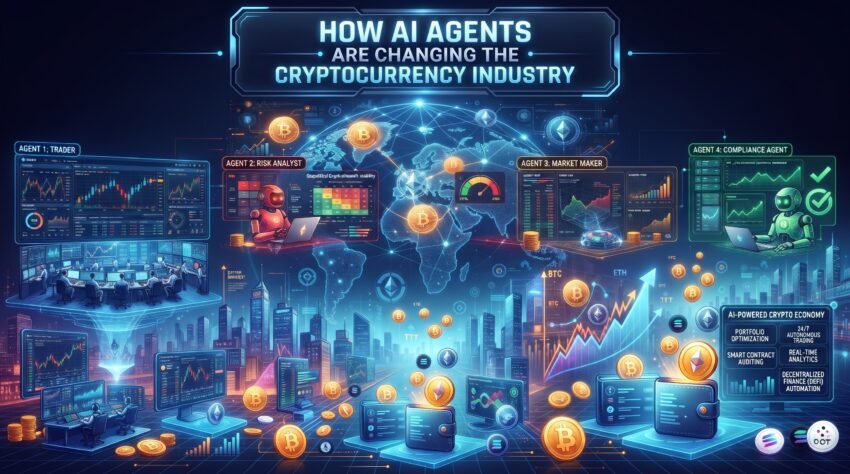
The cryptocurrency industry is entering a new phase of technological development as artificial intelligence (AI) agents begin to transform how people interact with digital assets, decentralized finance (DeFi), and blockchain networks. Unlike traditional trading bots that follow predefined rules, AI agents can analyze information, plan multi-step tasks, use connected tools, and take actions within the permissions they have been given.
As blockchain infrastructure continues to evolve, AI agents are emerging as a potential bridge between artificial intelligence and decentralized financial systems. From automated market analysis to on-chain transactions and crypto payments, these technologies could make blockchain applications more accessible and efficient.
Research and documentation from organizations such as Ethereum.org and Coinbase Institutional highlight the growing interest in AI agents and their potential applications in the cryptocurrency ecosystem.
In this article, we explore how AI agents are changing the cryptocurrency industry, their most promising applications, the risks investors should understand, and what the future may hold for AI-powered blockchain technology.
What Are AI Agents in Cryptocurrency?
AI agents are software systems that use artificial intelligence to pursue specific objectives by analyzing information, making decisions, and performing tasks. Depending on their design, they can operate with varying levels of autonomy and interact with external applications, APIs, blockchain networks, and cryptocurrency wallets.
In the crypto industry, an AI agent might monitor market conditions, analyze blockchain activity, summarize project developments, or execute a transaction after evaluating predefined conditions.
For example, a user could instruct an AI agent to monitor selected cryptocurrency assets, notify them when certain market conditions occur, and prepare a transaction for approval. More advanced implementations may execute authorized transactions automatically within predefined limits.
AI Agents vs. Traditional Crypto Trading Bots
Traditional cryptocurrency trading bots generally follow programmed strategies. They might buy or sell an asset when a technical indicator reaches a specific threshold.
AI agents can potentially perform broader tasks by combining information from different sources, selecting appropriate tools, and adapting their actions to changing circumstances.
However, not every AI agent learns continuously or makes reliable decisions. Its capabilities depend on the underlying model, available data, connected tools, and safeguards.
The main difference is that a conventional bot typically executes a narrowly defined strategy, while an AI agent may be designed to manage a more complex workflow.
1. AI Agents Are Transforming Crypto Trading
One of the most visible applications of AI agents in cryptocurrency is trading automation.
Cryptocurrency markets operate around the clock, creating a continuous stream of price movements, trading volume changes, blockchain transactions, and news events. Monitoring all this information manually can be difficult.
AI-powered systems can help traders organize and analyze these large amounts of data.
Potential applications include:
- Market monitoring: Tracking cryptocurrency prices, trading volume, and market volatility.
- Technical analysis: Examining price patterns and technical indicators.
- News analysis: Summarizing developments that could affect cryptocurrency markets.
- Portfolio monitoring: Tracking asset allocations and identifying deviations from a target strategy.
- Trade execution: Placing authorized orders through supported trading platforms.
- Risk monitoring: Alerting users when exposure, volatility, or losses exceed predefined thresholds.
For example, an AI agent could monitor Bitcoin and selected altcoins, identify unusual trading activity, review relevant news, and generate a market report.
If connected to a compatible exchange, it might also execute trades within limits established by the user.
Nevertheless, automated trading does not guarantee profitability. AI systems can misinterpret market signals, respond incorrectly to unexpected events, or make decisions using incomplete information.
Investors should treat AI-generated trading decisions as tools to evaluate rather than guaranteed sources of profit.
2. AI Agents Are Expanding Decentralized Finance (DeFi)
Decentralized finance is another area where AI agents could have a significant impact.
DeFi applications allow users to access financial services through blockchain-based protocols without relying entirely on traditional financial intermediaries. However, navigating DeFi can be complicated. Users may need to compare lending rates, understand liquidity pools, evaluate transaction fees, and monitor risks across multiple protocols.
AI agents could simplify these activities by helping users gather information and coordinate transactions.
Automated DeFi Strategies
Depending on their permissions and integrations, AI agents could help with:
- Comparing lending and borrowing rates across protocols.
- Monitoring liquidity pools and token prices.
- Evaluating potential yield opportunities.
- Tracking collateral requirements.
- Identifying changes in transaction fees.
- Rebalancing portfolios according to predefined strategies.
For instance, a DeFi-focused agent could compare lending opportunities on supported protocols and present the estimated returns, fees, and associated risks.
With suitable wallet permissions and smart-contract integrations, an agent might also execute an approved strategy.
However, estimated yields can change rapidly. Smart-contract vulnerabilities, liquidation events, liquidity shortages, and token-price fluctuations can result in substantial losses. An AI agent cannot eliminate these risks simply by automating the decision-making process.
3. AI Agents Can Interact Directly With Blockchain Networks
Blockchain networks provide a foundation for AI agents to perform verifiable financial and operational activities.
Unlike systems that only generate recommendations, blockchain-connected agents can potentially interact with smart contracts, transfer supported digital assets, and perform other authorized on-chain operations.
According to Ethereum.org, blockchain infrastructure offers capabilities that can support AI agent applications, including transparent transaction records and programmable smart contracts.
What Can Blockchain-Connected AI Agents Do?
Depending on the network and implementation, an AI agent may be able to:
- Read public blockchain data.
- Monitor transactions and wallet activity.
- Interact with supported smart contracts.
- Exchange compatible tokens.
- Send or receive cryptocurrency payments.
- Participate in selected decentralized applications.
For example, an agent could monitor a blockchain for activity involving a particular token and generate alerts when predefined conditions are met. A more advanced agent might prepare a transaction to interact with a decentralized exchange.
The ability to execute transactions introduces additional responsibility. Incorrect contract addresses, malicious smart contracts, or excessive wallet permissions can expose funds to serious risks.
Developers therefore need to implement transaction validation, spending limits, and appropriate authorization mechanisms.
4. Crypto Payments Between AI Agents Could Create New Opportunities
One of the most interesting developments is the possibility of AI agents paying for digital services independently.
Traditional software services often require a human to register an account, manage a subscription, or authorize each payment. Cryptocurrency-based payment systems could allow software agents to pay for certain services programmatically.
For example, one AI agent might purchase market data from another service, pay for computing resources, or obtain access to a specialized API.
Stablecoins could be useful for these transactions because their values are designed to track a reference asset, typically a national currency. However, stablecoins still carry issuer, redemption, regulatory, and other risks.
Coinbase AgentKit provides infrastructure for developers building AI agents that interact with blockchain applications. Such tools illustrate how AI systems can be connected to cryptocurrency infrastructure.
These developments point toward a potential machine-to-machine economy in which software agents can purchase resources and exchange services with less direct human involvement.
However, widespread adoption will depend on factors such as transaction costs, payment reliability, security, and interoperability between different systems.
5. AI Agents Could Improve Crypto Research and Token Analysis
Cryptocurrency investors often face an overwhelming amount of information.
A single token may have documentation, tokenomics, exchange listings, blockchain transactions, community discussions, governance proposals, and project announcements spread across numerous platforms.
AI agents can help organize this information into more useful research.
How AI Agents Can Analyze Crypto Projects
An AI-powered research agent could assist investors by:
- Summarizing a project’s whitepaper and technical documentation.
- Examining token supply and distribution.
- Tracking wallet movements and on-chain activity.
- Monitoring liquidity and trading volume.
- Comparing project milestones with public announcements.
- Identifying inconsistencies in project claims.
- Producing structured research reports.
For example, an investor researching a newly launched altcoin could use an AI agent to gather information about its tokenomics, contract address, liquidity, and development activity.
The agent could then prepare a report highlighting potential warning signs and unanswered questions.
This may reduce the time required for preliminary research, but it does not replace independent verification.
AI-generated summaries can contain factual errors, overlook important information, or misinterpret suspicious activity. Blockchain data also cannot independently prove that a project has a legitimate business model or sustainable revenue.
Investors should verify important claims using primary sources, blockchain explorers, official documentation, and independent security assessments.
6. AI Agents Are Creating New Possibilities for Web3 Applications
Web3 applications frequently require users to understand wallets, network fees, token approvals, and smart-contract interactions. For beginners, these requirements can make decentralized applications difficult to use.
AI agents could provide a more accessible interface by allowing users to describe their objectives in natural language.
Instead of manually navigating several applications, a user might ask an AI assistant to check a wallet balance, compare transaction costs, or prepare a token swap.
The agent would then translate the request into a sequence of actions supported by its connected tools.
Potential applications include:
- AI-powered crypto portfolio assistants.
- Automated blockchain monitoring services.
- Decentralized application management.
- Personalized on-chain analytics.
- AI-driven community management.
- Automated reporting for decentralized autonomous organizations (DAOs).
These applications could make blockchain technology more accessible to people without extensive technical knowledge.
However, ease of use must not come at the expense of transparency. Users should be able to understand what an agent intends to do, which permissions it requires, and what financial consequences may follow.
7. AI Agent Tokens Are Not the Same as AI Agent Technology
As interest in AI and cryptocurrency grows, investors may encounter tokens marketed as AI agent projects.
These tokens can be associated with different types of ecosystems, including agent development platforms, decentralized computing networks, AI-powered applications, and projects that use tokens for particular services.
However, the existence of an AI agent does not automatically establish that its associated cryptocurrency has meaningful utility.
Some projects may have working products, while others may rely primarily on marketing, speculative interest, or ambitious roadmaps.
Before evaluating an AI-related cryptocurrency, investors should examine several factors.
- Real product utility: Does the project provide a functioning service, or does it mainly promote a future vision?
- Token utility: What specific role does the token play in the ecosystem?
- User adoption: Is there evidence of actual usage beyond social media engagement?
- Revenue and economic activity: Does the project generate sustainable demand for its services?
- Tokenomics: How are tokens distributed, and are substantial unlocks or concentrated holdings potential concerns?
- Security: Has the project undergone independent security reviews, and are its contracts and infrastructure appropriately protected?
Investors should evaluate AI crypto projects individually rather than assuming every token associated with artificial intelligence will benefit from the industry’s growth.
8. The Biggest Risks of AI Agents in Cryptocurrency
Despite their potential benefits, AI agents introduce risks that cannot be ignored.
Because cryptocurrency transactions can be difficult or impossible to reverse, mistakes involving autonomous systems may have direct financial consequences.
Security Vulnerabilities
An AI agent connected to a wallet or exchange account may be exposed to compromised software, malicious tools, insecure integrations, or stolen credentials.
If an attacker gains access to the agent’s transaction capabilities, funds could be placed at risk. Developers should use secure key management, restricted permissions, transaction limits, and continuous monitoring.
Incorrect Decisions
AI models can misunderstand instructions, produce inaccurate analysis, or select inappropriate actions. In volatile markets, an incorrect decision may result in losses before a human notices the problem.
Prompt Injection and Manipulated Data
AI agents often process external information, including websites, messages, and data feeds. Malicious content could attempt to manipulate an agent into ignoring its intended task or performing unauthorized actions.
Developers must treat external information as potentially untrusted and separate data interpretation from transaction authorization.
Smart-Contract Risks
An AI agent may interact with a smart contract that contains vulnerabilities or behaves differently than expected. Even if the agent correctly follows its instructions, the underlying protocol could still fail.
Regulatory Uncertainty
Rules governing cryptocurrency trading, financial services, data protection, and autonomous systems vary by jurisdiction. Businesses deploying AI agents must consider their legal responsibilities, particularly when agents manage customer funds or provide financial services.
Lack of Accountability
When an autonomous system makes a harmful decision, determining responsibility may be complicated. The roles of developers, service providers, users, and protocol operators need to be clearly defined.
For these reasons, AI agents should operate with limited permissions, transparent controls, and appropriate human oversight, particularly when financial assets are involved.
9. What the Future Holds for AI Agents and Cryptocurrency
The future of AI agents in cryptocurrency will depend on whether developers can turn experimental capabilities into secure, useful, and economically sustainable products.
Several developments could influence the industry’s direction.
More Secure Autonomous Wallets
Wallet infrastructure may increasingly support spending limits, transaction restrictions, isolated accounts, and temporary permissions.
These controls could allow agents to perform specific tasks without receiving unrestricted access to a user’s assets.
Greater Interoperability
Standards for agent identity, reputation, and communication could help different applications discover and interact with one another.
Ethereum’s ecosystem is exploring ERC-8004, a standard intended to support on-chain registries for AI agent identity, reputation, and validation.
The success of these approaches will depend on implementation quality, adoption, and the reliability of the information being recorded.
Automated Financial Workflows
AI agents could increasingly coordinate tasks such as portfolio monitoring, financial reporting, transaction preparation, and selected trading operations.
Rather than replacing every financial tool, they may initially serve as an intelligent layer connecting existing applications.
AI-Powered On-Chain Services
Developers may build specialized agents for market analysis, blockchain security monitoring, data services, and decentralized application management.
These services could create new business models if users are willing to pay for demonstrable value.
Better User Controls
Future systems may combine AI-driven decision-making with stronger cryptographic verification, smart-contract restrictions, and clear approval processes.
The objective should not simply be to make agents more autonomous. It should be to make their actions more predictable, auditable, and secure.
Ultimately, the strongest projects may be those that solve real problems rather than relying solely on the popularity of AI-related narratives.