
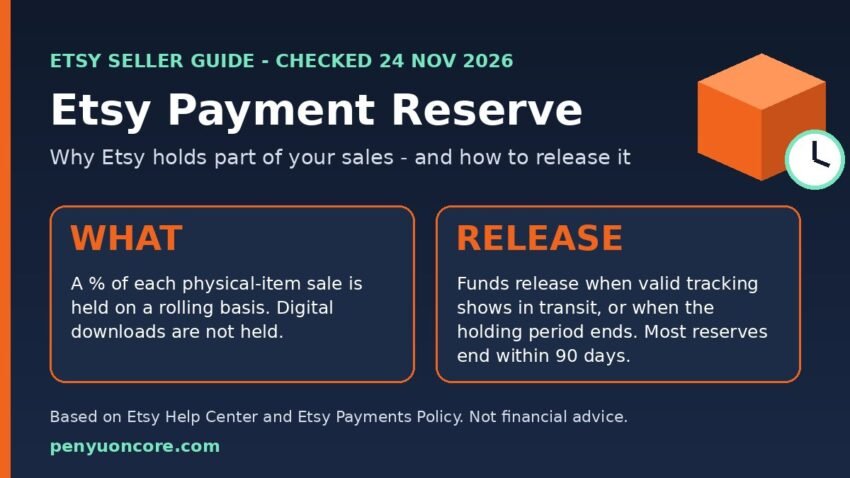
An Etsy payment reserve means Etsy is holding back a percentage of each new physical-item sale for a set period instead of letting you deposit it straight away. You don’t lose the money: each sale’s reserved share is released when Etsy can confirm the order is in transit with valid tracking, or when the default holding period ends. Etsy says that for most sellers the reserve is removed within 90 days.
Reserves often show up when a shop gets a sudden jump in orders, which is exactly what Black Friday (27 November 2026), Cyber Monday (30 November) and the run-up to Christmas can bring. Here is what Etsy’s Help Center and Payments Policy say, checked on 24 November 2026, and how to get funds released sooner.
What is an Etsy payment reserve?
According to Etsy’s Help Center article What is a Payment Account Reserve?, when a reserve is placed on your account, a percentage of funds from each new sale of a physical item is held and won’t be available for deposit within the standard processing time. Etsy shows the holding time and the reserve percentage in your Payment account, and says both can vary from account to account.
Two details are worth knowing straight away:
- Digital downloads are not held. Etsy states that sales of digital items are not held in reserve. If you sell printables or templates, our guide to Etsy fees for digital downloads covers the costs side.
- It works on a rolling basis. Each sale has its own release date, so money keeps arriving as older sales clear, even while newer sales are being held.
The Etsy Payments Policy gives an example of how a fixed reserve can work: a 30% reserve on a 45-day rolling period, where 30% of a sale made on day 2 is held until day 47. Etsy marks this example as illustrative only, so your actual percentage and window may be different. Check your own Payment account rather than relying on figures from forums.
Why Etsy put a reserve on your shop
Etsy says reserves are there to stop your Payment account balance going negative, and your card on file being charged, if you get chargebacks, refunds or other unexpected charges. It also notes that many sellers with a reserve are simply getting more sales than usual.
The Help Center lists these risk factors, while saying the list is not complete:
- A sudden sharp increase in orders or refunds
- Orders consistently missing tracking information or tracking events
- Orders not shipped on time
- A recent increase in refunds
- Making your first sale on Etsy
- Receiving a notice of counterfeit, unauthorized reproduction or alleged intellectual property infringement from a rights owner
Etsy also says its Support team can’t tell you the specific reason for your reserve and can’t remove it for you. Your time is better spent on the steps below.
How long does an Etsy payment reserve last?
The reserve on your shop
Etsy says that for most sellers the reserve will be removed within 90 days. During that time Etsy monitors the shop, and if there are concerns about order fulfilment or policy violations, the reserve may be extended. Etsy also says it regularly reviews accounts with a reserve and may adjust or remove it based on your shop’s activity and standing, and that it will notify you if your reserve status changes.
The Payments Policy sets the outer limits. It describes a variable reserve as a percentage of your balance that can be delayed for up to 180 days before becoming available, or deducted as a reserve for up to 90 days, subject to periodic review. Etsy may reduce or remove a reserve after positive performance, such as fewer cases or better order fulfilment, but it can also raise the percentage or lengthen the period after a review.
The hold on each individual sale
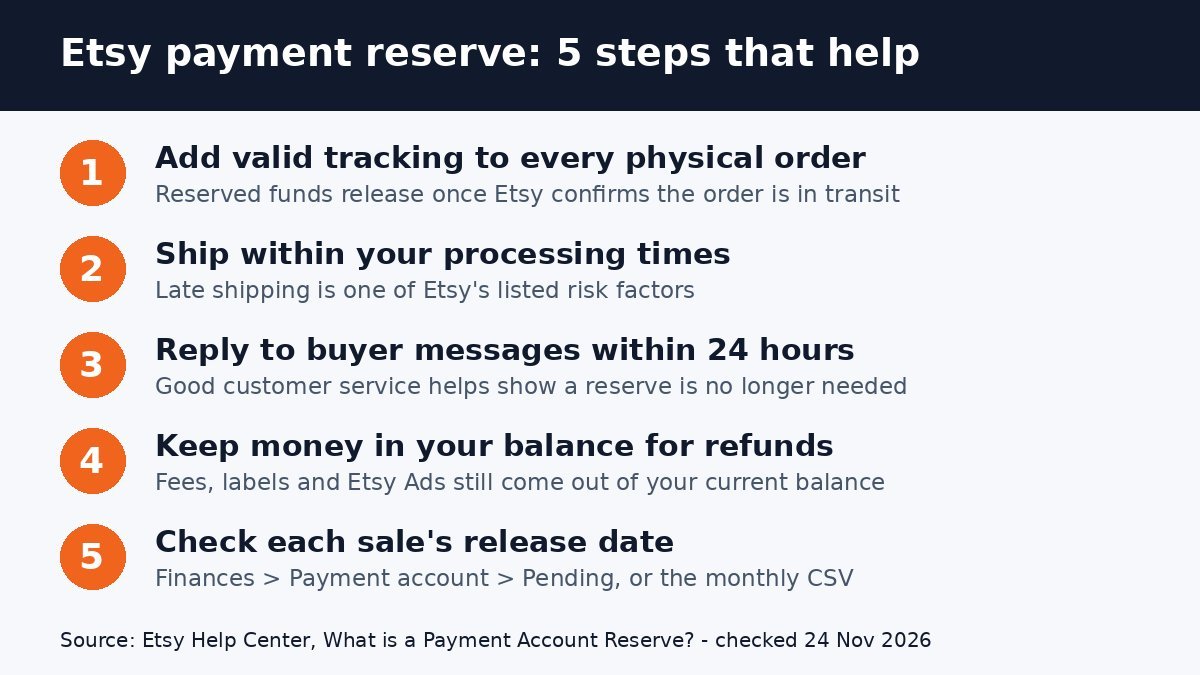
Each order’s reserved portion has its own date. You can find it in Shop Manager under Finances > Payment account: under Recent activities, select the Pending tab and find the order to see how much is held and when it is expected to become available. In the Orders page, affected orders carry an “Order in reserve” badge. Etsy’s monthly statement CSV also includes a Status column and an Availability Date column.
Released funds become available at 6pm ET on their release day.
How to get reserved funds released sooner
Etsy’s main advice is simple: add valid tracking. If Etsy can confirm the tracking shows the order in transit, the reserved funds for that order are released immediately rather than at the end of the holding period.
- Use tracked shipping on every physical order. Sellers in the US, Canada, Australia and the UK can buy shipping labels on Etsy that may include tracking. Etsy warns it can’t always confirm tracking for some carriers, and if it can’t see the order in transit, funds stay reserved for the full period.
- Only mark orders as shipped once they are with the carrier. Etsy specifically lists this in its tips for avoiding reserves.
- Set realistic processing times. Late shipping is one of the listed risk factors. If holiday volume is stretching you, lengthen processing times before orders come in rather than shipping late.
- Reply to buyers fast. Etsy suggests responding within 24 hours if you can.
- Keep refunds and cases down. A rise in refunds is a risk factor, and the Payments Policy says fewer cases can lead to a reserve being reduced or removed.
Etsy also says that if you are already a Star Seller, a reserve will not be placed on your shop. Star Seller eligibility starts 90 days after your first sale and requires, among other things, replying to 95% of first messages within 24 hours, shipping 95% of orders on time with valid tracking or an Etsy label (when required), a 4.8+ average review rating, and at least 5 orders and $300 in sales over the past 3 months.
Reserve, hold, deposit delay or security hold?
“Etsy is holding my money” can mean several different things. Etsy’s Payment account guide and Payments Policy separate them like this:
| Type | What it is | How long |
|---|---|---|
| Payment account reserve | A percentage of each physical-item sale held on a rolling basis | Until tracking shows in transit, or the default holding period ends; most reserves removed within 90 days |
| New seller deposit timing | Normal processing time before sale funds can be deposited | New sellers generally 14 days after a sale; established shops as soon as the next business day |
| Bank details security hold | A pause after you add or change your bank account | 5 days after verification |
| Hold (dispute or investigation) | Funds held because of a significant dispute or investigation | Shorter of 180 days after estimated delivery or the end of the investigation |
| Deposit delay | Account-wide days between a sale and funds becoming available | Between 0 and 180 days, shown in your Payment account |
If you sell on several platforms, the same idea shows up elsewhere under different names. See our explainers on why PayPal holds funds and the Fiverr clearance period.
What the reserve covers, and the negative balance trap
While you have a reserve, everyday charges such as buyer refunds, Etsy fees, Etsy shipping labels and Etsy Ads keep coming out of your current balance. Reserved money sits in your pending balance. Etsy’s redesigned Payment account now shows Current, Pending and Total, and the current balance can go negative if refunds or real-time fees (such as Etsy Ads or postage labels) are bigger than what is available.
If your current balance goes negative, reserved funds are applied as they are released, and anything left over becomes available for deposit. If current and pending balances together still don’t cover refunds and charges, Etsy will charge the card on file for the difference.
Planning your cash flow during the holiday rush
- Budget for supplies from money you already have, assuming part of each holiday sale won’t be available for weeks.
- Watch your Etsy Ads spend. Ads are charged in real time and can push your current balance negative.
- Keep your reserve email. Etsy notifies you by email and in Shop Manager, and the Payment account shows when your reserve will next be re-evaluated.
- Track income for tax. Reserved money is still part of your sales. For US reporting thresholds, see our guide to the 1099-K threshold, which applies to marketplaces in general.
FAQ
Can Etsy Support remove my payment reserve?
No. Etsy says its Support agents can’t remove a reserve. Etsy reviews accounts itself and will notify you if the reserve is adjusted or removed.
Does the reserve apply to digital downloads?
No. Etsy states that sales of digital items are not held in reserve.
Why is Etsy holding my money for 45 days?
45 days is the period in Etsy’s illustrative example, but the actual percentage and period vary by account. Your own figures are in Shop Manager under Finances > Payment account.
Will I get the reserved money back?
Yes, unless it’s needed to cover refunds, chargebacks, cases or fees that your available funds can’t cover. The Payments Policy says unused reserve funds are released in full at the end of each reserve period on a rolling basis.
This article is general information based on Etsy’s published policies as of 24 November 2026, not financial or legal advice. Etsy can change its policies, so check your Payment account and the linked Etsy pages for the latest terms.