
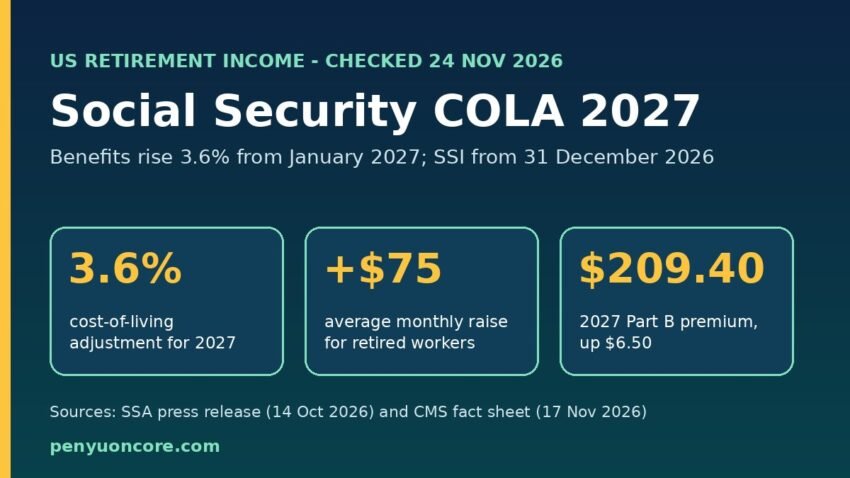
The Social Security COLA 2027 is 3.6%. The Social Security Administration (SSA) announced it on 14 October 2026, and it will raise the average retirement benefit by about $75 a month. Social Security beneficiaries see the increase starting with their January 2027 payment. Supplemental Security Income (SSI) recipients get it a little earlier, on 31 December 2026.
Short answer: Benefits go up 3.6% for 2027, so the estimated average retired worker’s check rises from $2,095 to $2,170 a month. For most retirees, Medicare takes part of that raise. The standard Part B premium goes up $6.50 to $209.40 a month, and it is usually deducted from the Social Security payment.
The SSA, CMS and Federal Register pages linked below were checked on 24 November 2026.
Social Security COLA 2027 at a glance
According to SSA’s 14 October 2026 press release, nearly 72 million Social Security beneficiaries and about 7.3 million SSI recipients get the 3.6% increase. The adjustment is tied by law to the rise in the Consumer Price Index for Urban Wage Earners and Clerical Workers (CPI-W) from the third quarter of 2025 to the third quarter of 2026.
The COLA for 2026 was 2.8%, according to SSA’s historical COLA table. That makes 3.6% the largest increase since the 8.7% COLA for 2023. CNBC, citing the Senior Citizens League, reports that COLAs averaged 2.6% from 2000 to 2026.
Estimated average monthly benefits in January 2027
These estimates come from SSA’s 2027 COLA fact sheet:
| Beneficiary type | Before 3.6% COLA | After 3.6% COLA |
|---|---|---|
| All retired workers | $2,095 | $2,170 |
| Aged couple, both receiving benefits | $3,238 | $3,355 |
| Aged widow(er) alone | $1,936 | $2,005 |
| Widowed mother and two children | $3,932 | $4,074 |
| All disabled workers | $1,642 | $1,701 |
| Disabled worker, spouse and one or more children | $2,970 | $3,077 |
These are averages. Your own increase is 3.6% of your own benefit, so the exact amount will show on your COLA notice.
When will you get the higher payment?
The COLA applies to benefits for December 2026, and those benefits are paid in January 2027. SSA’s Federal Register notice says federal SSI rates go up 3.6% for January 2027, but that payment is made on 31 December 2026.
Based on SSA’s published 2027 payment schedule, as summarized by Kiplinger, the first higher payments arrive on these dates:
- Thursday, 31 December 2026: SSI recipients, people who get both SSI and Social Security, and people who started benefits before May 1997. Their January payment comes early because 1 January is a holiday.
- Wednesday, 13 January 2027: Social Security beneficiaries born on the 1st to the 10th of the month.
- Wednesday, 20 January 2027: beneficiaries born on the 11th to the 20th.
- Wednesday, 27 January 2027: beneficiaries born on the 21st to the 31st.
If you get SSI, the 31 December payment is your January payment. You won’t get a second one in January.
Where to see your new amount
SSA says people with a personal my Social Security account can see their COLA notice online starting in late November. The notice is a simplified one-page letter showing your new benefit and any deductions, including your 2027 Medicare premium. If you haven’t signed up for paperless notices, your letter arrives by mail in December.
How the Medicare Part B premium eats into the 2027 COLA
CMS announced on 17 November 2026 that the standard Medicare Part B premium for 2027 will be $209.40 a month, up $6.50 from $202.90. The annual deductible rises from $283 to $292 (CMS fact sheet). For most retirees, the premium is taken out of the Social Security payment before it reaches the bank, so the net raise is smaller than the headline COLA.
The premium increase is a flat dollar amount, so it takes a bigger share of the raise from smaller checks. The rough figures below assume you pay the standard premium out of your benefit:
| Monthly benefit now | 3.6% COLA (approx.) | Part B increase | Net raise (approx.) |
|---|---|---|---|
| $1,000 | $36.00 | $6.50 | $29.50 |
| $1,500 | $54.00 | $6.50 | $47.50 |
| $2,095 (average retiree) | $75.00 | $6.50 | $68.50 |
| $3,000 | $108.00 | $6.50 | $101.50 |
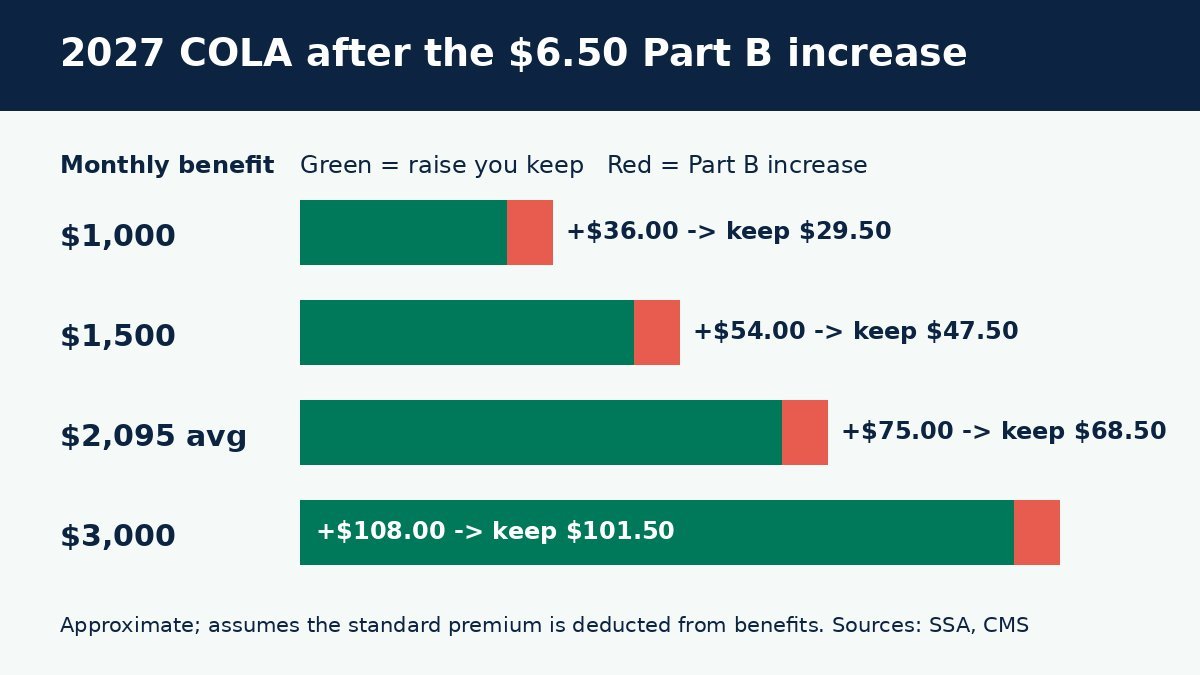
Fortune did the same math and found that the higher premium takes about 18% of the raise on a $1,000 check, compared with about 9% for the average retiree. This year is still better than many recent years. CNBC quotes policy analyst Mary Johnson: “It’s not often that we see a Part B [premium] increase that is lower than the COLA.” The Part B premium is rising 3.2%, while benefits rise 3.6%.
Higher earners pay more. If your modified adjusted gross income is above $112,000 (single) or $224,000 (joint), income-related surcharges (IRMAA) raise your 2027 Part B premium to between $293.10 and $711.80 a month. Part D drug plan premiums vary by plan and can also cut into the net raise.
Other 2027 Social Security figures SSA released
SSA published several other automatic adjustments along with the COLA. All of the figures below come from the 2027 fact sheet:
| Item | 2026 | 2027 |
|---|---|---|
| Maximum taxable earnings (Social Security) | $184,500 | $192,300 |
| Earnings test, under full retirement age | $24,480/yr | $25,560/yr |
| Earnings test, year you reach full retirement age | $65,160/yr | $67,920/yr |
| Max benefit, worker retiring at full retirement age | $4,152/mo | $4,188/mo |
| SSI federal payment, individual | $994/mo | $1,029/mo |
| SSI federal payment, couple | $1,491/mo | $1,544/mo |
| Substantial gainful activity (non-blind) | $1,690/mo | $1,770/mo |
| Quarter of coverage | $1,890 | $1,970 |
If you’re still working
Social Security tax is 6.2% for employees, and the 2027 cap is $192,300. That means the most a worker will pay is $11,922.60, and employers pay the same amount (SSA). If you claimed benefits before full retirement age and keep working, SSA withholds $1 for every $2 you earn above $25,560. In the year you reach full retirement age, it withholds $1 for every $3 you earn above $67,920, counting only the months before you reach that age (SSA earnings test). Withheld benefits aren’t lost. SSA raises your monthly benefit after you reach full retirement age to account for them. Workers who are still saving can also check the new 401(k) contribution limit for 2027.
What to do before January
- Check your COLA notice in my Social Security when it posts. Make sure the gross benefit, Medicare deduction and net payment match what you expect.
- Review your tax withholding. CNBC notes that the income thresholds for taxing benefits aren’t indexed. Up to 50% of benefits can be taxable once combined income passes $25,000 (single) or $32,000 (joint), and up to 85% once it passes $34,000 or $44,000. A bigger benefit can push you over one of these lines.
- Watch your income if you’re near an IRMAA bracket. Large IRA withdrawals or Roth conversions can raise future Medicare premiums. Our guides to Roth vs traditional IRAs and missed RMD penalties explain how withdrawals affect taxable income.
- Update your budget using your net payment, not the 3.6% headline.
FAQ
What is the Social Security COLA for 2027?
It is 3.6%. SSA announced it on 14 October 2026 and estimates it will add about $75 a month to the average retirement benefit.
When does the 2027 COLA start?
Social Security beneficiaries get it with their January 2027 payment. SSI recipients get it with the payment made on 31 December 2026.
How much is SSI in 2027?
The federal SSI payment standard is $1,029 a month for an individual and $1,544 for a couple, up from $994 and $1,491. Some states add a supplement.
Will the Medicare premium wipe out my raise?
For most people, no. The standard Part B premium rises $6.50, which is less than the 3.6% COLA adds to any benefit above roughly $181 a month. Surcharges for higher earners and Part D premiums can reduce the net raise further.
Disclaimer: This article is for general information only and is not financial, tax or legal advice. Figures are from official sources as of 24 November 2026. Check your own COLA notice or contact SSA for amounts that apply to you.