
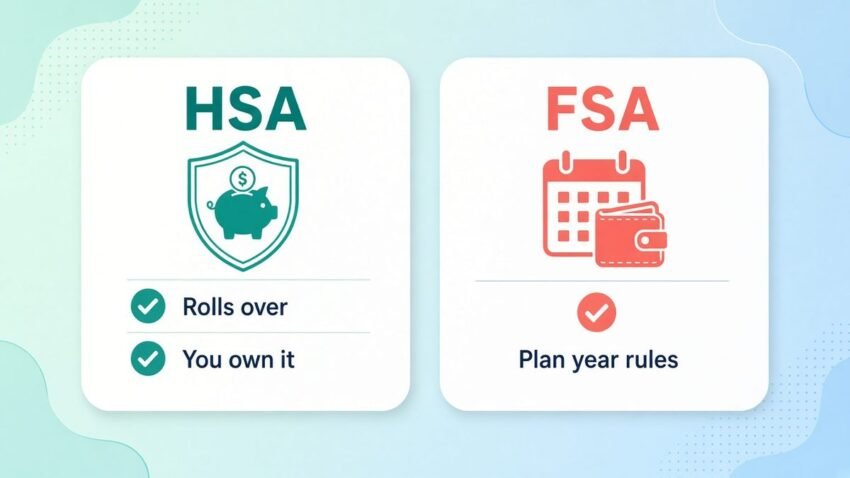
Short answer: An HSA is usually better if you have (or can choose) a qualifying high-deductible health plan (HDHP) and want a portable account that rolls over and can grow over time. An FSA can be better if you do not have an HDHP, expect predictable medical costs this plan year, and want an easy payroll deduction through your employer. For 2026, IRS limits are $4,400 (self-only) / $8,750 (family) for HSAs, plus a $1,000 catch-up at age 55+, versus a $3,400 health FSA salary-reduction limit (with an optional carryover of up to $680 if your plan allows it).
This guide compares HSA vs FSA using verified 2026 IRS and HealthCare.gov figures—so you can match the account to your health plan and cash-flow needs, not a slogan.
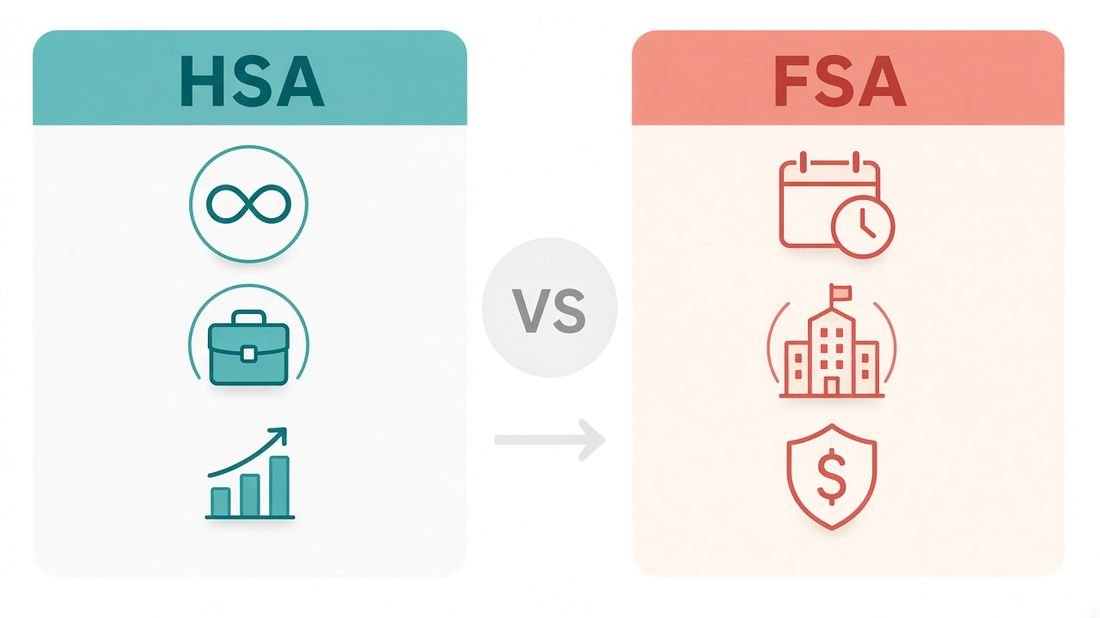
HSA vs FSA: portability and rollover rules are the biggest practical differences.
Quick Comparison Table
| Feature | HSA (Health Savings Account) | Health FSA (Flexible Spending Arrangement) |
|---|---|---|
| 2026 contribution limit | $4,400 self-only / $8,750 family | $3,400 salary reduction (plan years beginning in 2026) |
| Age 55+ catch-up | +$1,000 | None |
| Requires HDHP? | Yes (with limited exceptions for other coverage) | No |
| Rolls over unused money? | Yes — balance stays yours | Generally no; plan may offer grace period or limited carryover |
| Portable if you change jobs? | Yes | Usually no (employer plan benefit) |
| Full annual amount available early? | Generally as funded | Yes — annual election typically available at once |
| Can coexist? | Not with a general-purpose FSA; limited-purpose / post-deductible FSA may be OK | Same rule from the HSA side |
Sources: IRS Rev. Proc. 2025-19, IRS Publication 15-B (2026), IRS Publication 969, HealthCare.gov HDHP/HSA page.
2026 HSA Limits and HDHP Thresholds
According to IRS Rev. Proc. 2025-19 and HealthCare.gov:
HSA contribution limits (2026):
- Self-only HDHP coverage: $4,400
- Family HDHP coverage: $8,750
- Additional contribution if age 55 or older by year-end: $1,000 (IRS Pub. 15-B; Pub. 969)
HDHP definition for 2026:
| Coverage | Minimum annual deductible | Maximum out-of-pocket (not premiums) |
|---|---|---|
| Self-only | $1,700 | $8,500 |
| Family | $3,400 | $17,000 |
To contribute to an HSA you generally need qualifying HDHP coverage, must not be enrolled in Medicare, and cannot be claimed as a dependent on someone else’s return (Pub. 969).
2026 Health FSA Limit, Carryover, and Grace Period
From IRS Publication 15-B (2026):
- For plan years beginning in 2026, a cafeteria plan may not allow salary-reduction contributions to a health FSA above $3,400.
- Health FSAs are generally use-or-lose. Employers may optionally offer either:
– a grace period of up to 2½ months after the plan year to incur expenses, or – a carryover of unused amounts into the next plan year—not both (Pub. 969; Notice 2013-71).
Carryover dollar amount: IRS Notice 2020-33 sets the maximum carryover at 20% of the annual salary-reduction limit. Applied to the 2026 $3,400 limit, that is $680 if your plan permits carryover (plan may set a lower amount). Pub. 969 states the parallel 2025 figures as $3,300 / $660, which follows the same 20% rule.
Self-employed people are not eligible for health FSAs (Pub. 969).
How HSAs and FSAs Differ in Practice
HSA in brief
From Pub. 969 and HealthCare.gov:
- You own the account; it is portable if you change employers or leave the workforce
- Unused balances roll over year to year
- Contributions you make (other than employer amounts) are generally deductible above the line; employer contributions are typically excluded from income
- Qualified medical distributions can be tax-free
- Earnings can grow tax-free while in the HSA
- Non-qualified withdrawals are taxable and may face an additional 20% tax (exceptions include disability, age 65, or death)
Health FSA in brief
- Funded mainly by pre-tax payroll salary reductions through an employer cafeteria plan
- You can usually access the full annual election early in the plan year
- Must reimburse qualified medical expenses incurred during the coverage period (with optional grace period rules)
- Unused amounts are generally forfeited unless the plan offers grace period or carryover
- Not portable like an HSA when you leave the employer
Can you have both?
A general-purpose health FSA (or HRA) that reimburses medical expenses before the HDHP deductible generally blocks HSA eligibility. However, Pub. 969 allows HSA contributions while covered by a limited-purpose FSA/HRA (for example dental, vision, and certain preventive care) or a post-deductible FSA/HRA. Ask your benefits administrator which design your plan uses.
Worked Example: 2026 Limits With Concrete Numbers
Label clearly: simplified illustration, not tax advice. Assumptions: age 40; self-only HDHP that meets 2026 IRS thresholds; federal marginal rate 22%; ignore state tax and investment returns.
Path A — Max HSA contribution ($4,400):
- Pre-tax (or deductible) contribution: $4,400
- Approximate federal tax savings this year: $4,400 × 22% ≈ $968
- Unused amount at year-end: stays in your HSA and can be used later for qualified medical expenses
Path B — Max health FSA salary reduction ($3,400):
- Pre-tax payroll reduction: $3,400
- Approximate federal tax savings this year: $3,400 × 22% ≈ $748
- If you spend only $2,800 and your plan allows carryover: up to $680 may roll to next year; the remaining $600 could be forfeited under use-or-lose rules
- If the plan has a grace period instead, you may have ~2½ months to incur more expenses—then unused funds may still be lost
Takeaway: The HSA’s higher 2026 ceiling and rollover design favor people who can fund an HDHP deductible and think beyond one plan year. The FSA’s early access to the full election can help if costs arrive early in the year—but forecasting poorly can mean forfeiting money.
If you are also building cash reserves outside medical accounts, see how much emergency fund you may need and compare parking cash in SGOV vs a high-yield savings account.
A Simple Checklist: Which May Fit You Better?
Lean HSA if you:
- Have (or can elect) a qualifying HDHP for 2026
- Want money to roll over and stay with you after a job change
- Can cover higher deductibles from savings or HSA funds
- Are age 55+ and want the extra $1,000 catch-up
- Prefer pairing with a limited-purpose FSA for dental/vision only
Lean health FSA if you:
- Do not have an HDHP (or cannot meet HSA eligibility)
- Expect predictable out-of-pocket medical costs this plan year
- Want the full election available early for large bills
- Prefer a simple employer payroll deduction and can estimate spending carefully
- Confirm whether your plan offers a grace period or carryover (not both)
Also consider tax-advantaged investing elsewhere: If medical costs are covered and you are optimizing long-term taxes, compare Roth vs Traditional IRA for 2026.
FAQ
What is the HSA contribution limit for 2026?
$4,400 for self-only HDHP coverage and $8,750 for family coverage, plus $1,000 if you are age 55 or older by year-end (Rev. Proc. 2025-19; Pub. 15-B).
What is the health FSA limit for 2026?
For plan years beginning in 2026, salary-reduction contributions to a health FSA cannot exceed $3,400 (Pub. 15-B).
Does unused FSA money roll over in 2026?
Only if your employer’s plan allows it. The plan may offer a grace period or a carryover (commonly up to $680 for 2026 under the IRS 20% rule)—not both. Otherwise, unused amounts are generally forfeited (Pub. 969; Notice 2020-33).
Can I contribute to an HSA and an FSA at the same time?
Not with a general-purpose health FSA. You may still contribute to an HSA with a limited-purpose or post-deductible FSA, if your plan is designed that way (Pub. 969).
Is an HSA portable if I change jobs?
Yes. An HSA is owned by you and stays with you if you change employers or leave the workforce (Pub. 969). A health FSA is an employer plan benefit and typically does not travel with you the same way.
Bottom Line
For 2026, HSA vs FSA is less about which acronym “wins” and more about eligibility and time horizon. If you qualify for an HDHP, the HSA’s higher limits, rollover, and portability usually make it the stronger long-term medical savings tool. If you only have a traditional plan or need this year’s expenses smoothed through payroll, a carefully estimated health FSA can still cut taxes—just respect use-or-lose rules.
Related reading: Roth IRA vs Traditional IRA for 2026 · How much emergency fund do you need? · SGOV vs high-yield savings
Disclaimer: This article is for educational purposes only and is not financial, tax, or legal advice. Contribution limits, plan designs, and tax outcomes depend on your situation, employer plan documents, and current IRS rules. Confirm figures with IRS.gov, your plan administrator, and a qualified tax professional before making elections.