
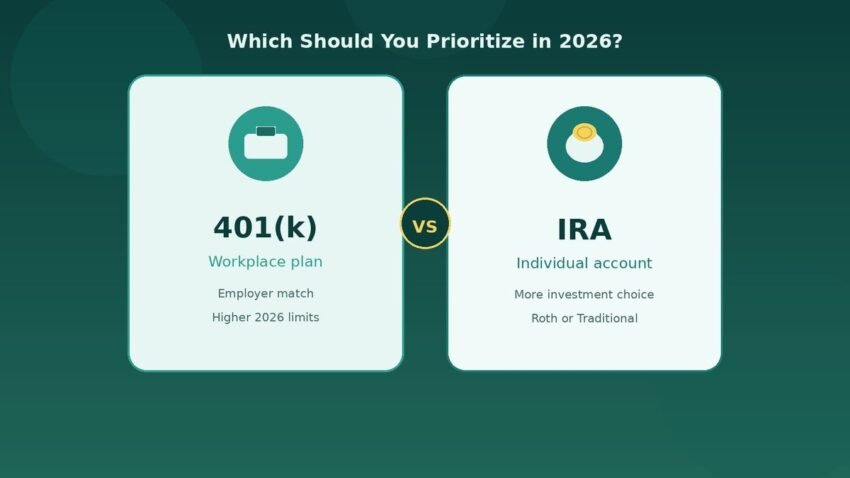
Short answer: In most cases, contribute enough to your 401(k) to capture the full employer match first—that match is free money you cannot get from an IRA. After the match, choose between more 401(k) money and an IRA (Traditional or Roth) based on fees, investment menu, Roth access, and your tax situation. You can contribute to both a 401(k) and an IRA in the same year; the limits are separate systems under IRS rules.
This guide compares 401(k) vs IRA using verified 2026 IRS contribution and income figures, then walks through a common contribution-priority order with worked dollar examples.
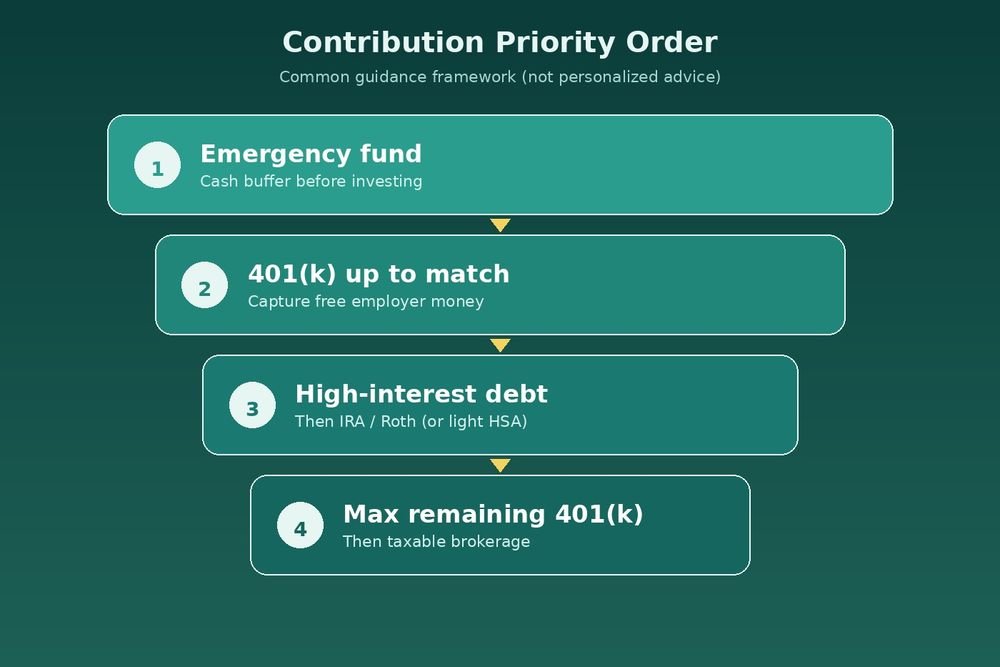
A common order: match first, then IRA or other tax-advantaged space, then max the 401(k).
Quick Comparison Table (2026)
| Feature | 401(k) (typical workplace plan) | IRA (Traditional / Roth) |
|---|---|---|
| 2026 employee elective deferral | $24,500 | Combined Traditional + Roth: $7,500 |
| Age 50+ catch-up | $8,000 (often $32,500 total employee) | $1,100 → $8,600 total |
| Ages 60–63 higher catch-up (SECURE 2.0) | $11,250 instead of $8,000 | N/A (IRA uses the age-50+ catch-up above) |
| Overall annual additions (employee + employer + forfeitures, excl. catch-up) | Lesser of 100% of compensation or $72,000 ($80,000 with catch-up; up to $83,250 ages 60–63) | N/A (IRA has its own contribution limit) |
| Compensation limit for plan contributions | $360,000 | Earned income / compensation rules apply |
| Employer match | Often yes (plan-specific) | No |
| Investment choice | Plan menu only | Broad brokerage / fund choice (custodian-dependent) |
| Loans | Sometimes allowed by plan | Generally not |
| Roth option | Designated Roth 401(k) if plan offers it | Roth IRA (income phase-outs apply) |
| Income limits to contribute | No MAGI limit on elective deferrals | Roth IRA MAGI phase-outs; Traditional deduction phase-outs if covered by a workplace plan |
| RMDs | Traditional 401(k): yes (rules apply); Roth 401(k) treated under current law | Traditional IRA: yes; Roth IRA: no lifetime RMDs for original owner |
Sources: IRS IR-2025-111, IRS 401(k) contribution limits, IRS IRA contribution limits.
2026 Limits You Should Know
Per IR-2025-111 and the IRS retirement-topics pages:
- 401(k) / 403(b) / governmental 457 / TSP employee elective deferral: $24,500 (up from $23,500 in 2025).
- Age 50+ catch-up (most plans): $8,000, so many savers can defer up to $32,500.
- Ages 60–63 higher catch-up under SECURE 2.0: $11,250 instead of $8,000.
- Overall annual additions limit: lesser of 100% of compensation or $72,000 (or $80,000 including catch-up; up to $83,250 for ages 60–63).
- Compensation taken into account for contributions: $360,000.
- IRA (Traditional and Roth combined): $7,500; age 50+: $8,600.
Roth IRA MAGI phase-out ranges (2026): Single / HoH $153,000–$168,000; married filing jointly $242,000–$252,000; married filing separately (lived with spouse) $0–$10,000.
Traditional IRA deduction phase-outs if covered by a workplace plan (2026): Single $81,000–$91,000; MFJ if the contributor is covered $129,000–$149,000; MFJ if the contributor is not covered but the spouse is $242,000–$252,000; MFS covered $0–$10,000.
You can put money into a 401(k) and an IRA in the same year. The elective-deferral and IRA contribution limits are separate; IRA deductibility and Roth eligibility still depend on income and workplace-plan coverage.
For a deeper Roth vs Traditional IRA comparison, see our guide on Roth vs Traditional IRA for 2026.
Recommended Contribution Priority (Common Guidance)
The following order is a widely used framework among planners—not personalized advice:
- Build a basic emergency fund so you are not forced to raid retirement accounts. (See how much emergency fund you may need.)
- Contribute to the 401(k) up to the full employer match. Skipping the match is like declining a raise.
- Attack high-interest consumer debt (for example, credit cards) if interest rates clearly exceed what you can reasonably expect from long-term investing.
- Fund an IRA (or Roth IRA if eligible)—and, if you qualify, consider an HSA lightly as another tax-advantaged bucket—or keep increasing the 401(k) if your plan is excellent.
- Max the remaining 401(k) room up to the elective-deferral limit.
- Taxable brokerage for additional long-term investing.
Market sell-offs can shake confidence mid-year; staying consistent with a written order often matters more than timing. Related reading: retirement savings during a market sell-off.
When an IRA Might Come Before Extra 401(k)
After the match, an IRA can deserve the next dollar when:
- Your 401(k) has a weak fund menu or high expense ratios.
- You want Roth IRA contribution flexibility and broader investment choice.
- The plan offers no match (or only a tiny one you already captured).
- You prefer IRA features (for example, no plan-loan friction, or Roth IRA’s lack of lifetime RMDs for the original owner under current rules).
If the 401(k) is low-cost with good index funds and a solid Roth 401(k) option, filling more of the $24,500 deferral before (or alongside) the IRA can still make sense.
Worked Examples (Illustrative Only)
Figures below are rounded illustrations using 2026 IRS limits. They ignore plan fees, vesting schedules, state taxes, and investment returns. Not advice.
Example A — Age 35, $80,000 salary, 4% match
Assume a dollar-for-dollar match on the first 4% of pay (a common structure; yours may differ).
- 4% of $80,000 = $3,200 employee deferral to get the full match.
- Employer match = $3,200.
- If you skip the 401(k) and only fund an IRA, you may leave $3,200 of match on the table that year—money an IRA cannot replace.
A practical split after the match: keep deferring at least 4%, then decide whether the next dollars go to a Roth/Traditional IRA (up to $7,500 if under 50) or more 401(k).
Example B — Age 52, catch-up year
If the plan allows catch-ups and you are 50+:
- 401(k) employee deferral potential: $24,500 + $8,000 = $32,500.
- IRA potential: $7,500 + $1,100 = $8,600.
- Combined employee-directed ceiling in this simple view: $41,100 (plus any employer contributions toward the overall annual-additions limit).
Ages 60–63 may use the higher 401(k) catch-up of $11,250 instead of $8,000 when the plan permits it.
Example C — High earner near Roth IRA phase-out
If your MAGI sits inside or above the 2026 Roth IRA phase-out ($153,000–$168,000 single / HoH; $242,000–$252,000 MFJ), you may be limited or barred from a direct Roth IRA contribution. Some households discuss a backdoor Roth strategy; tax rules, pro-rata treatment, and timing are complex. Do not rely on a blog checklist—confirm with the IRS IRA pages and a qualified tax professional. A workplace Roth 401(k) (if offered) has no MAGI contribution phase-out for elective deferrals, which is another reason high earners sometimes prioritize the plan after the match.
401(k) vs IRA: Decision Checklist
Ask:
- Am I getting the full match?
- Are 401(k) fees and funds competitive with an IRA brokerage?
- Do I want Roth space now (Roth 401(k) and/or Roth IRA)?
- Does my income affect Roth IRA eligibility or Traditional IRA deductibility?
- Do I need features only one account offers (loans, broader funds, RMDs)?
FAQ
Can I contribute to both a 401(k) and an IRA in 2026?
Yes. The 401(k) elective-deferral limit and the IRA contribution limit are separate. IRA deductibility and Roth eligibility still depend on income and whether you (or your spouse) are covered by a workplace plan.
Should I always max the 401(k) before any IRA?
Not always. Capture the match first. After that, compare fees, investments, and Roth access. A low-cost IRA can beat dumping more money into a high-fee plan—while a strong 401(k) may deserve dollars before the IRA.
What are the 2026 401(k) and IRA limits?
Employee 401(k) deferrals: $24,500 (+ $8,000 catch-up at 50+, or $11,250 at ages 60–63). IRA: $7,500 (+ $1,100 at 50+). Overall 401(k) annual additions: up to $72,000 (higher with catch-ups as published by the IRS).
Does a Roth 401(k) replace a Roth IRA?
They share the “Roth” tax idea but sit under different rules, limits, and (often) investment menus. Many people use both over a career when eligible.
What if markets drop while I’m contributing?
Contribution order is about tax advantages and match math, not market timing. See retirement savings during a market sell-off for mindset and process tips.
Disclaimer
This article is for educational purposes only and is not financial, tax, or investment advice. Limits and phase-outs cite IRS publications available at the time of writing; always verify current figures on IRS.gov and consult a qualified advisor or tax professional for your situation.
Related reading: Roth vs Traditional IRA 2026 · How much emergency fund do you need? · Retirement savings in a market sell-off